How Many Blog Posts Per Month Do You Actually Need for SEO?
How many blog posts per month for SEO? 4 is the honest floor, 8–12 for newer sites — and why coverage, not volume, is the number that matters. Real data.

By Evan Rief, Founder & Lead SEO Strategist
Last reviewed: July 2026
This post draws on my real Clementine client campaigns — the numbers below come straight from a live Google Search Console account, and I'm happy to walk through it with you on a call. It also leans on named public data from HubSpot, Ahrefs, and Google's own statements. Results vary by market, niche, and competition; treat every figure here as a real example, not a promise.
How many blog posts per month you need for SEO comes down to your situation. For most local and health/wellness small businesses, 4 high-quality posts a month is the practical floor, and 8–12 a month is the target if you're on a newer domain or in a competitive niche. In HubSpot's long-running benchmark data, the measured gains for small companies top out around 11 posts a month — past that, depth and quality carry it, not raw volume. And a fact most agencies won't tell you: Google says publishing frequency itself is not a ranking factor. Cadence matters because it builds keyword coverage and compounding authority, not because more posts equal a higher position.
Key Takeaways
4 posts a month is the practical floor for most local and health businesses; 8–12 a month for newer domains or competitive niches.
In HubSpot's benchmarks, the measured small-company gains top out around 11 posts a month — beyond that, depth and quality outrank volume.
Google's John Mueller has stated publishing frequency is not a ranking factor; cadence builds coverage and compounding, not position directly.
In one of my 12-posts-a-month campaigns, 73% of the site's trailing-12-month clicks (1.32K of 1.81K) came in the first four months — best case, not a guarantee.
Mature sites should shift budget toward refreshing winning posts, not only publishing new ones.
How many blog posts per month for SEO? (the short answer)
Four solid posts a month is the floor for most established local businesses in a lower-competition niche. If your domain is new or your niche is crowded, target 8–12 a month while your authority builds. Past roughly 11 posts a month, the benchmark data stops showing volume alone paying — depth wins from there.
You've probably seen the stock answer everywhere: "2–4 to start, but it depends." That's copy-paste filler that avoids committing to anything useful. The honest version ties the number to your actual situation, which is what the table below does. Cadence is only useful when it's executed as a system, not a scramble — that's the point of the monthly content engine.
One truth reframes the whole question: Google's John Mueller has repeatedly stated that publishing frequency is not a ranking factor. Cadence helps because more good posts mean more keyword coverage and more compounding authority over time — not because frequency is a dial the algorithm reads.
And here's the math I actually plan around. A typical local business has a keyword map of roughly 36 terms worth owning — the services, questions, and comparisons its buyers actually search. At 12 posts a month, you cover that entire map in a single quarter. That's why my recommended plan is 12 a month on a 3-month run: the number falls out of coverage pace, not out of a magic dial in the algorithm.
Established local business, low-competition niche — 4 posts/mo (floor). Enough to cover core service + question keywords over time.
Newer domain (under 12 mo) or competitive niche — 8–12 posts/mo. Faster keyword coverage while authority compounds.
Mature site with 100+ posts — 4 new + refresh existing. Compounding shifts toward updating winners.
Brand-new domain, no links, unclear offer — Fix foundation first. Volume won't rank you yet (see "when NOT to")
What my own campaigns show (the receipts)
Most articles on this topic recite the same benchmark and then wave their hands with "we've seen it work." Here's what I actually see, with numbers you can verify.
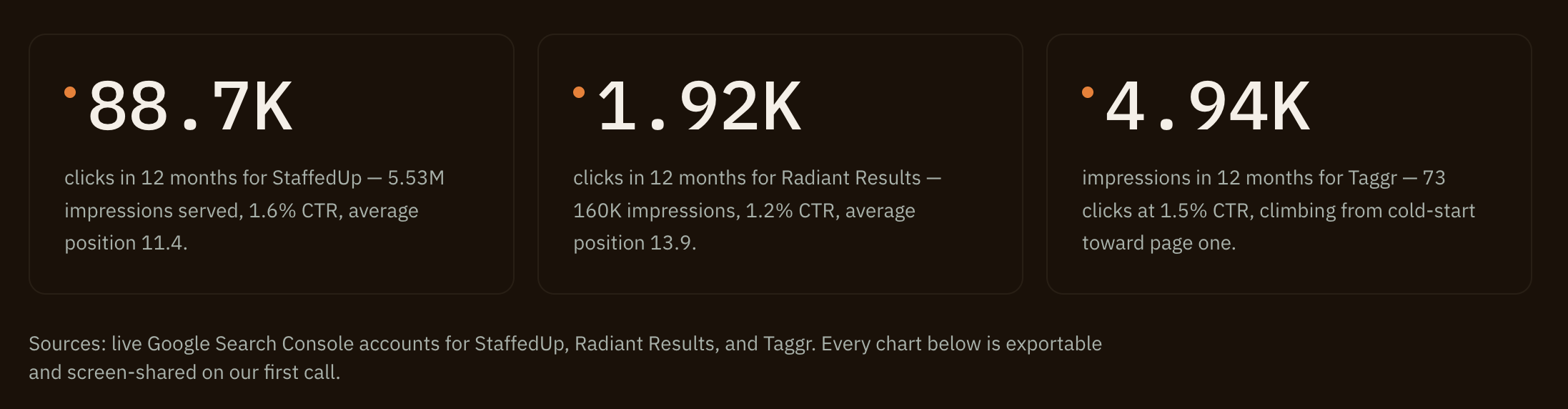
One client is a multi-location medical-wellness franchise on a 12-posts-a-month cadence. The engagement began in March 2026. Within the first four months, that site generated 73% of its trailing-12-month Google clicks (1.32K of 1.81K) and 87% of its trailing-12-month impressions (119K of 137K). Peak daily clicks reached roughly 10× the pre-engagement baseline — about 44 a day versus around 4 a day before the start.
On the ranking side, the first keyword hit #1 in three weeks. That's faster than typical — a best case, not what I promise anyone. More representative: of the first 17 keywords tracked, 9 reached the top 5 within 60 days and 14 reached the top 10.

Across my client Search Console accounts, the pattern is consistent: impressions move first, clicks lag behind, and conversions lag further still. A 4-posts-a-month engagement covers the same ground more slowly — fewer keyword entries per month, so the compounding curve simply starts later.
If you want to see it live, I'm happy to screen-share the actual Search Console account on a call. You can also read more about who's behind these campaigns.
The truth about "16+ posts = 3.5x traffic" (and what the data actually shows past ~11/month)
You'll see one stat repeated on nearly every page about this topic, and it's real. According to HubSpot's blogging frequency benchmarks, blogs that publish 16 or more times a month receive 3.5x more traffic than those publishing weekly or less, and companies publishing 16+ posts a month generate 4.5x more leads than those publishing 0–4 monthly.
Here's the part those pages leave out. In HubSpot's own breakdown, companies with 10 or fewer employees drove their gains at around 11 blogs a month — those publishing more than 11 had almost three times the traffic of those publishing one a month. Read that closely: the small-company buckets top out at 11+, which means the measured gains live in getting from near-zero to roughly eleven a month. Past that, the data simply can't show volume alone paying — and in my campaigns, it doesn't. Depth and topical coverage take over.
One honesty note before you build a strategy on it: these are HubSpot's long-standing benchmarks — correlational, and old enough to treat as directional. Companies that publish 16 posts a month are also bigger and better funded, which inflates the correlation. I use the data as a guardrail, not a law. Google's John Mueller has said publishing frequency is not a ranking factor — volume helps by building coverage, up to a point. Past that point, the lever is quality and topical depth.
How to choose your cadence: domain age, niche competition, and reach
The right number is a decision, not a default. Here's how the variables translate:
Domain age. Ranking takes time on a new site. Ahrefs' study of top-ranking pages found the large majority of Top 10 pages are years old — the age of a typical top-ranking page is measured in years, not months. If your domain is young, expect a ramp and plan a higher cadence to cover ground while authority builds.
Niche competition. Crowded niches need both more posts and more depth per post. A quiet niche can win on far less.
Local vs. national reach. Local health and service businesses need a fraction of the total posts a national publisher does. Your job is to cover the specific questions your buyers actually ask — not to out-publish the whole internet.
Capacity to maintain quality. Pick the highest cadence you can sustain without thinning quality. A well-executed 4 beats a sloppy 12 every time.
Cadence answers how much to publish. How long it takes to rank is its own question — the short version: impressions move first, clicks lag, and in my campaigns lower-competition local terms typically reach page 1 in 30–60 days, with compounding gains at 60–90+ days.
Cadence by budget: what 4, 8, and 12 posts a month actually cost and buy
Nobody in this SERP tells you the money side, so here it is. Legitimate small-business SEO typically runs $500–$5,000 a month depending on scope and market. Where you land inside that range should map to the coverage you actually need.
The Dominate plan is $1,500 a month — 12 blogs at $125 each — and includes keyword research, on-page optimization, and the monthly rank report, on a 3-month recommended run and month-to-month after. Volume tiers exist at 6 (Starter) and 9 (Grow) blogs a month, with per-blog rates on the live calculator, and multi-location businesses get 10% off (2–5 locations) or 20% off (6+). No setup fee, no dashboard fee.
A word on the cheap end. When you see "$200/month SEO," you're usually buying spun content and directory spam — and it backfires. Per Google's guidance on helpful content, its systems generate a site-wide signal: if a site carries a relatively high amount of unhelpful content, even its genuinely helpful pages may perform worse. Volume of thin posts doesn't just waste money; it can drag down the good work.
~4 posts/mo (DIY-viable floor) — Lower end of the $500–$5,000 market range. Steady coverage of core services + top questions; slower ramp.
6 or 9 posts/mo (Clementine Starter & Grow) — Per-blog rates on the live calculator. Faster keyword coverage; suits newer or competitive sites.
12 posts/mo (Clementine Dominate — recommended) — $125/blog · $1,500/mo. Full engine: 12 articles, keyword research, on-page, monthly rank report.
You can see the full published pricing rather than requesting a quote to find out.
The free visibility snapshot takes one reply: send your domain and top service, and within 48 hours you'll see exactly where you rank today. Or start with the free first batch — I target 6 keywords for your business; if at least one isn't in Google's top 3, you owe nothing.
New posts vs. refreshing old ones: the split most agencies ignore
As your library grows, the smartest place for your budget shifts. On a young site, new posts open new doors. On a mature site with 100+ posts, updating and improving existing content often outperforms adding net-new posts — you already have pages earning impressions, and small gains on those can beat starting from zero.
One caution, because this trips people up: real refreshing means adding genuine value. Google's John Mueller has stated that simply updating the date on a page is unlikely to have any impact on rankings — and Google's own helpful-content guidance asks site owners directly whether they're changing dates to make pages seem fresh without substantially changing them. Rewriting the timestamp is not a strategy; expanding, correcting, and improving the content is.
In my practice, a mature site's monthly plan usually looks like roughly 4 new posts plus several meaningful refreshes of pages that are already ranking on the edge of page one. That's a rule of thumb, not a law — the split depends on how much of your library is already pulling weight.
Blogging cadence in the AI-search era (Overviews, ChatGPT, Perplexity)
Search is changing, but the fundamentals that win aren't. Your cadence should serve answer engine optimization and AI Overview citations, not just crawl freshness.
Here's how it works in practice. AI Overviews draw from pages that already rank well, then favor content that answers the query cleanly — Google's own AI-features documentation says the same SEO fundamentals apply, with no separate index and no special markup. The system extracts passages, so the unit that wins is a tight, self-contained answer. Each post should nail one question clearly rather than sprawl.
The encouraging part for small businesses: LLM citations appear to be based on content quality and relevance rather than domain size. A small site with well-structured, highly relevant content that directly answers a specific query can get cited. That argues for fewer, deeper, well-organized posts over a firehose of thin ones — a dozen shallow articles a month won't out-cite four genuinely useful ones.
When you should NOT publish 12 posts a month
Sometimes the honest answer is "publish less." Here's when 12 a month is the wrong call:
Brand-new domain, no backlinks, no topical foundation. Volume is premature. Fix the foundation first; a firehose of posts on a site with no authority mostly sits unread.
No capacity to maintain quality. Thin, rushed volume can trigger the site-wide unhelpful-content risk covered above — the opposite of what you're paying for.
A weak offer or a broken booking flow. This is what SEO can't fix. I can send qualified traffic to your page, but if the offer doesn't land or the booking form is broken, blogging won't repair a leaky funnel. Fix the funnel first.
A tiny or highly seasonal query universe. If your niche only supports a handful of genuinely useful topics, you'll exhaust them, and extra posts become digital mulch.
And sometimes DIY is the right call. An owner with time, real subject expertise, and a small niche can absolutely start at 4 solid posts a month themselves. Hiring out pays off when you lack the capacity or consistency, or when you want the keyword strategy and reporting handled — not before.
Frequently Asked Questions
Is one blog post per month enough for SEO?
It can work for a small, low-competition niche, but it's slow. One post a month gives you limited keyword coverage and a long ramp, so expect modest results over a long horizon. For most businesses, 4 a month is a more realistic floor.
How often should you blog for SEO?
Four posts a month is the practical floor for most local and health businesses; 8–12 a month suits newer domains or competitive niches. Quality gates all of it — a sustainable, high-quality cadence beats an unsustainable big one.
Does posting more blogs actually help rankings?
Up to a point. In HubSpot's benchmarks, the measured small-company gains top out around 11 posts a month. Google's John Mueller has stated publishing frequency is not a ranking factor; more posts help by building keyword coverage and authority, not because frequency is a signal itself.
How long does it take for blog posts to rank?
Expect months, not days. Ahrefs' study of top-ranking pages found the large majority of Top 10 results are years old, so new content typically ramps over time as authority builds. Newer sites should plan for a longer runway.
Is it better to publish new posts or update old ones?
Both, and the balance shifts with your site's maturity. New posts open new doors on younger sites; refreshing winning pages often outperforms net-new content on mature sites. Just make refreshes real — Mueller has noted that changing only the date won't move rankings.
How do I find out if blogging is worth it for my business?
Send your domain and top service for a free visibility snapshot, and within 48 hours you'll see where you rank today. If you'd rather test the work itself, the free first batch targets 6 keywords for your business — if at least one isn't in Google's top 3, you owe nothing.