How Much Does SEO Cost for a Small Business? (2026 Pricing, Explained by an Agency That Publishes Its Own Rates)
What SEO really costs a small business in 2026: verified survey data, transparent per-blog pricing, honest timelines, and when not to hire an agency at all.

By Evan Rief, Founder & Lead SEO Strategist
Last reviewed: July 2026
The pricing in this article reflects real 2026 market data — Ahrefs' survey of 439 SEO professionals — alongside Clementine's own published rates. The client results referenced come from a live Google Search Console account, and I'm happy to walk through it with you on a call. Results vary by market, competition, and the shape of your site — nobody honest can promise otherwise.
Legitimate small-business SEO runs $500–$5,000 per month in 2026, and the honest answer inside that range depends on who you hire and what you're buying. Survey data says the single most common fee band is $500–$1,000/mo, while averages sit near $2,900 — pulled up by big agencies. In my experience, durable content-led SEO for a competitive local market usually lands between $1,500 and $2,500/mo. Clementine prices per published blog: $125/blog at the recommended 12 a month, $1,500/mo — and below, I show exactly what that buys.
Key Takeaways
Legitimate small-business SEO spans $500–$5,000/mo. The most common survey fee band is $500–$1,000/mo; in my experience, durable content-led work in a competitive local market usually lands at $1,500–$2,500/mo.
At the rock-bottom end — the $99–$300 "package" — you're usually paying for activity, not results: directory spam and filler that can now hurt a site rather than help it.
Clementine's pricing is flat and published: $125/blog at the recommended 12 a month ($1,500/mo), with 6- and 9-blog tiers, multi-location discounts of 10–20%, and no setup or dashboard fees.
SEO is a compounding investment, not a switch: lower-competition local terms typically reach page 1 in 30–60 days, with bigger gains at 60–90+ days.
The honest test of a provider is whether they'll publish a price and show you real Google Search Console data — most won't.
How Much Does SEO Cost for a Small Business? (The Direct Answer)
Start with the real distribution, because "average" numbers hide it. Ahrefs' study of 439 SEO professionals found SEO costs $2,917 per month on average, local SEO averages $1,557 per month, and 78.2% of SEOs charge a monthly retainer — a flat recurring monthly fee. But the single most common fee band in the same survey is $500–$1,000/mo, charged by 23% of SEOs. Averages get dragged upward by large agencies billing five figures; the middle of the market sits lower than the mean suggests.
So what should you expect to pay? Here's my first-hand read after running these campaigns: for a small business in a competitive local vertical, work thorough enough to produce durable rankings — real content, real optimization, real reporting — usually lands between $1,500 and $2,500 per month. Quieter markets and narrower goals can sit honestly below that; national and e-commerce plays sit above it. The variable is the work in front of you, not a mystery.
The wide range also reflects starting points. A site that needs a technical cleanup, has thin content, or competes in a crowded vertical costs more to move than a clean site in a quiet market. Two businesses can pay very different amounts and both be quoted fairly.
That is also why so many providers give you a range and then hide their own number. I take the opposite approach — you can see the transparent pricing before you ever talk to me.
2026 SEO Pricing Ranges by Business Type
What you should budget depends on the shape of your business more than on any single average. A one-location clinic, a regional group with five offices, and a national e-commerce store are three different problems with three different price tags. The ranges below are my budgeting guidance from quoting against this market — anchored to the survey data above, not pulled from a pricing guide written three years ago.
Local single-location (one clinic or studio) — $500–$1,500/mo. The survey's most common band lives here: the Map Pack plus a handful of service keywords.
Local, competitive vertical / higher LTV — $1,500–$2,500/mo. Where I see durable, content-led results land.
Multi-location / regional — scales with locations. Volume discounts are standard — Clementine takes 10% off for 2–5 locations, 20% off for 6+.
E-commerce / national — $3,000–$5,000+/mo. Broader keyword sets and the fiercest competition — this end drags the $2,917 average up.
DIY (your time only) — ~$0–$300/mo in tools. Viable in specific cases — see below.
One caution: at the advertised rock-bottom end, you're usually buying volume, not outcomes. More on why that matters shortly.
SEO Pricing Models: Retainer vs. Project vs. Hourly
There are three common ways SEO gets billed, and knowing which one fits your situation saves you money.
A retainer is a flat recurring monthly fee for ongoing work — content, on-page optimization, and reporting month after month. A one-time project is a fixed scope with a defined end, like a technical audit or a Google Business Profile fix. Hourly billing covers consulting and ad-hoc help when you mostly need a second set of eyes.
The retainer dominates for good reason. Ahrefs found 78.2% of SEOs charge a monthly retainer, and the average hourly rate for SEO is $111. SEO is ongoing — rankings shift, competitors publish, and Google updates — so a one-and-done rarely holds.
Clementine runs the retainer model, but prices it per published blog instead of per vague "deliverables" — $125/blog at the recommended 12 a month, with no setup fee to start. If you want to see how each piece fits together, here's how the process works.
One pattern to watch: providers who sell a set number of backlinks or articles per month as though volume equals results. It doesn't. Relevance and quality move rankings; counting deliverables just makes the invoice look full. You're not paying for a word count — you're paying for pages that earn their rankings.
What the $1,500/Month Actually Buys (Line-by-Line)
Most agencies won't show you this, so here it is. The Dominate plan is $1,500/mo — 12 blogs at $125 each — and this is the scope. Every line, no mystery.
Deliverable:
12 publish-ready articles a month. Content targeting real buyer keywords in your vertical's language.
Keyword research & strategy. The money terms your customers actually type, mapped to pages.
On-page optimization. Titles, structure, and internal links done right on every page.
Monthly ranking report. Where you rank, what moved, and what's next — in plain English.
Screen-shareable results. I'll show a live Google Search Console account on a call.
Google has confirmed that demonstrating real experience and expertise helps it assess a page's credibility, and that content produced with clear expertise supports strong, durable performance. That E-E-A-T principle, laid out in Google's helpful content documentation, shows up in my own numbers.
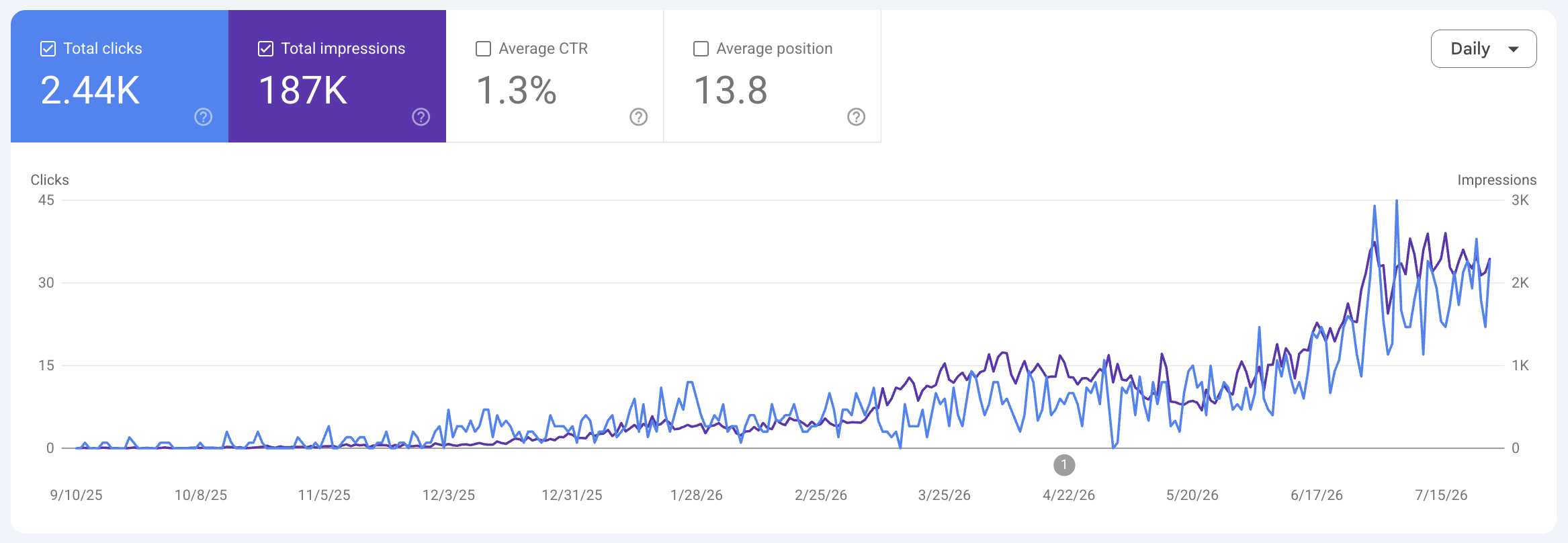
With a multi-location medical-wellness client whose engagement began in March 2026, the compounding pattern was clear. In the first four months, 73% of the site's trailing-12-month clicks (1.32K of 1.81K) and 87% of impressions (119K of 137K) landed in that window.
Peak daily clicks reached roughly 10× the pre-engagement baseline — 44/day versus about 4/day. The first #1 ranking came in three weeks, which is faster than typical and not something I promise. Within 60 days, 9 of the first 17 tracked keywords hit the top 5, and 14 of 17 reached the top 10.
Every figure above is first-hand, and I'm happy to walk through the live Search Console account so you can verify them yourself.
The free visibility snapshot takes one reply: send your city and top service, and within 48 hours you'll see exactly where you rank today. Or start with the free first batch — I target 6 keywords for your business; if at least one isn't in Google's top 3, you owe nothing.
Freelancer vs. Agency vs. DIY: The Real Cost Comparison
There are three routes to get SEO done, and the cheapest sticker price isn't always the cheapest outcome.
A freelancer is often the most affordable option, and many are excellent. The trade-off is single-point-of-failure risk — if they get busy, sick, or take on a bigger client, your work stalls. An agency costs more; Ahrefs found agencies charge 138% more than freelancers, with the average hourly rate across the field at $111. What that premium buys is capacity and continuity: a team that doesn't disappear.
DIY costs only your time plus tools, and in the right situation it's a legitimate choice. Hiring in-house is the priciest path — a full-time SEO hire typically costs well over six figures once you add salary and overhead. That's more than most retainers for a fraction of the breadth.
Be honest with yourself about the very low end. The "$200/mo will rank you" offer buys a little activity and no durable result. When work is that cheap, you're usually paying for a report that says something happened, not for rankings that show up in your booking calendar.
When You Should NOT Hire an SEO Agency (The Honest Part)
Sometimes the right answer is not to hire me — or anyone. I'd rather tell you that than take a retainer that won't work.
DIY is genuinely viable when you're very local, competition is thin, you're targeting a handful of keywords, and you have the time to learn. In that situation, a modest tool budget and consistent effort can carry you a long way.
A one-time project beats a retainer when you mainly need a technical cleanup or a Google Business Profile fix rather than ongoing content. Pay for the fix, then reassess — you may not need a monthly commitment at all.
And match the budget to the goal. A quiet single-location market can get real value at the lower end of the honest range; a competitive vertical usually can't — underfunding a hard market buys you activity without traction, which is the most expensive kind of cheap.
Finally, know what SEO can't fix. I see this constantly — SEO amplifies a business that already works. It cannot rescue a weak offer, a broken booking flow, or a practice with no capacity to take new clients. If your intake is leaking or the offer doesn't convert, fix that first. More traffic to a broken funnel just spends money faster.
Is SEO Worth It? ROI, Break-Even, and a Realistic Timeline
For most local businesses with real demand and a working offer, yes — and the math is usually not close. As an illustration: take a med spa where a new client is worth, conservatively, $1,500 in first-year value. At $1,500/mo, you break even on a single new client per month; anything beyond that is return. Plug in your own average client value and the picture sharpens fast.
The honest timeline matters as much as the math. In my campaigns, lower-competition local terms typically reach page 1 in 30–60 days, with the bigger, compounding gains arriving at 60–90+ days. The three-week #1 from my case study is the best case, not the promise.
Google's own guidance lines up with that. In Google's "How to Hire an SEO" video, Maile Ohye put it at "four months to a year" to first implement improvements and then see potential benefit.
Local visibility is also worth more than it was a year ago. BrightLocal's Local Consumer Review Survey 2026 — a representative panel of 1,002 US adults — found the share of consumers using AI to find local business recommendations climbed from 6% in 2025 to 45% today. The compounding pattern in my own data (73% of a client's clicks arriving in the first four months) is how that investment stacks over time.
Do You Need to Pay Extra for AI Search (GEO/AEO) in 2026?
For a small local business, usually not — at least not as a separately billed add-on. The fundamentals that earn organic traffic and rankings are the same ones that earn citations in AI Overviews and AI assistants: clear, expert content that directly answers what people ask.
That matters because search behavior has shifted. BrightLocal's data showing 45% of consumers now use AI for local recommendations means being the source AI trusts is increasingly the same job as ranking well. Answer engine optimization, at heart, is the same discipline as good SEO — structured, credible answers that a language model can quote.

Be skeptical of anyone selling a separately billed "GEO/AEO package" on top of your SEO for a single-location local business. In my campaigns, sound fundamentals — real authorship, structured answers, genuine expertise — are what earn AI Overview citations. If a provider can't explain how their AI-search add-on differs from good SEO, it probably doesn't. That is the same honest test to apply to any SEO cost for a small business: transparent pricing, real data, no mystery.
Frequently Asked Questions
Is SEO worth it for a small business?
For most local businesses with genuine demand, yes — provided your offer and booking flow already work. The break-even math is often a single new client per month against a $1,500/mo plan. SEO amplifies a working business; it can't rescue a broken one.
How long does SEO take to show results?
In my campaigns, lower-competition local terms often reach page 1 in 30–60 days, with compounding gains at 60–90+ days. Google's Maile Ohye has said that in most cases SEO needs four months to a year to implement improvements and then see the benefit. Timelines vary with your market and the state of your site.
Can I do SEO myself?
Yes, in specific cases — when you're very local, competition is thin, you're targeting a few keywords, and you have the time to learn. If your market is competitive or you'd rather buy back the hours, hiring makes more sense. Be honest about which situation you're actually in.
What's the difference between a freelancer and an agency?
Cost, reliability, and capacity. Ahrefs found agencies charge 138% more than freelancers, but that premium buys continuity and a team that doesn't disappear when things get busy. Many freelancers are excellent; the main risk is single-point-of-failure.
How much should a small business budget per month?
The honest market range is $500–$5,000/mo. Survey data puts the most common fee band at $500–$1,000/mo and the overall average near $2,900, pulled up by big agencies. In my experience, durable content-led work in a competitive local market usually lands at $1,500–$2,500/mo — Clementine's recommended plan sits at $1,500 ($125/blog × 12), with 6- and 9-blog tiers on the live calculator.
How do I find out if SEO is worth it for my business?
The fastest way is a free visibility snapshot: send your city and top service, and within 48 hours you'll see exactly where you rank today. If you'd rather see proof first, the free first batch targets 6 keywords for your business — if at least one isn't in Google's top 3, you owe nothing.