SEO for Acupuncturists: An Honest Guide to Getting Found by Patients
SEO for acupuncturists, explained honestly: cost ranges, a realistic timeline, and why your patients search their condition and insurance—not "acupuncture."

By Evan Rief, Founder & Lead SEO Strategist
Last reviewed: July 2026
This guide draws on my real client campaigns in health and local-service verticals — and if you want to see the numbers for yourself, I'm happy to walk through the live Google Search Console account on a call. It also relies on Google's own documentation and on Medicare.gov and CMS for coverage rules. Results vary by market, by how competitive your metro is, and by how much of a local head start your practice already has.
SEO for acupuncturists typically runs inside the honest small-business range of $500–$5,000/month — Clementine prices per published blog, at $125/blog for the recommended 12 a month ($1,500/mo). It works in two phases. Your Google Business Profile and reviews typically start moving in the local Map Pack within 30–120 days. Condition-specific pages — migraines, fertility, back pain, stress — compound over 3–6 months. The single biggest mistake is optimizing for the word "acupuncture." Your patients search their condition and their insurance, not the treatment.
Key Takeaways
Patients search their condition and their insurance, not "acupuncture" — the head term is a trap that pits your solo practice against directories you can't outrank.
Local SEO comes first: Google ranks local businesses on relevance, distance, and prominence, where prominence is driven partly by how many websites link to you and how many reviews you have.
Realistic timeline: lower-competition local terms typically reach page 1 in 30–60 days; compounding gains show up at 60–90+ days.
The insurance-keyword play — including the narrow Medicare low-back-pain rule — is the highest-intent, lowest-competition opportunity almost no acupuncture site ranks for.
Honest pricing: legitimate small-business SEO runs $500–$5,000/month; Clementine is $125/blog at the recommended 12 a month ($1,500/mo), with 6- and 9-blog tiers and multi-location discounts. In my flagship medical-wellness campaign, the first #1 ranking landed in 3 weeks — the best case, not a promise.
How Your Patients Actually Search (and Why "Acupuncture" Is the Wrong Keyword)
Nobody wakes up and types "acupuncture" into Google. They type what hurts. "Acupuncture for migraines." "Does acupuncture help fertility." "Acupuncture for lower back pain near me." The treatment is the answer to their question — but the question is about their body and their wallet.
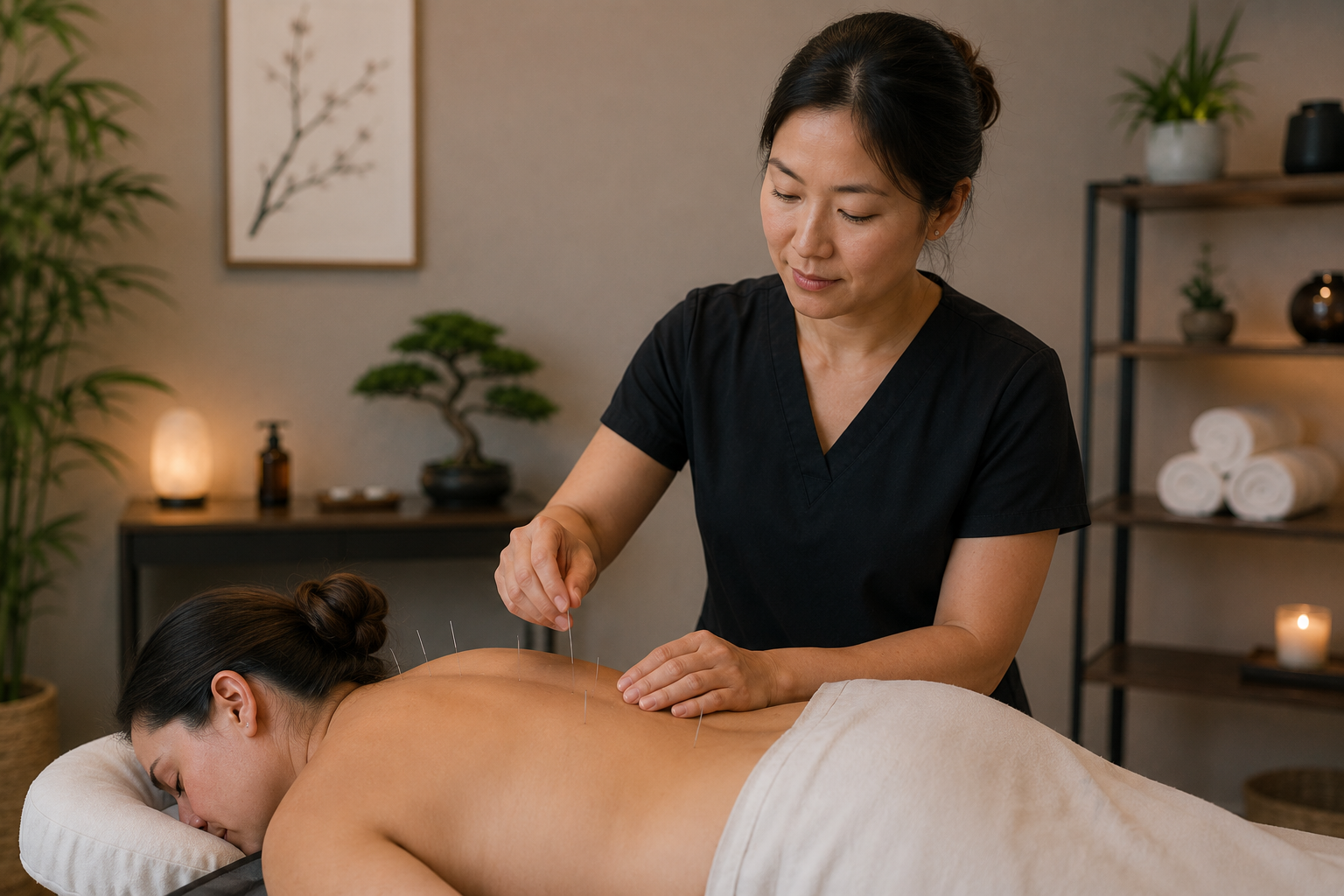
The journey is predictable, and it's worth mapping because every stage is a keyword. A patient moves from symptom ("why does my neck still hurt") to skepticism ("does acupuncture actually work for X") to money ("is acupuncture covered by insurance," "how much does it cost") to proximity ("acupuncture near me") to booking. A practice with a real page for each stage catches the patient at every step.
In my client Search Console accounts, condition and insurance long-tail pages consistently pull higher-intent, easier-to-win traffic than the generic service term. It's not close. The searcher who types a full condition-plus-insurance phrase is far closer to booking than the one poking at "acupuncture."
Here's the honest part. A solo practice will rarely win the bare word "acupuncture." That result is owned by directories and aggregators with thousands of backlinks, and chasing it wastes your budget. Aim where the intent is high and the competition is thin.
Head term (avoid as primary target) — e.g. "acupuncture." Difficulty: High. Intent: Broad/low.
Condition + near me — e.g. "acupuncture for migraines near me." Difficulty: Low–Med. Intent: High.
Condition + cost — e.g. "fertility acupuncture cost." Difficulty: Low. Intent: High.
Insurance + carrier + city — e.g. "acupuncture that takes [carrier] [city]." Difficulty: Low. Intent: Very high.
Medicare + condition — e.g. "does Medicare cover acupuncture for back pain." Difficulty: Low. Intent: High.
If building out that map sounds like a lot, it is — it's exactly how the monthly content engine builds condition pages so you don't have to write them one at a time.
Local SEO First: Your Google Business Profile and the Map Pack
Before you write a single condition page, get your local footing right. The Map Pack is the block of three business listings that appears above the regular organic results when someone searches with local intent. For a practice, that placement is often more valuable than the #1 blue link below it.
Google has confirmed how it ranks these listings. Per Google's local ranking guidelines, relevance is how well your profile matches what someone searches for. Distance is how far your practice is from the searcher, and if they don't share their location, Google estimates it. Prominence is how well-known your business is — based partly on how many websites link to you and how many reviews you have.
Your week-one checklist is simple and free: claim and verify your Google Business Profile, set the correct primary category, complete every service, get your hours and service area right, and add real photos of your space and your practice.
Reviews are your biggest prominence lever. BrightLocal's Local Consumer Review Survey 2026, based on a representative panel of 1,002 US adults, tracks how heavily reviews shape whether consumers choose a local business. Healthcare has a wrinkle here — patients leave fewer reviews than restaurant-goers do, and the ask lands best a few days after the visit, once they've felt the result.
If you're a brand-new solo practice with a clean profile and a handful of reviews, this section is your starting point. Do it yourself first. When you're ready to scale the listings and links behind it, that's the local-presence side of what Clementine builds.
The Condition-Page Playbook: Migraines, Fertility, Back Pain, Stress
Condition pages work as a hub and spoke. You build one pillar "conditions we treat" page, then a dedicated page for each condition — migraines, fertility support, chronic low back pain, stress and anxiety — all linked back to the hub. That structure tells Google what you're an authority on, and it gives the patient a page written for exactly their problem.
Each condition page follows the same anatomy: answer the patient's real question first, explain what to expect on a first visit, frame the evidence honestly, link internally to related pages, and mark up the FAQ with schema so it's eligible for rich results.
Don't underestimate the "what to expect on your first visit" content. A skeptical patient who's never had needles in them isn't just deciding whether acupuncture works — they're deciding whether they can go through with it. Answering that anxiety directly is what turns a reader into a booking.
A word on YMYL, or "Your Money or Your Life" — the category Google uses for health content it holds to a higher accuracy bar. Your condition pages must not overstate clinical efficacy. Keep claims measured, cite what's real, and never guarantee an outcome. Accuracy outranks hype here, both ethically and algorithmically.
Across my client campaigns, condition-specific pages are where the compounding traffic lives. In my flagship engagement — a vertical where Medicare Part B only covers acupuncture for chronic low back pain and can't pay licensed acupuncturists directly — the depth of the condition and insurance content did the heavy lifting.
The Insurance & Medicare Keyword Opportunity Nobody's Ranking For
This is the play almost no acupuncture site runs. Searches like "does insurance cover acupuncture," "acupuncture that takes [carrier]," and "does Medicare cover acupuncture" are high-intent and low-difficulty. The patient asking them is ready to book — they just need to know they can afford it.
Get the Medicare facts exactly right, because this is where your YMYL fluency shows. Per Medicare's acupuncture coverage rules, Medicare Part B only covers acupuncture, including dry needling, for chronic low back pain — and Medicare can't pay licensed acupuncturists directly. Medicare covers up to 12 treatments in 90 days; if you show improvement, it covers an additional 8 sessions, for a maximum of 20 treatments in a 12-month period.
The costs matter too. Patients pay 20% coinsurance after meeting the Part B deductible, and Medicare does not cover acupuncture for any other condition — including neck pain, migraines, fibromyalgia, or nausea. One more honesty rule: coverage specifics like the annual Part B deductible change every year, so verify the current figures on Medicare.gov the day you publish your own coverage page — and date the page.
The page-build playbook: create an "insurance & payment" hub, a dedicated Medicare-and-low-back-pain page, and carrier or state variants where they're actually true for your practice. Yes, you should publish your prices and insurance information — it answers a high-intent query and builds trust with a patient who's been burned by surprise bills before.
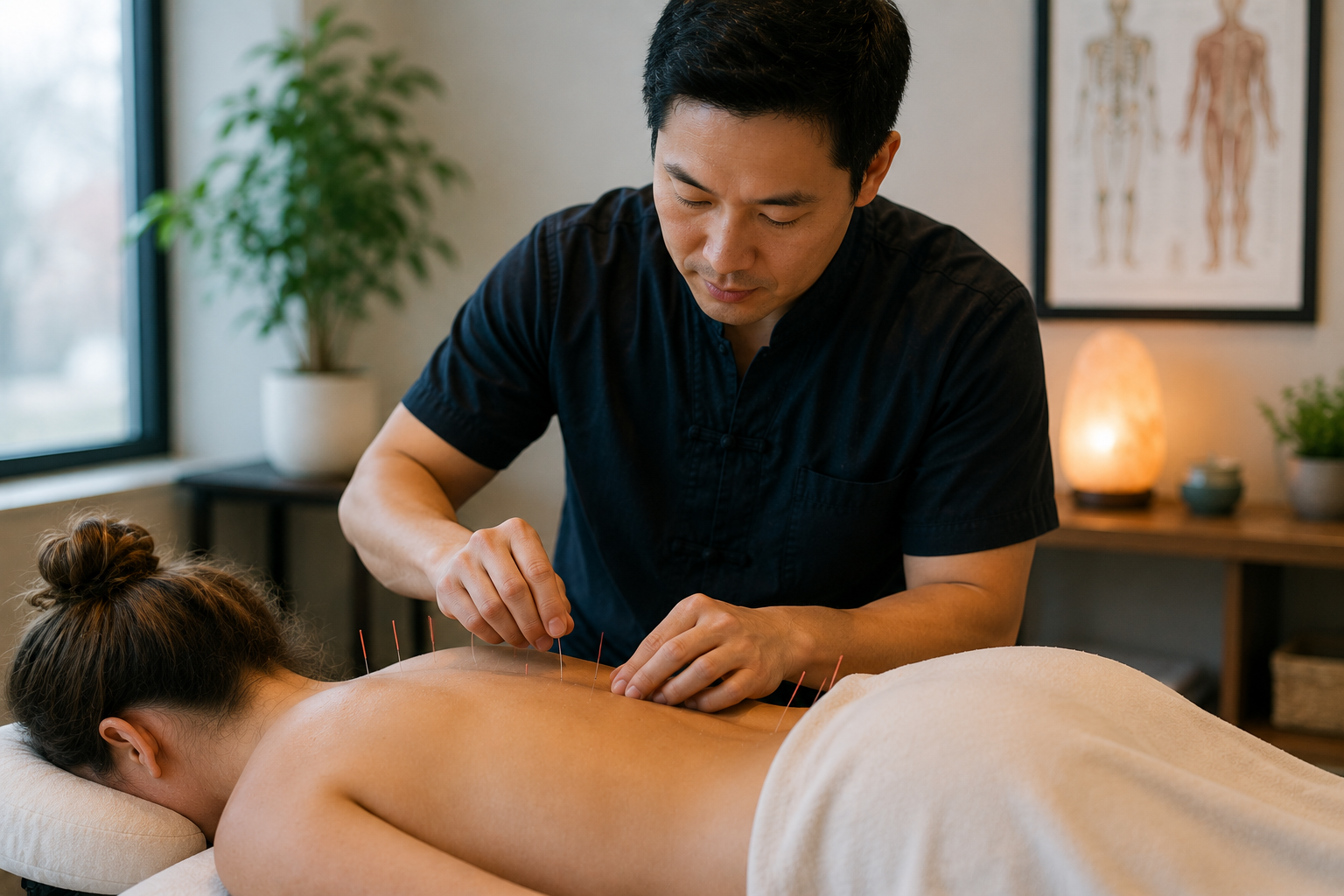
Here's the honesty flag, and it's non-negotiable: your Medicare page must be accurate, not aspirational. Per the CMS national coverage determination, Medicare does not pay a licensed acupuncturist directly — coverage runs through a physician, nurse practitioner, physician assistant, or clinical nurse specialist. Never let your page imply your practice bills Medicare when it can't. Explain how coverage actually works, and you'll rank and keep your patients' trust.
What Acupuncture SEO Actually Costs (Real Ranges, Not "Contact Us")
You've probably hit a pricing page that says "a few hundred to several thousand dollars" or, worse, hides the number behind a contact form. That's not information — it's a filter to get you on a sales call. Here are the real numbers.
Legitimate small-business SEO typically runs $500–$5,000/month. Where you land inside that depends on your market's competitiveness and how much you're building at once. My own pricing is published, not negotiated on a call:
Dominate (recommended) — $125/blog · $1,500/mo. 12 blogs/mo, keyword research, on-page optimization, monthly rank report. Legitimate small-business SEO typically runs $500–$5,000/mo.
Starter & Grow — Per-blog rates on the live calculator. 6 or 9 blogs/mo, same engine at lower volume.
The recommended run is three months — ranking physics, not a contract trick — and month-to-month after. No setup fee, no dashboard fee — and multi-location businesses get 10% off (2–5 locations) or 20% off (6+). You can see exactly what each tier includes without booking anything.
Now the warning. A $150–$300/month "SEO package" almost always buys spun content, directory spam, and no strategy. In 2026 that's not just wasted money — it can be actively harmful. Google's spam policies explicitly name scaled content abuse — mass-produced pages that add little value — as a violation, and its broad core updates keep recalibrating what deserves to rank, most recently with the March 2026 core update that finished rolling out in April. Thin filler can now demote a site rather than do nothing. Cheap SEO isn't a smaller version of good SEO; it's a different, worse thing.
The free visibility snapshot takes one reply: send your city and top service, and within 48 hours you'll see exactly where you rank today. Or start with the free first batch — I target 6 keywords for your practice; if at least one isn't in Google's top 3, you owe nothing.
How Long Acupuncture SEO Takes: A Realistic 6-Month Timeline
Anyone who promises you page-one rankings by a date is guessing or lying. What I can give you is a realistic arc based on how these campaigns actually move.
Local Map Pack (GBP + reviews) — 30–120 days. Local visibility for "near me" + city terms.
Lower-competition local terms — 30–60 days to page 1. Early wins.
Compounding gains — 60–90+ days. Momentum builds.
Condition/insurance content — 3–6 months. Topical authority + AI citations.
Here's real first-hand data from my flagship medical-wellness campaign, so you can see the shape of it:
73% of the client site's trailing-12-month Google clicks were generated inside the first 4 months (1.32K of 1.81K clicks).
87% of trailing-12-month impressions in the same window (119K of 137K).
Peak daily clicks reached ~10× the pre-engagement baseline (44/day vs. ~4/day).
First #1 ranking in 3 weeks — explicitly faster than typical, the best case, not the promise.
9 of the first 17 tracked keywords reached the top 5 within 60 days; 14 of 17 reached the top 10.
I'm happy to walk you through that live Search Console account on a call — no slide deck, the actual data.
Two honest caveats. This was a multi-location medical-wellness client, not a solo acupuncturist, so your numbers won't be identical. And that cuts both ways: a solo practice in a low-competition town may move faster on local terms and slower on content authority. There are no guarantees here — only a defensible pattern.
Winning AI Overviews and the Post-2026 Reality for Health Sites
Search is changing, and it's tempting to panic. Don't. The fundamentals that earn a citation in Google's AI Overviews are the same ones that have always won: clear direct answers, real expertise, accurate YMYL content, and structured data.
For a small acupuncture site, earning an Overview citation is concrete work, not magic. Write a dated, specific, quotable answer block at the top of each key page. Show genuine experience — a named practitioner, real credentials, honest limitations. And build condition and insurance pages that answer the exact question a patient asks, in the words they ask it.
The bigger shift is where patients and AI systems look. Per BrightLocal's 2026 consumer research, the share of consumers using AI tools to find local businesses has jumped sharply year over year. That means your brand has to be consistent and credible across every platform an AI might pull from — not just your own site.
Let me be clear about what this is not. SEO is not dead, and dismissing AI search is a mistake. The site that wins the Overview is usually the same site that would have won the featured snippet — clear, accurate, and trustworthy. That's how the content engine is built for AI-era search: the fundamentals, done consistently, dated, and accurate.
When You Should NOT Hire an SEO Agency for Your Practice
I run an SEO firm, and I'm going to tell you when not to hire one. If you've been burned before, this is the section that should earn your trust.
When you should DIY first: If you're a brand-new solo practice with one location in a town with almost no acupuncture competition, don't pay anyone yet. Claim and optimize your Google Business Profile, ask happy patients for reviews, and see how far that gets you. For many solo practices, that free work alone fills the schedule for a while.
When SEO can't help you yet: SEO drives clicks — it cannot fix what happens after the click. If your offer is weak, you have no reviews, or your online booking is broken or confusing, more traffic just means more people bouncing. Fix the booking flow and gather your first reviews before you spend a dollar on rankings.
When an agency actually makes sense: Multiple locations, a competitive metro, or simply no time to run the GBP-and-content flywheel yourself. That's when the math works.
Watch for one pattern regardless of who you hire: generalist agencies that treat a medical clinic like a pizza shop, ignoring YMYL accuracy rules and the entire insurance-keyword opportunity. If a vendor can't speak fluently about the Medicare low-back-pain rule, they don't understand your patients' searches. Done right, SEO for acupuncturists is less about the treatment keyword and more about meeting patients at their condition, their insurance, and their moment of decision.
Frequently Asked Questions
How much does SEO cost for an acupuncture clinic?
Legitimate small-business SEO runs an honest market range of $500–$5,000/month. Clementine prices per published blog — $125/blog at the recommended 12 a month ($1,500/mo), with 6- and 9-blog tiers on the live calculator and multi-location discounts of 10–20%. Anything under a few hundred dollars a month almost always buys spun content that can now hurt your site.
How long does acupuncture SEO take to see results?
Lower-competition local terms often reach page 1 in 30–60 days, with compounding gains at 60–90+ days, while condition content builds topical authority over 3–6 months. Your Map Pack visibility can start moving within 30–120 days as your profile and reviews improve. These are typical arcs, not guarantees — your market's competitiveness changes the timeline.
What keywords should acupuncturists target?
Condition, insurance, and city terms — not the word "acupuncture" alone. Phrases like "acupuncture for migraines near me," "fertility acupuncture cost," and "does Medicare cover acupuncture for back pain" carry high intent and low competition. The bare head term is dominated by directories your solo practice won't outrank.
Do I need a website, or is a Google Business Profile enough?
You need both. A Google Business Profile gets you into the Map Pack — Google ranks it on relevance, distance, and prominence — but your website is where condition and insurance pages live, and those are what earn organic rankings and AI Overview citations. The profile brings local visibility; the site does the deeper, compounding work.
Does Medicare cover acupuncture, and can I rank for those searches?
Medicare Part B only covers acupuncture for chronic low back pain, and Medicare can't pay licensed acupuncturists directly — coverage runs through a physician, NP, PA, or clinical nurse specialist. It covers up to 12 treatments in 90 days and a maximum of 20 in a year, with 20% coinsurance after the Part B deductible. That narrow, confusing rule is exactly why a clear, accurate coverage page ranks well and converts.
How do I find out if SEO is worth it for my practice?
The simplest way is a free visibility snapshot: reply with your city and top service, and within 48 hours you'll get a report of where you currently rank. If you'd rather see proof before paying anything, the free first batch targets 6 keywords for your practice — and if at least one isn't in Google's top 3, you owe nothing.