SEO for Chiropractors: An Honest, Data-Backed Guide to Getting Found (2026)
What chiropractic SEO really costs in 2026, how long it takes, and where to start — data-backed, no ranking guarantees, and live Search Console proof.

By Evan Rief, Founder & Lead SEO Strategist
Last reviewed: July 2026
This guide draws on my real client campaigns — including a multi-location medical-wellness engagement whose live Google Search Console account I'm happy to walk through on a screen-share. It also draws on Google's own documentation and named data from BrightLocal and Search Central. Results vary by market and competition, and no one can honestly guarantee a ranking; anyone who tells you otherwise is the vendor this guide is meant to help you avoid.
SEO for chiropractors is the work of getting your practice found by people searching for care in your area — primarily through Google's local Map Pack and through pages that answer condition-specific searches like "sciatica treatment near me." Realistically, lower-competition local terms reach page one in 30–60 days, with gains compounding at 60–90+ days; Google's own guidance puts full results at four months to a year. Legitimate chiropractic SEO typically costs $500–$5,000/month; Clementine's pricing is flat per blog — $100/blog at the recommended 12 a month ($1,200).
Key Takeaways
The Google Map Pack — the box of three businesses with the map that sits atop local results — is the primary channel for chiropractors. Almost nobody drives 45 minutes for an adjustment, so proximity-driven local search decides most bookings.
Timeline, straight: lower-competition local terms typically hit page one in 30–60 days, with compounding gains at 60–90+ days. Google's documented guidance is four months to a year for full results.
Legitimate chiropractic SEO runs $500–$5,000/month. Clementine publishes flat per-blog pricing instead: $150/blog at 6 blogs a month ($900) or $100/blog at the recommended 12 ($1,200). Sub-$300 "packages" usually buy directory spam and spun content that can trigger Google's low-value demotions.
In my flagship medical-wellness campaign, the first #1 ranking landed in 3 weeks — faster than typical, the best case, not a promise I make to you.
SEO can't fix a booked-solid schedule or a broken booking flow. If your phone already rings more than you can answer, or patients can't schedule online, fix that first.
What SEO for Chiropractors Actually Is — and the Pipeline You Own
SEO — search engine optimization — is the work of making your practice the result Google shows when someone nearby searches for care. That happens in two places: the Map Pack (the three-business box with a map at the top of local results) and the organic results (the standard blue links below it).

Here's the reframe that matters for a chiropractor specifically. Most practices lean heavily on two channels they don't control: referral relationships and insurance-network flow. Both can dry up when a referring physician retires or a network shifts its panel. Search is different — it's a pipeline your practice owns.
In my campaigns, the reason that ownership compounds is simple: a new chiropractic patient rarely means one visit. It usually opens a treatment-plan relationship with repeat adjustments, so acquiring patients through search pays back over months, not minutes. (I won't hand you a lifetime-value dollar figure — the numbers you'll see quoted elsewhere are unverified. Model it on your own rebooking data.)
One vertical-specific reality competitors gloss over: you're a healthcare provider handling protected health information, and HIPAA constrains how you can use patient stories and testimonials in your marketing. That shapes what content is even usable, which is why generic "post reviews everywhere" advice can get a practice in trouble.
To be clear — SEO complements your referral relationships; it doesn't replace them. If you want the mechanics, how the monthly content engine works lays out the build.
Local Map Pack vs. Blog Content: Where to Put Your Effort First
The real question owners ask isn't "should I do SEO" — it's "where do my limited time and money go first?" Here's the model I use.
Map Pack first. It captures booking-ready searchers typing "chiropractor near me" who are ready to call today. Google has confirmed how it decides those rankings. According to Google's local ranking guidance, local results are based mainly on relevance, distance, and prominence. Relevance is how well your Business Profile matches the search, distance is how far you are from the searcher, and prominence is how well-known your practice is — driven partly by how many websites link to your business.
Condition and service content second. These pages catch earlier-stage searchers ("why does my lower back hurt when I sit") and, increasingly, feed AI answers. They also build the links and relevance signals that reinforce your Map Pack standing.
In my campaigns, this sequence works best:
Google Business Profile completeness — accurate categories, hours, services, photos, and a steady flow of reviews.
Condition-specific service pages for what you actually treat.
Supporting blog content that answers the questions patients ask before they book.
That ordering is my first-hand opinion, not Google doctrine — but it beats the common advice of "just publish blog posts" with no priority logic behind it. Getting the Google Business Profile foundation right is where I start every engagement.
Real New-Patient Numbers: What Chiropractic SEO Can Produce
Numbers without proof are just marketing. So here's a real one, with the standing offer to inspect it yourself — I'm happy to walk through the live Search Console account on a screen-share, the thing an unattributed "67% more leads" claim can never do.
This is a multi-location medical-wellness franchise engagement that began in March 2026. The mechanics — local Map Pack plus condition-based demand — transfer directly to chiropractic. The durability matters too: the same foundational SEO best practices driving these results are what Google says apply to its AI features.
On this account specifically:
73% of trailing-12-month clicks were generated in the first 4 months (1.32K of 1.81K).
87% of trailing-12-month impressions came in that same window (119K of 137K).
Peak daily clicks reached roughly 10× baseline (44/day versus about 4/day).
The first #1 ranking landed in 3 weeks — faster than typical, the best case on this account, not a promise for yours.
9 of the first 17 tracked keywords reached the top 5 within 60 days, and 14 of 17 reached the top 10.
I'll say the honest part plainly: this is one client's data in one market. Your competition, your starting point, and your city all change the math. It's evidence of what's possible, not a forecast.

How Long Chiropractic SEO Takes — An Honest, Phased Timeline
Straight answer: lower-competition local terms typically reach page one in 30–60 days, with gains compounding at 60–90+ days. For the fuller picture, Google's own "How to Hire an SEO" guidance — delivered by then–Google developer programs tech lead Maile Ohye — puts it at "four months to a year" to first implement improvements and then see potential benefit.
The 3-week #1 from my case study? That's the best case, not the promise. Here's what to realistically expect.
Foundation — Weeks 1–4. GBP optimization, technical fixes, first condition pages. What you'll see: Impressions begin in Search Console.
Early traction — 30–60 days. Lower-competition local terms move. What you'll see: First page-1 rankings on easier terms.
Compounding — 60–90+ days. Content library and reviews reinforce each other. What you'll see: Rankings broaden; calls and bookings rise.
Maturity — 4–12 months. Authority accrues, per Google's guidance. What you'll see: Fuller results; competitive terms move.
You'll find pages online promising results in a week and others warning it takes nine months. Both are trying to sell you something. The honest range, sourced to Google and to what I see in my own campaigns, is above.
What Chiropractic SEO Costs in 2026
Direct answer: legitimate small-business SEO typically runs $500–$5,000/month depending on scope. Clementine skips the quote wall — pricing is flat, per published blog:
Dominate (recommended) — $125/blog · $1,500/mo. 12 blogs/mo, keyword research, on-page optimization, monthly rank report. Legitimate small-business SEO typically runs $500–$5,000/mo.
Starter & Grow — Per-blog rates on the live calculator. 6 or 9 blogs/mo, same engine at lower volume.
The recommended run is three months — ranking physics, not a contract trick — and month-to-month after. No setup fee, no dashboard fee. Full pricing is published — no "contact us for a quote" wall.
Now the part most agencies skip: what cheap SEO actually buys. A $99–$300/month "package" typically means automated directory submissions and spun, machine-produced content. Per Google's people-first content guidance, content made primarily to attract search-engine visits isn't aligned with what its systems reward, and using automation to produce content primarily to manipulate rankings violates its spam policies. In plain terms, those cheap packages can trigger the demotions you're trying to avoid — money spent, nothing owned, and sometimes a cleanup bill.
I'm telling you this to protect your budget, not to upsell you.
The Service-Page-Per-Condition System
Here's a mistake I see constantly: one page trying to rank for back pain, sciatica, sports injury, and pediatric care all at once. It ranks for none of them well. Google can't tell what the page is about.
The fix is one focused page per condition or service — using the language patients actually search:
"sciatica chiropractor"
"sports injury adjustment"
"prenatal chiropractic care"
"auto accident chiropractor"
"pediatric chiropractor near me"
This ties directly to Google's confirmed relevance factor: relevance is how well your profile and pages match what someone searches, and complete, detailed information helps Google connect you to the right queries. A dedicated sciatica page simply matches "sciatica chiropractor" better than a catch-all services page ever will.
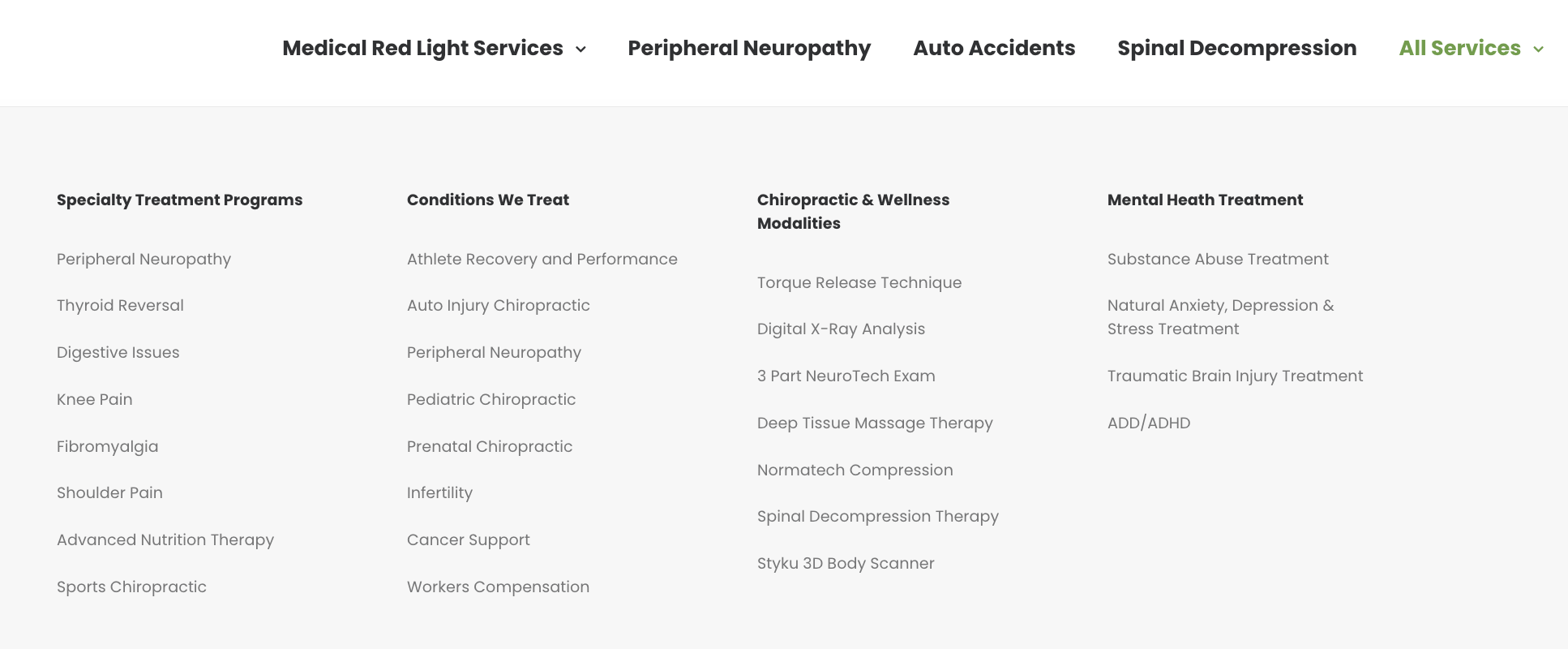
One honesty flag: only build pages for conditions you actually treat. Creating a "prenatal chiropractic" page when you don't offer it is a thin, low-value page that hurts you — and it misleads patients, which no ranking is worth. These focused pages also become the raw material for AI answers, which brings us to the next section.
Getting Your Practice Cited in AI Answers (AEO for Chiropractors)
Search is changing, but the fundamentals aren't dead — and there's no secret "AI Overview hack" to buy, no matter what a vendor claims.
Google has confirmed the mechanics. Per its documentation on AI features in Search, AI Overviews are only shown when its systems determine they're additive to classic Search, and they often don't trigger at all. The same foundational SEO best practices apply. To be eligible as a supporting link, a page must be indexed and eligible to be shown with a snippet. There is no separate AI index and no special markup that grants you access.
So the practical work that earns citations is the work that was already good SEO:
Lead each section with a direct, extractable answer.
Use clear, question-style headings.
Add FAQ, Article, and Organization schema.
Show a named author and a visible update date.
Keep collecting reviews — they feed both local prominence and AI trust signals.
On consumer behavior: patients are increasingly using tools like ChatGPT to find local businesses — BrightLocal's Local Consumer Review Survey 2026 documents the shift, with the share of consumers using AI tools for local discovery jumping sharply year over year. That's a directional trend to prepare for, not a confirmed law of search. The good news is the preparation is identical to the SEO you should already be doing.
The free visibility snapshot takes one reply: send your city and top service, and within 48 hours you'll see exactly where you rank today. Or start with the free first batch — I target 6 keywords for your practice; if at least one isn't in Google's top 3, you owe nothing.
When NOT to Hire an SEO Agency (and When the Map Pack Is Enough)
I'd rather lose a sale than take a client who shouldn't buy. Here's when the honest answer is don't hire me yet.
When DIY is genuinely right. A solo practice on a tight budget can manage its own Google Business Profile: post updates, respond to every review, and keep your name, address, and phone consistent everywhere. That alone moves the needle. Start there and mean it.
When you shouldn't hire anyone yet. If you're booked solid with no capacity, SEO just makes a phone ring you can't answer. And if your website is broken or won't convert — no online scheduling, a clunky booking flow, a slow mobile experience — that's a build-and-fix conversation first. SEO drives traffic; it can't repair a leaky funnel.
When the Map Pack alone may be enough. A single-location practice in a low-competition town can often get most of what it needs from a strong Business Profile and steady reviews, without a full content engine.
Red flags in any vendor you talk to:
Guarantees of #1 rankings (impossible — walk away)
No named humans or author behind the work
No transparent pricing
Directory-spam "packages"
Contracts with no exit
That last point is why the free first batch is risk reversal, not a rankings guarantee — it's the opposite of the "we guarantee page one" pitch. And you're not signing with an anonymous mill: Clementine is a one-person shop by design, and the person you talk to is the person who does the work.
Frequently Asked Questions
How much does SEO for chiropractors cost per month?
Legitimate chiropractic SEO typically costs $500–$5,000/month depending on scope. Clementine publishes flat per-blog pricing instead: $150/blog at 6 blogs a month ($900) or $100/blog at the recommended 12 ($1,200), on a 3-month recommended run. Be wary of sub-$300 packages — they usually buy directory spam and spun content that can trigger Google's low-value demotions.
How long does chiropractic SEO take to show results?
In my campaigns, lower-competition local terms reach page one in 30–60 days, with gains compounding at 60–90+ days. Google's own guidance, via Maile Ohye, is four months to a year for full results. Anyone promising a week is selling you something.
Can I do chiropractic SEO myself, or should I hire an agency?
You can, and for a solo practice on a tight budget, managing your own Google Business Profile is genuinely worthwhile — post updates, reply to reviews, keep your info consistent. Hiring makes sense when you need condition-page content, technical work, and link-building at a scale that competes in a busier market. Both answers are honest depending on your situation.
Is the Google Map Pack or blog content more important for chiropractors?
The Map Pack first — it captures booking-ready searchers who are ready to call today. Content comes second, catching earlier-stage searchers and feeding AI answers while reinforcing your local prominence. Fund the Map Pack foundation before you scale content.
Do chiropractors need a separate page for each condition?
Yes. One page can't rank well for back pain, sciatica, sports injury, and pediatric care simultaneously because Google can't tell what it's about. Build one focused page per condition you actually treat — never for services you don't offer.
Does SEO actually work for chiropractors — what's the real ROI?
It can. In my flagship medical-wellness campaign, 73% of a year's clicks arrived in the first four months, and the first #1 ranking landed in three weeks — faster than typical, and one client's data, not a promise. Results vary by market and competition, which is why I'll screen-share the live Search Console account so you can judge the numbers yourself. To find out where you stand, send your city and top service for a free visibility snapshot.