SEO for Estheticians: The Local Playbook That Books Skin Clients
SEO for estheticians is mostly local SEO. Learn the GBP, keyword, and one-page-per-treatment playbook that ranks skin studios in 30–60 days.
By Evan Rief, Founder & Lead SEO Strategist
Last reviewed: August 2026
This playbook draws on real client campaigns for local skin-and-wellness businesses, plus Google's own documentation and named data studies from SparkToro and BrightLocal. Wherever I reference our flagship campaign results below, we're happy to walk through the live Search Console account on a screen-share. Results vary by market and competition — there are no ranking guarantees here.
SEO for estheticians is the practice of optimizing your Google Business Profile, website, and reviews so your skin studio shows up when nearby clients search for the exact treatments you offer — like "dermaplaning near me" or "chemical peel [your city]." For most solo estheticians in lower-competition markets, the specific treatment-plus-location searches start ranking in about 30–60 days, with compounding gains at 60–90+ days. Realistic budgets run from free (DIY) to roughly $500–$1,500/month for done-for-you help.
Key Takeaways
SEO for estheticians is mostly local SEO: your Google Business Profile and reviews often matter more than your homepage.
Target the treatment-plus-location searches your clients actually type ("hydrafacial [city]," "dermaplaning near me"), not vague terms like "facials."
Give each treatment its own page — a homepage-plus-booking-link site can't rank for individual-service searches.
Timeline: lower-competition local terms typically reach page 1 in 30–60 days, with compounding gains at 60–90+ days.
Cost: free to DIY, or roughly $500–$1,500/month for done-for-you local help within the honest $500–$5,000 market range.
What SEO for Estheticians Actually Is (and What It Isn't)
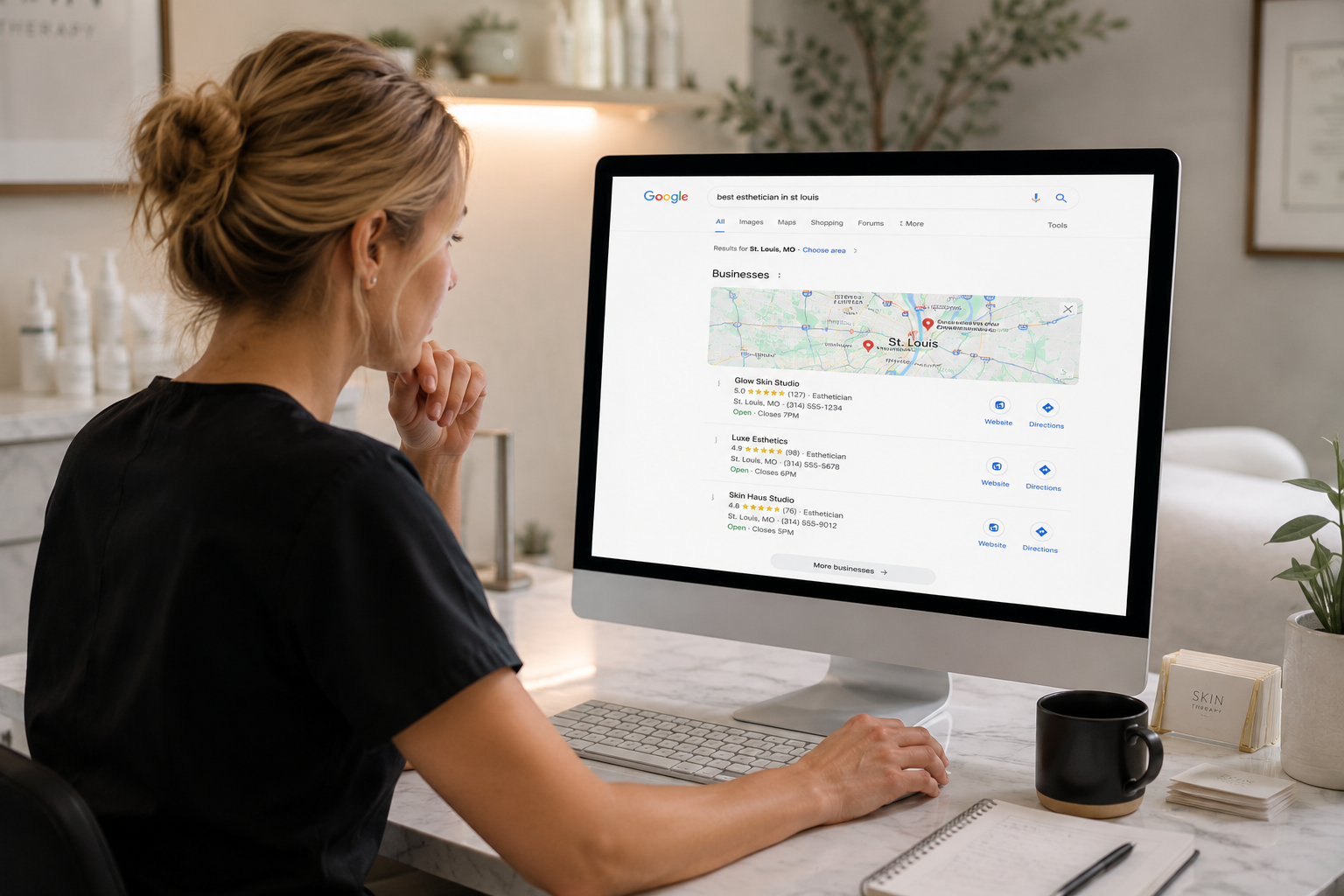
SEO — search engine optimization — for estheticians is mostly local SEO: the work of getting your skin studio to appear in the local pack (the map plus three business listings at the top of Google) and in nearby search results for the treatments you offer.
The searches that matter are long-tail keywords — longer, more specific phrases like "dermaplaning near me" rather than a broad word like "facials." In our client campaigns, the searches that actually book appointments are almost never the broad ones. They're the specific ones where someone has already decided what they want.
Here's what it isn't. It isn't paying for ads — that's a separate line item. It isn't getting to #1 overnight. And it isn't stuffing your website with keywords until it reads like a robot wrote it.
One honest thing up front: SEO can't fix a weak offer, a broken or missing booking flow, or a studio with nothing that sets it apart. If a stranger lands on your page and can't figure out how to book, more traffic just means more people leaving. Get the fundamentals right first — then ranking for them is worth it.
If you want to see how we approach that work end to end, how our content engine works lays out the process.
Instagram & Word-of-Mouth vs. Google: The Bookings You're Missing
Instagram and referrals are real channels, and there's a good chance they built your studio. I'm not here to talk you out of them.
But the two do different jobs. Instagram is top-funnel discovery — it's how someone finds you before they're ready to book, and it's unbeatable for before-and-after proof and keeping past clients engaged. The gap opens the moment a stranger opens Google and types "dermaplaning near me." That's bottom-funnel, ready-to-book intent, and all your Instagram goodwill is invisible in that moment.
That gap matters more every year because of how people now search. According to SparkToro's June 2026 zero-click study, 68.01% of US Google searches ended without a click to the open web in the first four months of 2026, up from 60.45% in 2024. People increasingly get their answer, or make their choice, right inside the search result. Being seen in the result itself is the whole game.
So the honest read isn't "post more on Instagram" or "abandon it." It's both, doing what each does best: Instagram for discovery and retention, Google for capturing the people already reaching for their phone to book.
Your Google Business Profile: The Highest-Leverage Free Lever
Your Google Business Profile (GBP) — the free listing that powers your presence on Google Maps and in the local pack — is the single highest-return thing you can optimize, and it costs nothing.
Google is direct about how it ranks these results. Its Business Profile ranking documentation states that local results are mainly based on relevance, distance, and popularity. Relevance is how well your profile matches the search. Distance is how close you are to the searcher. Prominence (popularity) is how well-known you are. Distance is mostly fixed — but relevance and prominence are yours to control.
The most underused lever is your primary category. Google's guidance on managing your category advises choosing the most specific category available — its own example is picking "Nail salon" over a generic "Salon." For a skin studio, "Skin Care Clinic" or "Skin Care Service" beats a generic "Beauty Salon" when skin treatments are your core offer. Add relevant secondary categories, but don't stuff them.
From there, complete everything: a services list that mirrors your treatment pages, real photos of treatments and results (where compliance allows), accurate hours, and a working booking link. Reviews live here too — more on those shortly.
One honest limit: distance can't be optimized away. A studio across town from the searcher won't always win the local pack, and that's not an SEO failure — it's geography. Setting up and completing your profile is owner-doable, and it's the first thing worth doing.
The Service × Location Keyword Matrix
This is the centerpiece, and it's simpler than it sounds. List every treatment you offer down one axis. List your location modifiers — city, neighborhood, and "near me" — across the top. Every intersection is a keyword you can target. For example:
Facials — facials [city], facials [neighborhood], facials near me.
Dermaplaning — dermaplaning [city], dermaplaning [neighborhood], dermaplaning near me.
Chemical peel — chemical peel [city], chemical peel [neighborhood], chemical peel near me.
Hydrafacial — hydrafacial [city], hydrafacial [neighborhood], hydrafacial near me.
Microneedling — microneedling [city], microneedling [neighborhood], microneedling near me.
Waxing — waxing [city], waxing [neighborhood], waxing near me.
Acne treatment — acne facial [city], acne treatment [neighborhood], acne facial near me.
These long-tail terms have lower search volume than "facials," but the intent is far higher: the searcher has already chosen the treatment and is now choosing a provider. And many of these — facials, acne programs — rebook, so a single new client from one search can be worth far more than one visit.
In our client Search Console accounts, these treatment-plus-location terms convert to bookings at a noticeably higher rate than the broad head terms, even though they show fewer impressions. Fewer eyes, but the right ones.
One honest caveat: you won't rank for all of these at once. Start with your three or four highest-margin treatments and build out from there.
One Page Per Treatment: The Structure That Ranks
A homepage with a booking button can't rank for individual treatment searches. Google needs a dedicated, relevant page to match against "chemical peel [city]" — and that page has to actually be about chemical peels.
Each treatment page should cover what the treatment does, who it's for, what to expect (including duration), an honest price range, before-and-after or results where compliance allows, a clear booking CTA, and internal links to related treatments. Then mirror these pages to your GBP services list — that consistency reinforces relevance on both sides.
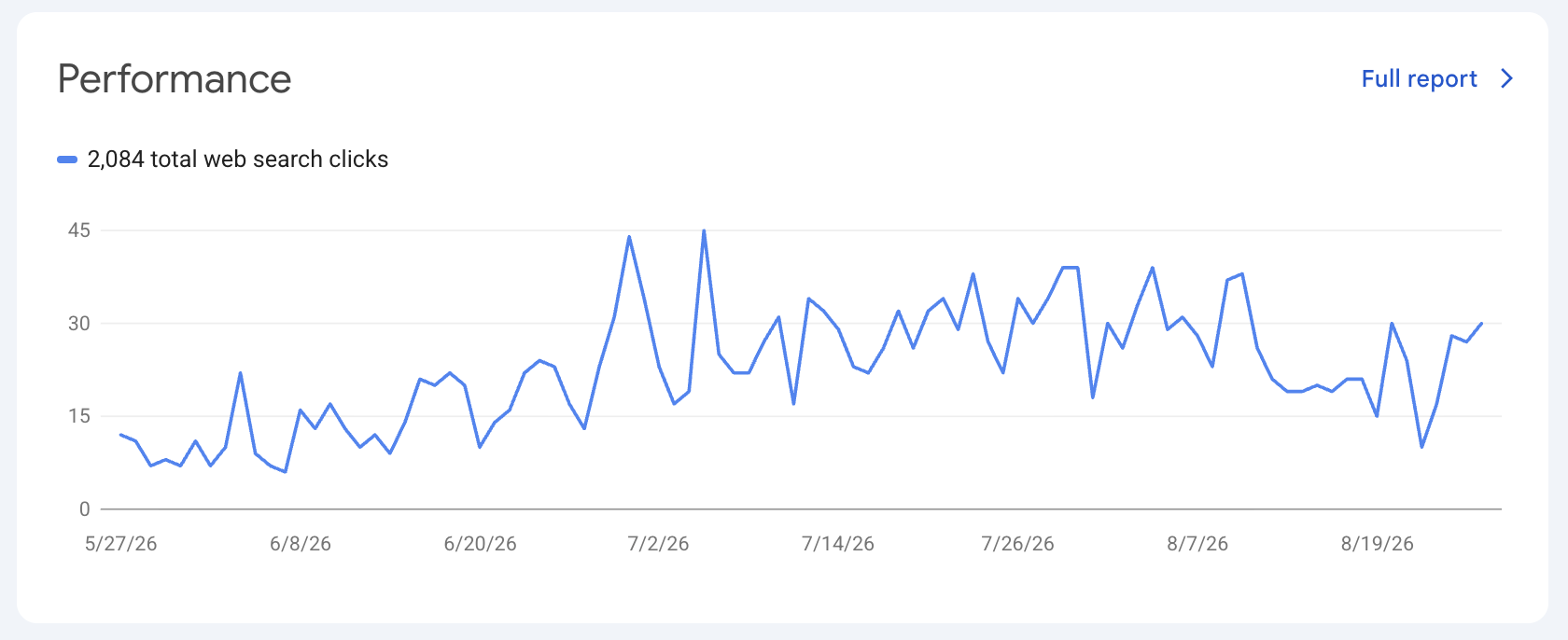
Across our campaigns the pattern is consistent: when a client ships a dedicated page for a specific treatment, that's when the treatment-plus-location term starts moving. In our flagship medical-wellness engagement, 9 of the first 17 tracked keywords reached Google's top 5 within 60 days, and 14 of 17 reached the top 10. One term hit #1 in just 3 weeks — faster than typical, and not a promise you should bank on. We're happy to walk through that live Search Console account on a screen-share.
One honest warning: don't ship near-duplicate pages where you swap the treatment name and change nothing else. Thin, copy-paste pages hurt more than they help. Each one has to say something real. You can read more about how we work and who we are for the fuller story.
Reviews, Relevance, Distance & Prominence: How Google Actually Ranks You
Reviews are the most controllable prominence lever you have. Google's documentation notes that prominent, well-known places are more likely to show up in results — and a steady flow of genuine reviews is how a small studio builds that.
Here's a small tactic that does double duty: ask happy clients to mention the specific treatment ("loved my dermaplaning"). That treatment-specific language quietly reinforces relevance for exactly the searches you're targeting.
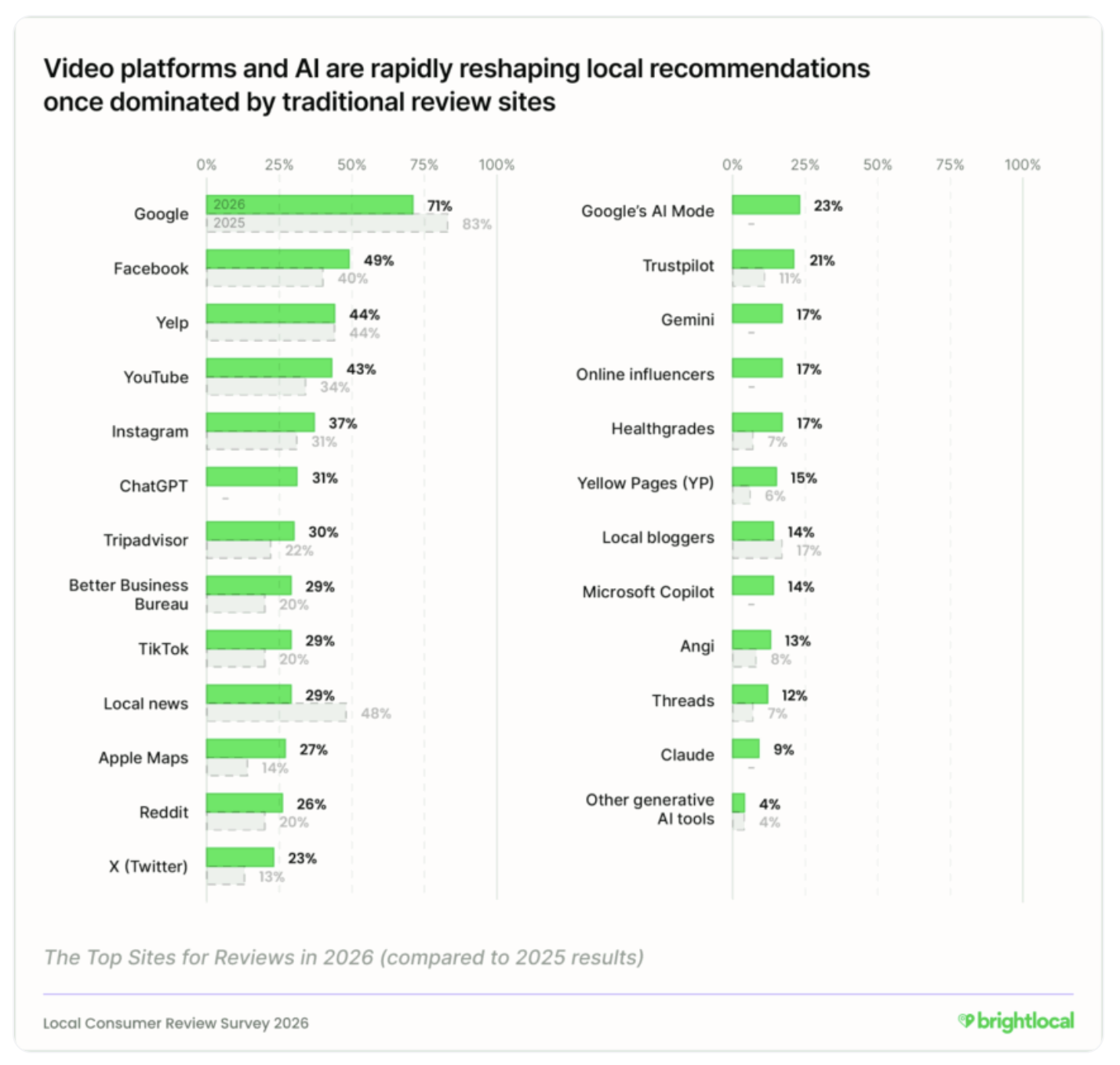
Where those reviews live is shifting, too. In our own client work, we're seeing trust spread across more surfaces than a single Google listing — including video and AI platforms — which lines up with the direction the BrightLocal Local Consumer Review Survey has tracked over recent years. Reviews still matter; they're just no longer the only signal buyers weigh.
Consistency across the web matters as well. Your name, address, and phone should match everywhere they appear — those directory listings, called citations, feed prominence. Whether you handle listings yourself or hand them off, the principle holds: consistent equals credible.
The honest part: you cannot fake or buy reviews, and you shouldn't try. The only durable path is delivering visits worth reviewing and asking, consistently.
The free visibility snapshot takes one reply: send your city and top treatment, and within 48 hours you'll see exactly where you rank today. Or start with the free first batch — we target 6 keywords for your studio; if at least one isn't in Google's top 3, you owe nothing.
What It Costs, How Long It Takes, and When You Should NOT Do This Yet
Let's talk real numbers. Legitimate small-business SEO runs roughly $500–$5,000/month depending on market and scope. Our content engine is $125/blog — $1,500/month at the recommended 12 (keyword research, on-page work, and a monthly rank report included), on a 3-month recommended run and month-to-month after. Starter (6) and Grow (9) tiers are on the live calculator, and multi-location studios get 10% off (2–5 locations) or 20% off (6+). No setup fee, no dashboard fee. Most solo estheticians can DIY the first 80% — GBP, reviews, and a few treatment pages — for free.
A realistic timeline looks like this:
Setup & indexing — weeks 1–3. GBP optimized, treatment pages published and indexed.
Early movement — 30–60 days. Lower-competition treatment-plus-location terms begin reaching page 1.
Compounding — 60–90+ days. Rankings stack across treatments; bookings compound.
Google's own SEO Starter Guide backs the patience this requires — it notes that changes take time to reflect, and that you generally want to wait a few weeks to assess whether your work had a beneficial effect.
Now the part most agencies won't write: sometimes you should not invest in SEO yet. If your studio is brand-new with no reviews and no bandwidth for content, if your booking flow is broken or nonexistent, if you can't commit to a few months of consistency, or if your budget is better spent sharpening the offer itself — DIY your GBP, lean on Instagram and referrals, and revisit SEO once the fundamentals are solid.
And be wary of the real cost of cheap SEO. Sub-$300/month "SEO" usually buys directory spam or AI-scaled thin pages that Google is actively demoting — that's not a bargain, it's a liability. When you're ready to compare, see our transparent pricing.
Ranking in AI Overviews & AI Search in 2026
Search is changing, but I'm not going to tell you SEO is dead — and I'm not going to dismiss AI either. The fundamentals that win AI citations are largely the same ones that win rankings.
Google has confirmed that AI Overviews draw from the same index that powers traditional search results. There's no separate "AI index" or "AI ranking algorithm." Content that performs well in organic search has a higher baseline probability of being cited, so the work above is the work here.
In our own campaigns, the pages that get pulled into AI answers tend to share a few traits: a clean, direct answer near the top, real first-hand experience, cited sources, and clear author credentials. That matches Google's public guidance, which encourages surfacing trusted sources, creator content, and first-hand perspectives so people can search with more confidence.
Practically, for your own site: answer the questions clients actually ask, directly on your treatment pages. Keep your profile and reviews current. And let genuine expertise show — who you are and what you know.
One honest limit: no schema trick guarantees a citation. Structured data helps Google understand your content, which can improve the odds, but it is not a citation trigger. There's no shortcut around being genuinely useful.
Frequently Asked Questions
What is SEO for estheticians?
It's the work of optimizing your Google Business Profile, website, and reviews so nearby clients find you for the treatments you offer. It's mostly local SEO, which means your profile and reviews often matter more than your homepage. The goal is showing up when someone searches a specific treatment plus a location.
How do estheticians rank higher on Google Maps?
Google ranks local results on relevance, distance, and prominence. You control relevance (a complete, specific profile — pick "Skin Care Clinic" over "Beauty Salon") and prominence (steady genuine reviews and consistent listings). Distance is mostly fixed, so focus your energy on the two you can influence.
Do I need a website, or is Instagram enough?
Instagram is excellent for discovery and retention, but it can't rank for "treatment near me" searches. A small website with one page per treatment captures the ready-to-book intent Instagram misses. Most studios do best running both.
What keywords should an esthetician target?
Treatment-plus-location long-tails, such as "dermaplaning [city]" or "hydrafacial near me" — not broad terms like "facials." These have lower volume but far higher intent, because the searcher has already chosen the treatment. Build a matrix of your treatments against your city, neighborhood, and "near me."
Should facials, dermaplaning, and chemical peels each have their own page?
Yes. A homepage plus a booking link can't rank for individual-treatment searches. Each treatment needs a dedicated page covering what it does, who it's for, price range, and how to book. Just don't make near-duplicate pages — each one has to say something real.
How do I find out if SEO is worth it for my studio?
Send your city and top treatment, and within 48 hours you'll get a snapshot of where you currently rank. If you'd rather see results before paying, the free first batch targets 6 keywords for your studio — and if at least one isn't in Google's top 3, you owe nothing. That's the lowest-risk way to find out whether the numbers work for your market.