SEO for Massage Therapists: An Honest Guide to Owning Your Client Pipeline
Honest SEO for massage therapists: what it costs, how long it takes, and when to skip it. Real client numbers, transparent pricing, no ranking guarantees.

SEO for Massage Therapists: An Honest Guide to Owning Your Client Pipeline
By Evan Rief, Founder & Lead SEO Strategist
Last reviewed: July 2026
This guide draws on my real client campaigns for wellness and local-service practices — and if you want to see the numbers behind the case study below, I'm happy to walk through the live Search Console account on a call. The Google and industry data cited here is listed at the end. One honest caveat up front: results vary by your market and competition, and nothing here is a ranking guarantee.
SEO for massage therapists is the work of getting your practice to show up when local people search for the treatment they want — "deep tissue massage near me," "prenatal massage [your neighborhood]" — in Google's Map Pack, in regular results, and increasingly in AI answers. Legitimate small-business SEO typically runs $500–$5,000/month, and for a solo practice most credible work sits at the lower end. Lower-competition local terms usually reach page 1 in 30–60 days, with compounding gains at 60–90+ days.
Key Takeaways
SEO for massage therapists is about owning the treatment+city searches ("deep tissue massage [city]") that bring booking-ready clients — the Map Pack captures roughly 42% of local-search clicks (industry data).
The real decision isn't SEO vs. ads — it's an owned asset versus renting client discovery from a marketplace that charges you per conversion.
Realistic timeline: page 1 for lower-competition local terms in 30–60 days; compounding gains at 60–90+ days. Rankings are never guaranteed.
Transparent pricing: $125/blog at the recommended 12 blogs a month ($1,500/mo), with 6- and 9-blog volume tiers and multi-location discounts — honest market range $500–$5,000/mo.
Google confirms there's no special trick for AI Overviews — the same SEO fundamentals earn AI citations, which is why named-practitioner, first-hand content now wins.
What SEO for massage therapists actually is (and what it isn't)
SEO — search engine optimization — is the ongoing work of earning your practice a spot when someone searches for the bodywork they need. The Map Pack — the block of three businesses that shows at the top of a local Google search, with the little map — is usually the first thing a searcher sees and the first target worth winning.
For massage specifically, the money pattern is modality plus location: "deep tissue massage [city]," "prenatal massage [city]," "sports massage [city]," "lymphatic drainage [city]." Modality specificity is the search-intent qualifier in this vertical. Someone typing "prenatal massage" is far closer to booking than someone typing "massage," and the specific page that matches that intent is the one that converts.
Why start with the Map Pack? Because that's where local searchers click. Backlinko's local SEO research found that 42% of people who conduct a local search click on results inside the Google Maps Pack — the single highest-leverage piece of local real estate you can win.
Here's what SEO isn't. It isn't paid ads, which stop the moment you stop spending. It isn't a marketplace listing you rent month to month. And it isn't an overnight fix — it's a compounding asset that takes weeks to start and months to mature. If you want to understand the mechanics of the ongoing content side, how the content engine works lays out the process I run.
SEO vs. booking marketplaces: who really owns your clients?
Here's the decision almost nobody frames honestly. Booking marketplaces like Mindbody are genuinely powerful discovery channels, and I'm not going to pretend otherwise. Per Mindbody's own published figures, consumers booked more than 60 million classes and appointments a month globally on the platform in 2025, more than 22,000 consumers a month discover and make their first purchase at a business through its app, and the marketplace runs on over 3 million active monthly users.
That's real reach you don't have to build yourself. But look closely at how the discovery works: those clients find you through the platform, and marketplace promotion is performance-based spend — Mindbody's Promoted Intro Offers charge you when a client converts. You keep paying, per conversion, for as long as you use it.

SEO builds the opposite: an asset the practice owns outright, where repeat bookings don't carry an ongoing acquisition cost. A search page you rank for keeps sending clients whether or not you paid this month.
Now, the scare line you'll see on competitor sites — that you "lose that client every single time" with a marketplace — is fear-mongering, and it's wrong. A first-time marketplace client can absolutely become your repeat client if you capture them into your own booking flow and email list. The two channels aren't enemies. The owned side of that equation — the site, the pages, the rankings — is what Clementine builds.
And the honest part: if you're a brand-new practice with zero web presence, a marketplace can fill your calendar faster than SEO will. That's a legitimate reason to start there.
The rebooking-LTV math: why one recovered client can pay for a year of SEO
Massage economics are built on rebooking, so that's where the SEO case actually lives. The math is simple enough to run on a napkin — plug in your own numbers.
Lifetime value = your average ticket × visits per year × years retained. So if your average client books, say, 8 times a year at $100, and stays with you for 3 years, that's an illustrative lifetime value of $2,400 per client. These are illustrative inputs — swap in your real ones. The point isn't the exact figure; it's the shape of it.
Against the $1,500/mo Dominate plan (12 blogs at $125 each), the model gets interesting fast. If your own LTV math lands anywhere near that illustrative range, even a modest handful of new rebooking clients per quarter covers the investment. I'm presenting this as a model to recalibrate with your numbers — never as a promise that SEO will produce them.
Across the client Search Console accounts I manage, one pattern holds: rebooking-intent local terms — the specific modality+city searches — convert at a higher rate than broad ones. That's a first-hand observation, not a guarantee, but it's why I push service-page depth over generic traffic. You can see the transparent pricing to run the retainer side of the math yourself.
One honest flag: SEO can't fix a weak offer or a broken booking flow. If clients don't rebook — because the experience, the pricing, or the online scheduling is the problem — more traffic won't save the practice. Fix retention first.
What actually moves the needle: Google Business Profile + service pages
Two pillars carry most of the results for a massage practice: a fully optimized Google Business Profile, and unique modality+location service pages.
Start with the Google Business Profile — the free listing that feeds the Map Pack. A common question from therapists who work from home or travel to clients: do I have to publish my home address? Google has confirmed you don't. Per Google Business Profile Help, if you don't serve customers at your business address, you can choose not to show your address and list your service area instead — a service-area business visits or delivers to customers without serving them at its listed address. Home-based and mobile therapists can rank without publishing a home address.
The second pillar is service-page architecture: one unique, genuinely written page per modality+city. "Deep tissue massage [city]" gets its own page; "prenatal massage [city]" gets its own page — each with real, distinct content. This is where keyword research and on-page optimization earn their keep, because each page targets a distinct booking intent.
Here's the trap to avoid: the doorway page. Do not write one template and swap the city name across twenty near-identical pages. Google treats that as spam, and it's one of the fastest ways to earn a manual penalty. Each page has to earn its place. As covered above, the Map Pack alone captures roughly 42% of local clicks — profile completeness and unique pages are what make you eligible for it.
The free visibility snapshot takes one reply: send your city and top service, and within 48 hours you'll see exactly where you rank today. Or start with the free first batch — I target 6 keywords for your business; if at least one isn't in Google's top 3, you owe nothing.
What it really costs and how long it really takes
Let me publish the actual numbers, because vague pricing is a red flag you've probably learned to spot.
Dominate (recommended) — $125/blog · $1,500/mo. 12 blogs/mo, keyword research, on-page optimization, monthly rank report. Legitimate small-business SEO typically runs $500–$5,000/mo.
Starter & Grow — Per-blog rates on the live calculator. 6 or 9 blogs/mo, same engine at lower volume.
The recommended run is three months — ranking physics, not a contract trick — and month-to-month after. No setup fee, no dashboard fee — and multi-location businesses get 10% off (2–5 locations) or 20% off (6+).
Here's the honest timeline — not a promise, a pattern.
Weeks 0–4. Foundation: GBP optimization, first service pages published.
30–60 days. Lower-competition local terms typically reach page 1.
60–90+ days. Compounding gains as pages mature and earn trust.
Now the case study, with real numbers from a live account. For one client site: 73% of the trailing-12-month Google clicks (1.32K of 1.81K) were generated in the first 4 months; 87% of trailing-12-month impressions (119K of 137K) came in that same window; peak daily clicks reached roughly 10× the pre-engagement baseline (44/day vs. ~4/day); the first #1 ranking landed in 3 weeks — faster than typical, and not something to expect as the norm; and of the first 17 tracked keywords, 9 reached the top 5 within 60 days and 14 reached the top 10. These figures come straight from the client's Google Search Console, and I'm happy to walk through the live account on a call.
And the honesty flag on cheap SEO: when you see "$99/mo SEO," the money goes to directory spam, AI-scaled filler articles, and no real reporting. The true cost isn't the $99 — it's the wasted months and the erosion of Google's trust in your site, which takes longer to repair than it took to damage.
SEO in the AI-Overview era: getting cited, not just ranked
Search is changing, and I'm not going to tell you "SEO is dead" — that's clickbait. What's true is that AI answers are now part of the local search experience, and the fundamentals that win a citation in them are the same ones that always won rankings.
Google has confirmed this directly. Its AI features documentation states that established SEO best practices remain what's relevant for AI features in Search — there are no additional requirements to appear in AI Overviews or AI Mode, and eligibility simply requires a page to be indexed and eligible to show with a snippet.
For context, Search Engine Land reports (background, second-tier) that AI Overviews now appear in a large share of local business-type queries — so this isn't a fringe concern for local practices.
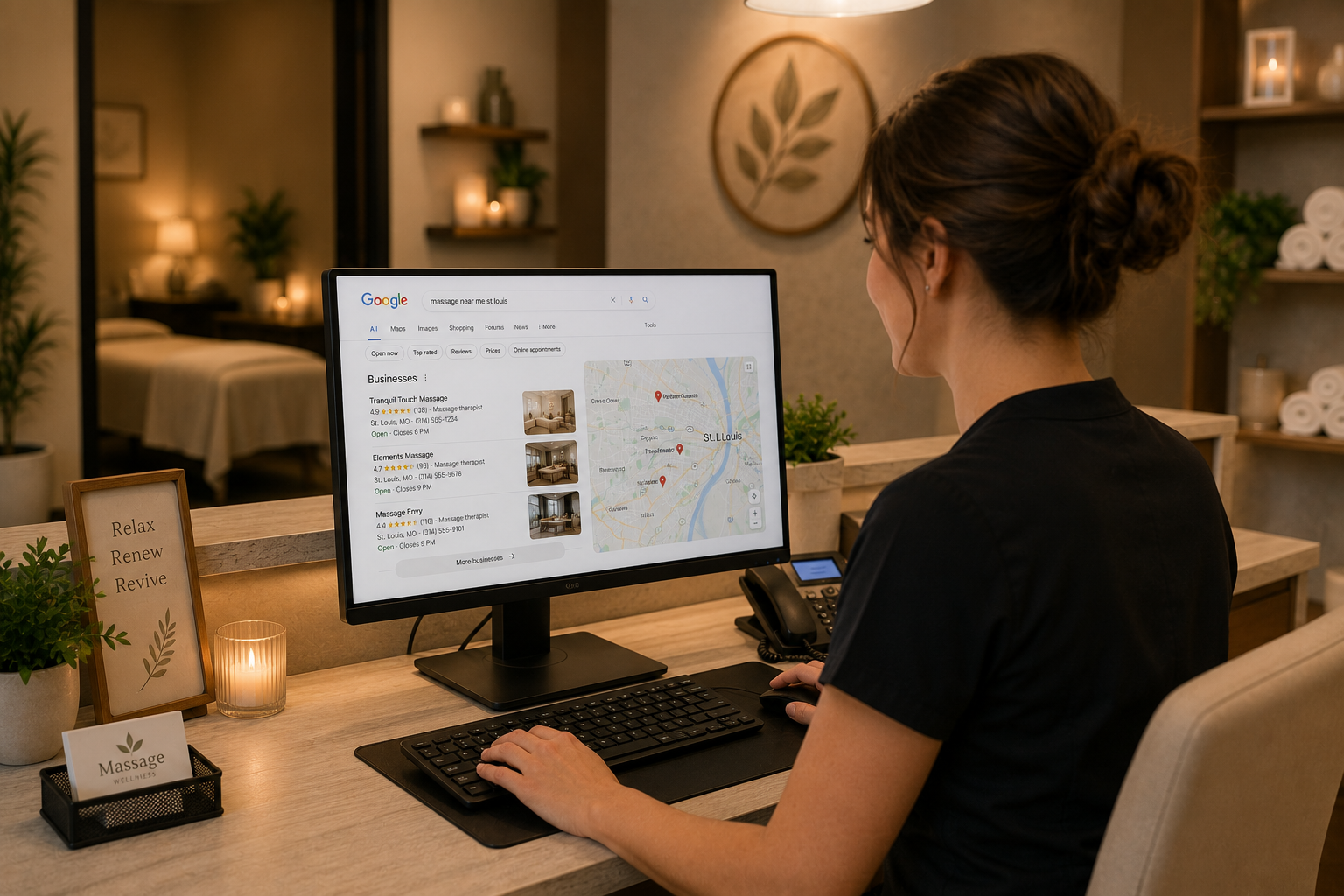
But keep it in proportion. BrightLocal's consumer search behavior research found that 40% of consumers actively use generative AI when searching online, while just 3% considered an AI platform their default for local searches — industry data suggesting AI is growing fast but Google still dominates local discovery.
The practical takeaways for a solo therapist: a clean direct-answer paragraph on each service page, accurate GBP details, real reviews, and original photos of your actual space. And this is the part that matters most in 2026 — anonymous, AI-scaled content is now a liability, not a shortcut. Content with a real, accountable practitioner behind it wins AI Overview citations for the same reason it wins rankings: E-E-A-T. That's not a marketing line; it's why every post here ships under my name. You can read about the founder to see what that looks like.
When NOT to invest in SEO for massage therapists (and when DIY wins)
I'd rather tell you not to hire me than watch you waste money, so here's the honest map for SEO for massage therapists.
When to skip or delay agency SEO: You're already fully booked — then SEO is solving a problem you don't have yet. You need clients this week — SEO compounds over months and is a terrible emergency lever. Your budget can't sustain 90+ days — starting and stopping wastes the momentum you paid for. Or your offer or booking flow is broken — fix that first, because traffic to a leaky funnel just costs more.
When DIY is genuinely right: A motivated solo therapist can absolutely claim and optimize a Google Business Profile, ask happy clients for reviews, and write a few honest service pages without hiring anyone. There's no shame in that — for a lot of practices it's the correct starting point.
When a marketplace is the smarter first move: Brand-new practice, no website, needs discovery volume now. A marketplace fills the calendar while your owned assets are still being built.
And a plain reminder of what SEO can't fix: a weak offer, poor reviews that stem from real service problems, or a checkout and booking flow that leaks bookings. No amount of ranking repairs those — they're your work, not mine.
Frequently Asked Questions
Do I need SEO if I already get referrals and repeat clients?
Maybe not yet. If you're fully booked and happy, SEO is solving a problem you don't have. It becomes worthwhile when you have availability to fill, or when you want to reduce your dependence on any single channel — referrals dry up, and marketplaces raise fees.
How much does SEO cost for a solo massage therapist?
Legitimate small-business SEO runs across a market range of $500–$5,000/month, and most credible solo work sits at the lower end. Clementine prices per published blog — $125/blog at the recommended 12 a month ($1,500/mo), with 6- and 9-blog tiers on the live calculator. Be cautious of anything priced at $99/month — that's usually directory spam, not real work.
How long does massage therapy SEO take to work?
Lower-competition local terms typically reach page 1 in 30–60 days, with compounding gains at 60–90+ days. In one client account, the first #1 ranking landed in 3 weeks, but that's the best case, not what you should expect. Anyone promising fast guaranteed rankings is selling you something.
Should I do SEO myself, hire an agency, or use a booking marketplace?
DIY works for the basics — claiming your Google Business Profile, gathering reviews, writing a few honest service pages. A marketplace is the fastest path to discovery when you're brand new with no site. An agency makes sense when you want an owned, compounding client pipeline and don't have time to run it yourself.
Do I need a physical clinic address to show up on Google Maps?
No. Google confirms that if you don't serve customers at your business address, you can choose not to show it and list your service area instead. A service-area business visits or delivers to customers but doesn't serve them at its business address — so home-based and mobile therapists can rank without publishing a home address.
How do I find out if SEO is worth it for my business?
The simplest way is a free visibility snapshot: reply with your city and top service (for example, "prenatal massage, [your city]") and within 48 hours you'll get a report of where you currently rank. If you'd rather see proof before paying anything, the free first batch targets 6 keywords for your practice — and if at least one isn't in Google's top 3, you owe nothing.