SEO for Med Spas: Will It Actually Fill Your Empty Appointment Slots?
SEO for med spas: real cost ($500–$5,000/mo), realistic timeline (30–60 days), HIPAA rules, and a verifiable multi-location Search Console case study.
By Evan Rief, Founder & Lead SEO Strategist
Last reviewed: July 2026
This guide draws on my real client campaigns — including a live multi-location medical-wellness engagement whose Google Search Console account I'm happy to walk through with you on a call. It also leans on named Google, HHS, and BrightLocal sources. Results vary by market and competition, and nobody can honestly guarantee rankings — anyone who does is selling you something.
If you own a med spa, you've probably heard SEO pitched as a slot-filling machine and an expensive black hole in the same week. This guide on SEO for med spas covers what it actually costs, how fast it realistically works, the HIPAA rules most agencies gloss over, and how to tell whether it's even the right first move for your practice right now.
Key Takeaways
SEO fills med spa slots on a compounding curve, not overnight: lower-competition local and treatment terms typically hit page one in 30–60 days, with compounding gains at 60–90+ days.
The honest market range is $500–$5,000/mo. Clementine publishes flat per-blog pricing instead: $150/blog at 6 blogs a month ($900) or $100/blog at the recommended 12 ($1,200), on a 3-month recommended run.
In one live multi-location campaign, 73% of the site's trailing-12-month clicks came in the first 4 months — and I'll screen-share the live Search Console account on a call.
Med spa SEO is a HIPAA/YMYL discipline: tracking pixels can leak protected health information, marketing vendors that touch it need a signed BAA, and before/after photos require patient consent.
The win is treatment pages plus Google Business Profile plus reviews — and SEO won't fix a weak offer or a broken booking flow.
Can SEO Actually Fill Your Med Spa's Empty Appointment Slots?
Yes — SEO can fill med spa appointment slots, but not next month. In my campaigns, lower-competition local and treatment-page terms typically reach page one in 30–60 days, with compounding gains at 60–90+ days; competitive terms and map-pack wins take longer. Realistic all-in cost runs $500–$5,000/mo across the market depending on locations and competition. It works when your offer, booking flow, and reviews are already solid — and it's the wrong first move if your books are empty right now.

The mechanism is simple to picture. Three things drive consultation bookings: the local "map pack" (the three business listings that sit above the regular organic results), your treatment pages, and your Google Business Profile. When someone in your city searches "Botox near me" or "laser hair removal cost," those three surfaces put you in front of them.
Here's the honest framing your gut already suspects: SEO is a compounding asset, not a light switch. Google's own SEO Starter Guide notes that "some changes might take effect in a few hours, others could take several months," and it recommends giving changes weeks before judging their effect. The 30–60 and 60–90+ day ranges are what I see first-hand across campaigns, not a promise.
And SEO has hard limits. It brings the qualified click. It does not fix a weak offer, a slow or broken online booking flow, or a thin, stale review profile. If your consultation page loads in eight seconds or your last review is from 2023, more traffic just means more people bouncing. Get those right first.
What Med Spa SEO Really Costs in 2026 (and the Cost-Per-New-Patient Math)
Let's talk money without the "contact us for a quote" runaround. Legitimate small-business SEO runs $500–$5,000/mo, and where you land inside that range depends mostly on how many locations you're marketing and how competitive your market is.
Clementine skips the quote wall entirely — pricing is flat, per published blog:
Dominate (recommended) — $125/blog · $1,500/mo. 12 blogs/mo, keyword research, on-page optimization, monthly rank report. Legitimate small-business SEO typically runs $500–$5,000/mo.
Starter & Grow — Per-blog rates on the live calculator. 6 or 9 blogs/mo, same engine at lower volume.
The recommended run is three months — that's ranking physics, not a contract trick — and month-to-month after. No setup fee, no dashboard fee. You can see Clementine's published pricing in full, and what a month actually includes if you want the deliverable-by-deliverable breakdown.
Now the math that actually matters to you — cost per new patient. As an illustrative example only: say your content engine runs $1,200/mo and, once it matures, brings in 10 new consultations a month that book. That's $120 in SEO cost per booked consult. For an aesthetics buyer with high average ticket and strong rebooking value over the year, that number tends to look very different from paid ads once the asset compounds. This is an example to show the shape of the math, not a projection for your practice.
A word on the bottom of the range. Sub-$500/mo "SEO" usually buys directory spam, thin AI-scaled pages, and keyword-density tricks. In a health vertical Google holds to a higher trust standard, that's not a bargain — it's a demotion risk, and when tracking is involved, a compliance risk. Transparent pricing beats a quote wall precisely because you've already been burned by the vague version.
A Real Multi-Location Case Study From the Medical-Wellness World (The Proof Most Pages Don't Have)
Most med spa SEO pages throw round, anonymous numbers at you — "276% more leads!" — with no client and no screenshot. Here's a real one, and you can see the live account yourself.
Full disclosure first: this client isn't a med spa. It's the adjacent aisle — a multi-location medical-wellness franchise, held to the same YMYL trust bar, selling to the same local, research-heavy buyer. Same playbook. The engagement began in March 2026. In this campaign, 73% of the site's trailing-12-month Google clicks came in the first 4 months (1.32K of 1.81K), and 87% of trailing-12-month impressions landed in that same window (119K of 137K). Peak daily clicks hit roughly 10× the pre-engagement baseline — about 44 per day versus around 4 before the start.
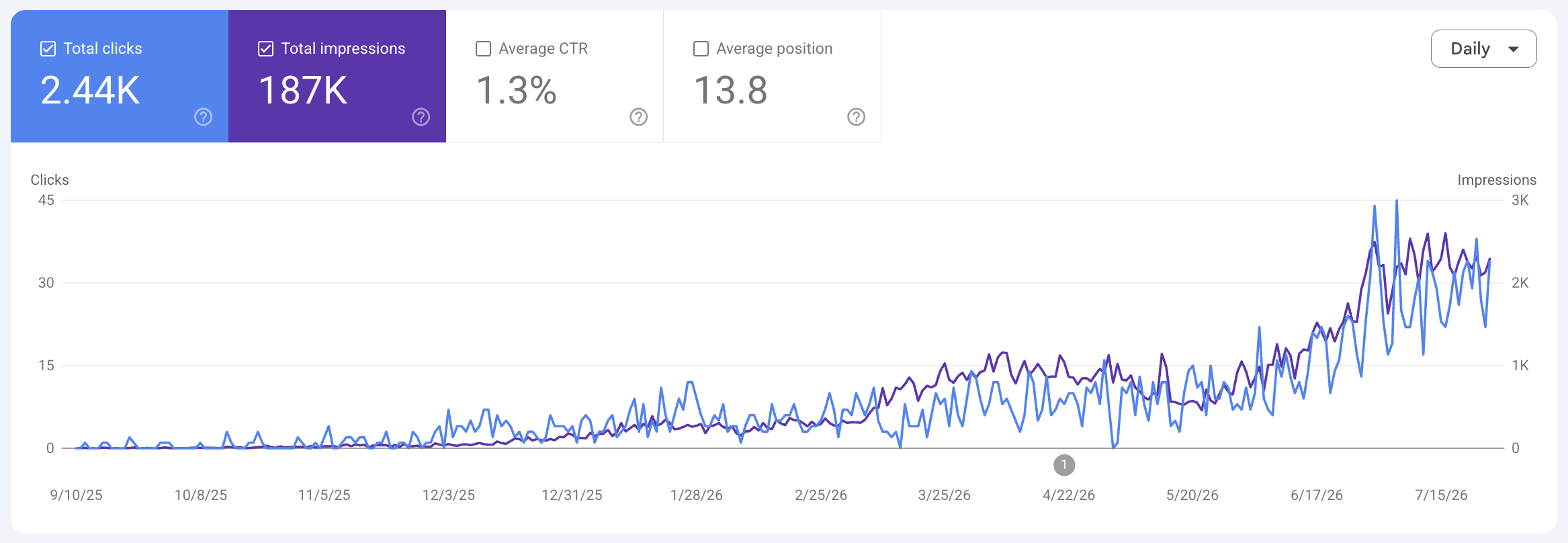
On rankings: 9 of the first 17 tracked keywords reached Google's top 5 within 60 days, and 14 of 17 reached the top 10. The first #1 ranking landed in 3 weeks — and I want to be clear that this was faster than typical. It's the best case, not the promise; expect the 30–60 and 60–90+ day timelines as your realistic frame.
I'd rather show you than tell you. I'm happy to walk through the live Google Search Console account on a call so you can watch the curve build week by week — no polished PDF, the actual dashboard. And for what it's worth, Clementine is a one-person shop by design: the person on that call is the person who does the work.
Why Med Spa SEO Is Different: HIPAA, YMYL, and Google's Strictest Trust Bar
Med spas sell regulated medical treatments. Botox is a prescription drug; lasers and energy devices are FDA-regulated. That means your marketing sits under several rule sets at once, and Google treats your content accordingly.
Your pages fall under what Google calls YMYL — "Your Money or Your Life" content that can affect someone's health, safety, or finances. Google holds YMYL pages to a higher trust standard, which is why a named author, real photos, clear medical answers, and genuine expertise matter more here than on a page selling t-shirts. Anonymous, AI-scaled fluff gets demoted fastest in verticals like yours — which is exactly why every campaign I run is built trust-first.
Reviews carry outsized weight for a high-consideration aesthetic purchase. Nobody books injectables from a business with three stars and two reviews. Google's own Business Profile documentation confirms that review count and rating quality feed directly into local ranking prominence.
Consumer behavior backs this up. BrightLocal's Local Consumer Review Survey 2026 — a representative panel of 1,002 US adults — found that nearly all consumers read reviews before choosing a local business, and roughly a third will now only use one rated 4.5 stars or higher. The same survey tracked AI assistants surging as a local discovery channel, which means your review corpus is increasingly being read back to buyers by machines, too. For a med spa, your review profile isn't a nice-to-have; it's part of the ranking engine.
The Treatment-Page Playbook (Botox, Fillers, Laser — One Money Page Each)
The play that wins in this vertical is one dedicated page per treatment, per market — built around the questions that actually turn a researcher into a booked consultation. That means cost, candidacy, downtime, and how many sessions it takes.
Think about how your ideal patient searches: "Botox forehead cost," "how many laser hair removal sessions needed," "lip filler downtime," "is CoolSculpting worth it." Each is a distinct intent that deserves its own thorough page — not a paragraph buried on a generic "Services" page. When you answer the real question fully, you earn the click and the AI Overview citation.
Structurally, this works as a hub and spoke. Each treatment page links up to a pillar page, and the pillar links back down to every treatment. That internal structure tells Google how your topics relate and concentrates authority where you want rankings.
One honest warning: thin, near-duplicate treatment pages — where you swap "Botox" for "Dysport" and keep the same boilerplate — are doorway pages, and Google won't reward them. Each page has to earn its place with real, differentiated answers about that treatment. Ten stamped-out pages will do less than three genuinely useful ones.
The free visibility snapshot takes one reply: send your city and top service, and within 48 hours you'll see exactly where you rank today. Or start with the free first batch — I target 6 keywords for your practice; if at least one isn't in Google's top 3, you owe nothing.
HIPAA-Safe Marketing: Before/After Photos, Tracking Pixels, BAAs, and State GFE Rules
Most pages name-drop "HIPAA compliant" and move on. Here's the actual mechanism, because it's where med spa marketing quietly gets practices in trouble.
The biggest risk is tracking pixels. A Meta or Google tracking pixel sitting on a treatment or booking page can transmit protected health information (PHI) — details tying a person to a health service — to a third-party vendor. HHS OCR's guidance on online tracking technologies is built around exactly this mechanism: a vendor whose tools process PHI needs either a signed BAA — a Business Associate Agreement, the contract binding a vendor to handle PHI under HIPAA's rules — or valid patient authorization. One honest wrinkle your attorney will know: portions of that guidance have since been narrowed in federal-court litigation, which is one more reason pixel decisions in a medical vertical belong in a conversation with counsel, not on a marketing checklist.
Either way, the practical question to ask any marketing or SEO vendor is direct: will your tools touch PHI, and will you sign a BAA? If they can't answer that, that's your answer.
Before/after photos and testimonials are regulated assets, not free marketing material. They require proper patient consent and authorization before they go anywhere near your site or social feeds. And the rules stack differently by state: California has physician-ownership requirements, Texas has specific injectable rules, and many states mandate a Good Faith Exam (GFE) — a required medical evaluation before treatment — with its own disclosure expectations.
This is general information, not legal advice. HIPAA specifics and state-board rules vary, and you should confirm your setup with a healthcare attorney. But a marketing partner who can't explain the pixel-and-BAA mechanism above hasn't done this in a medical vertical before.
SEO vs. Google Ads: When to Do Which (Sequencing Beats Either Alone)
Owners burned by rising ad costs often frame this as either/or. It isn't. The smart move is sequencing.
If your appointment slots need filling this month, run Google Ads now — that's the channel that delivers bookings on a same-week timeline. Meanwhile, build SEO underneath it. As your organic rankings mature across the 30–60 day early wins and the 60–90+ day compounding gains, your blended cost to acquire a new patient drops, because a growing share of your bookings come from organic traffic you don't pay per click for.
That's the core distinction: Ads are a faucet you rent, SEO is an asset you own. This is my first-hand recommendation, and the timeline figures behind it are what I see consistently in campaigns. SEO won't mature fast enough to be your emergency fix — but starting it late just means paying full ad price longer.
One caveat that applies to both channels equally: neither Ads nor SEO fixes a weak offer or a broken booking flow. If people click and don't book, more clicks won't save you. Fix the conversion path first, then turn on demand.
When You Should NOT Hire an SEO Agency
I'd rather tell you the truth than sell you the wrong thing. There are clear situations where hiring an SEO partner — including me — is the wrong call.
You need bookings this month. SEO won't get there in time. Run Ads first and build SEO in parallel.
You have less than three months of runway, or can't commit to the 3-month recommended run. SEO simply won't mature fast enough to earn its keep in that window.
Your offer, reviews, or booking flow are broken. Fix those before you pay anyone to send more traffic into a leaky bucket.
You're a single-location startup with time and appetite to DIY. Claiming and optimizing your Google Business Profile and writing a few solid treatment pages yourself is a perfectly reasonable starting point — no shame in it.
On a call, part of my job is telling you which of these situations you're actually in — even when the honest answer is "not yet." That's the version of this I wish someone had given me.
Frequently Asked Questions
How long does med spa SEO take to see results?
In my campaigns, lower-competition local and treatment-page terms typically reach page one in 30–60 days, with compounding gains at 60–90+ days; competitive terms and map-pack wins take longer. Google's own documentation confirms ranking changes can take anywhere from hours to months. These are realistic ranges, not guarantees.
How much does med spa SEO cost per month?
The honest market range is $500–$5,000/mo depending on locations and competition. Clementine publishes flat per-blog pricing instead: $150/blog at 6 blogs a month ($900) or $100/blog at the recommended 12 ($1,200), on a 3-month recommended run. Sub-$500 "SEO" usually buys thin, spammy work that risks a demotion in a health vertical.
Does SEO actually work for med spas, or is it a waste of money?
It works when your offer, reviews, and booking flow are solid — in one live multi-location campaign, 73% of the site's trailing-12-month clicks arrived in the first four months. It's a waste of money if you expect overnight results or your booking path is broken. It's also the wrong first move if your books are empty right now.
Should I do SEO or Google Ads first if my books are empty now?
Run Google Ads now for immediate slots, and build SEO underneath to lower your acquisition cost over time. SEO compounds but won't fill next month's calendar. Neither channel fixes a weak offer or a broken booking flow, so address those first.
Is med spa marketing subject to HIPAA — and does my SEO agency need a BAA?
Yes. Federal guidance treats tracking tools that process PHI — pixels are the common culprit — as requiring either a signed Business Associate Agreement or patient authorization, and parts of that guidance are still being shaped in court. Ask any prospective agency directly whether their tools touch PHI and whether they'll sign a BAA.
How do I find out if SEO is worth it for my med spa?
Start with the free visibility snapshot: send your city and top service, and within 48 hours you'll see exactly where you rank today. You can also start with the free first batch — I target 6 keywords for your practice, and if at least one isn't in Google's top 3, you owe nothing.