How SEO Works for a Brand-New Dental Practice: The Honest From-Zero Playbook
A brand-new dental practice starts SEO from zero. Here's the honest timeline, real costs, and the cold-start sequence that builds rankings that actually last.
By Evan Rief, Founder & Lead SEO Strategist
Last reviewed: August 2026
This post draws on real client SEO campaigns, including brand-new practice launches — we're happy to walk through the live Google Search Console account on a call so you can see the numbers yourself. It also cites Google's own documentation and BrightLocal's 2026 consumer research. Results vary by market, by how established your local competitors already are, and by how consistently the work gets done; nothing here is a guarantee of rankings or traffic.
SEO for new dental practices starts on the hardest setting Google offers. For a brand-new practice on a brand-new domain, expect early movement on lower-competition, local long-tail terms in roughly 30–60 days, with meaningful, compounding results building over 3–12+ months as your domain earns trust, your Google Business Profile matures, and reviews accumulate. That's slower than most agency pages admit — the widely quoted "3–6 months" figure describes an established practice, not one starting from zero. A new domain has no history, no links, and no reviews, so Google needs more time to trust it. The fastest lever a new practice controls isn't the website — it's the Google Business Profile (your listing on Google Maps and Search) and a review engine started in week one.
Key Takeaways
New domain = hardest mode. No history, no links, no reviews. Plan for 30–60 days to early local movement on lower-competition terms, and 3–12+ months to compounding results.
Your Google Business Profile and reviews move the needle fastest at zero. Google confirms local results are based on relevance, distance, and prominence — and prominence factors in how many websites link to you and how many reviews you have.
Reviews are now make-or-break. BrightLocal's 2026 survey found 97% of consumers read reviews before choosing a local business, the share who will only use a business rated 4.5 stars or higher nearly doubled from 17% to 31%, and 47% won't even consider a business with fewer than 20 reviews.
Don't chase the head cosmetic term on day one. Long-tail and "accepting new patients" searches build momentum first.
Cheap, spun content is a liability in a YMYL vertical — not a shortcut. And some early work (the GBP basics, review asks) you should DIY before paying anyone. Legitimate ongoing SEO runs $500–$5,000/mo.
Why a New Dental Practice Starts SEO on Hard Mode
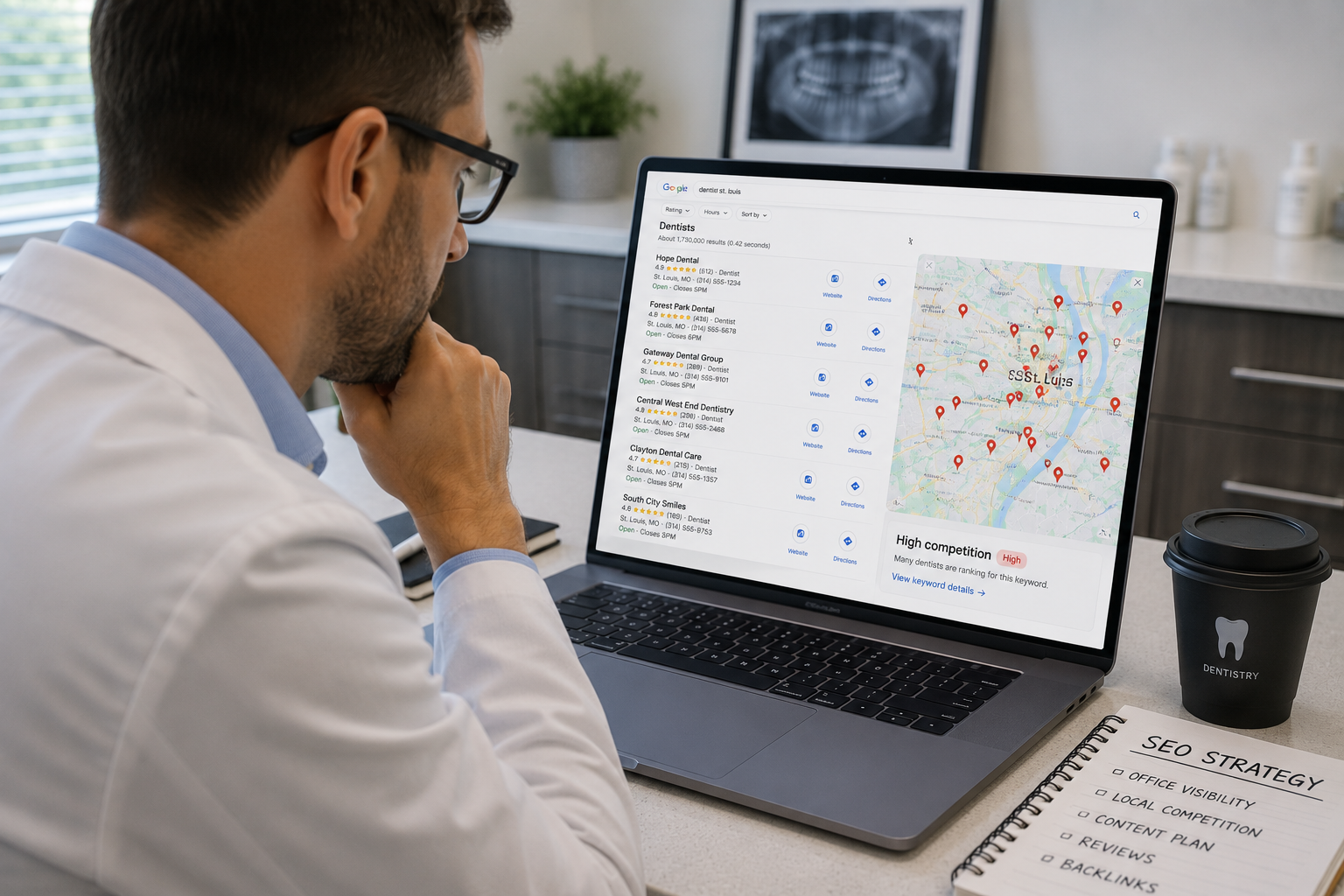
When you open a practice on a brand-new domain, you start from zero on every signal Google uses to rank you: no site history, no backlinks (other websites linking to yours), no reviews, and no local prominence. Your entrenched competitor down the road may have a ten-year-old domain and three hundred reviews. Google evaluates you from scratch.
That prominence gap matters more than most new owners expect. According to Google's local ranking documentation, prominence is based partly on information like how many websites link to your business and how many reviews you have, and more reviews and positive ratings can help your local ranking. A rival with hundreds of reviews isn't just more visible to patients; that review volume is an actual ranking input you don't have yet.
None of this means you can't win. It means the game is compounding, not a switch you flip. Google has also indicated that rankings fluctuate more in a site's first year as its systems figure out where you belong — so early bounce is normal, not a sign the work is failing.
In our new-practice launches, the single biggest early drag isn't the website — it's the review gap. You can have a technically flawless site and still sit below a rival whose only real advantage is that they've been collecting reviews for a decade. That's the honest starting position, and our monthly content engine is built to close the content side of it while your reviews catch up.
The Real Timeline: 30–60 Days to Early Movement, 3–12+ Months to Compounding Results
Here's the timeline nobody selling you a package wants to say plainly. On lower-competition local terms, a new practice typically reaches page 1 in 30–60 days, with compounding gains building at 60–90+ days and beyond. Meaningful, durable results — the kind that fill a schedule — build over 3–12+ months as your domain earns trust and reviews accumulate.
A new domain lags because trust takes time. Google needs a history to evaluate, and early rankings often bounce before they stabilize. The "3–6 months" figure you'll see quoted everywhere describes an established practice with existing authority — not one starting cold. Anyone promising you fast #1s from zero is either quoting keywords nobody searches or using tactics that will damage your site later.
For context on what's possible under good conditions: in our flagship multi-location medical wellness campaign, we hit a first #1 ranking in 3 weeks. (The engagement began in March 2026, and we'll screen-share the live Search Console account on a call.) That's faster than typical — a genuine best case, not what we promise. It was also a medical wellness franchise, not a new dental practice. In that same window, 9 of the first 17 tracked keywords reached Google's top 5 within 60 days, and 14 of 17 reached the top 10. Peak daily clicks hit roughly 10× the pre-engagement baseline (about 44 a day versus around 4). And 73% of the site's trailing-12-month Google clicks (1.32K of 1.81K) and 87% of trailing-12-month impressions (119K of 137K) were generated in the first four months.
A realistic phase-by-phase shape:
Weeks 0–4 — technical foundation, GBP claim/verify, review engine started, first content published. Indexing and first impressions; your GBP begins appearing for low-competition terms.
Days 30–60 — long-tail and "accepting new patients" terms optimized. Early page-1 movement on lower-competition local terms.
Months 2–3 — content depth plus reviews accumulating. Keyword rankings start to hold; map-pack visibility strengthens.
Months 3–6 — authority, links, and review recency compounding. Compounding gains; more consistent lead flow.
Months 6–12+ — sustained publishing and review velocity. Competitive terms become reachable; domain trust matures.
We publish our transparent pricing and terms for the same reason we publish this timeline: a from-zero owner deserves the real numbers before signing anything.
What SEO for a New Dental Practice Actually Costs
Legitimate small-business SEO typically runs $500–$5,000/mo — a wide band because scope varies enormously. Below that range, you're usually buying spun content and directory blasts; above it, you're often paying for enterprise overhead you don't need. Anything advertised at $100–$400/mo in a health vertical deserves real skepticism.
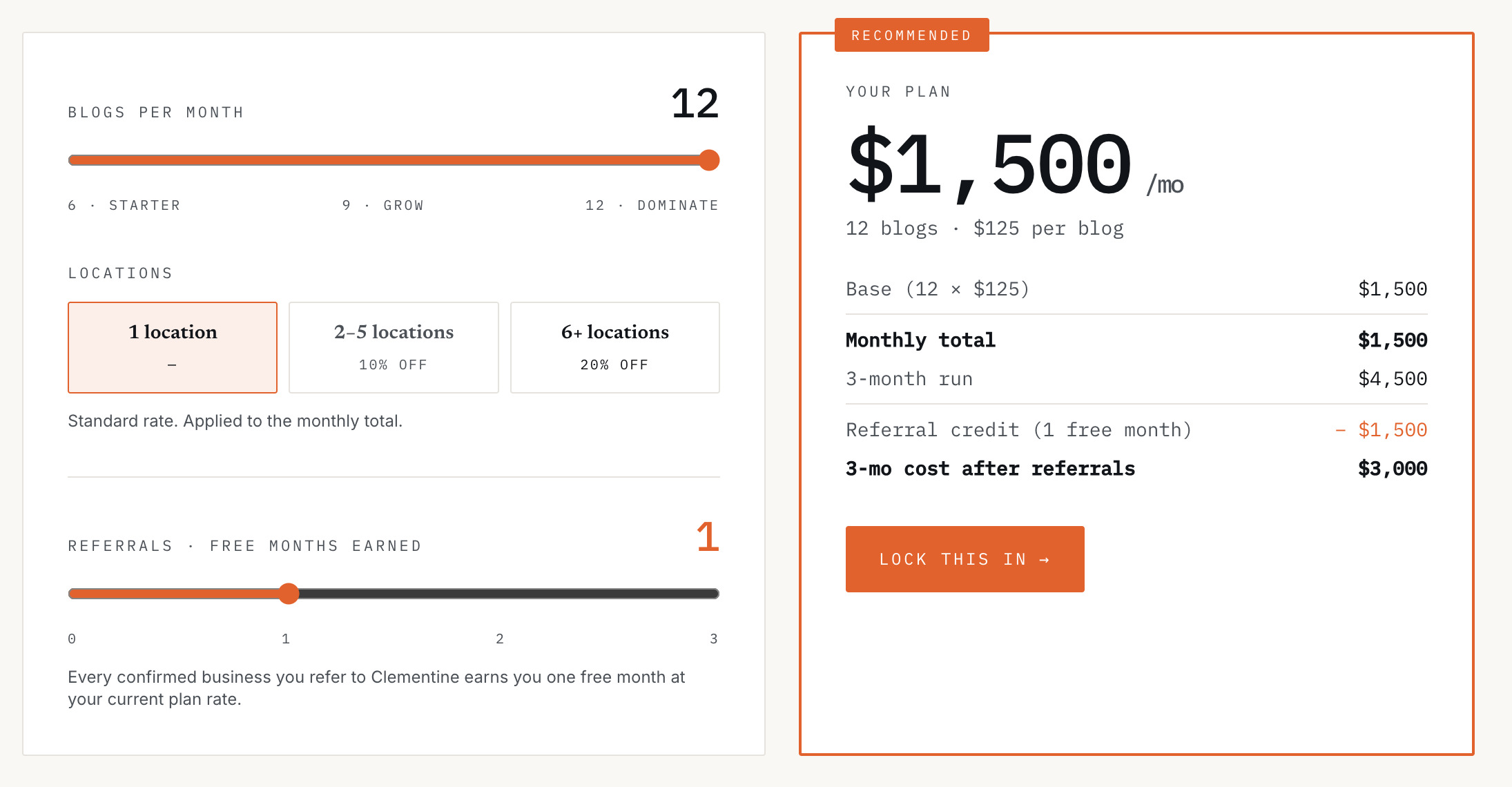
Here's what we charge, with scope, so you can compare like for like. Our content engine is $125/blog — $1,500/mo at the recommended 12: 12 articles, keyword research, on-page optimization, and a monthly rank report, on a 3-month recommended run and month-to-month after. Starter (6) and Grow (9) tiers are on the live calculator, and multi-location practices get 10% off (2–5 locations) or 20% off (6+). No setup fee, no dashboard fee.
For a brand-new practice, budget for the compounding runway — not a 30-day miracle. The mistake I see most often is a cash-strapped owner buying the cheapest package to "just get started," then quietly getting hurt by thin, duplicated content that recent core updates demote. Google's helpful content guidance is explicit that content created primarily to rank, rather than to help people, is exactly what its systems aim to demote.
DIY (time only) — GBP claim/verify, accurate info, asking every patient for reviews. Essential; do this regardless of who you hire — it's the fastest zero-cost lever.
Cheap ($100–$400/mo) — spun content, directory blasts. High risk in a YMYL vertical; thin content can be demoted.
Legitimate range ($500–$5,000/mo) — real content, on-page, local presence, reporting. Where sustainable new-practice growth actually lives.
Clementine content engine ($125/blog · $1,500/mo at 12) — 12 articles, keyword research, on-page, rank report. 3-month recommended run, month-to-month after; built for the runway.
If you're not ready to commit, you can start with the monthly engine whenever the timing's right — and DIY the GBP and review basics in the meantime.
The Month 0–12 Cold-Start Sequence (Do This in This Order)
Order matters more than effort here. Doing the right things in the wrong sequence wastes launch cash. Here's the sequence we run.
1. Technical foundation first. A fast, mobile-friendly site with correct dental schema — the structured code that tells Google exactly what you offer and where (LocalBusiness/Dentist and FAQPage markup). Get this right before you publish much, because it's what makes everything else legible to search engines.
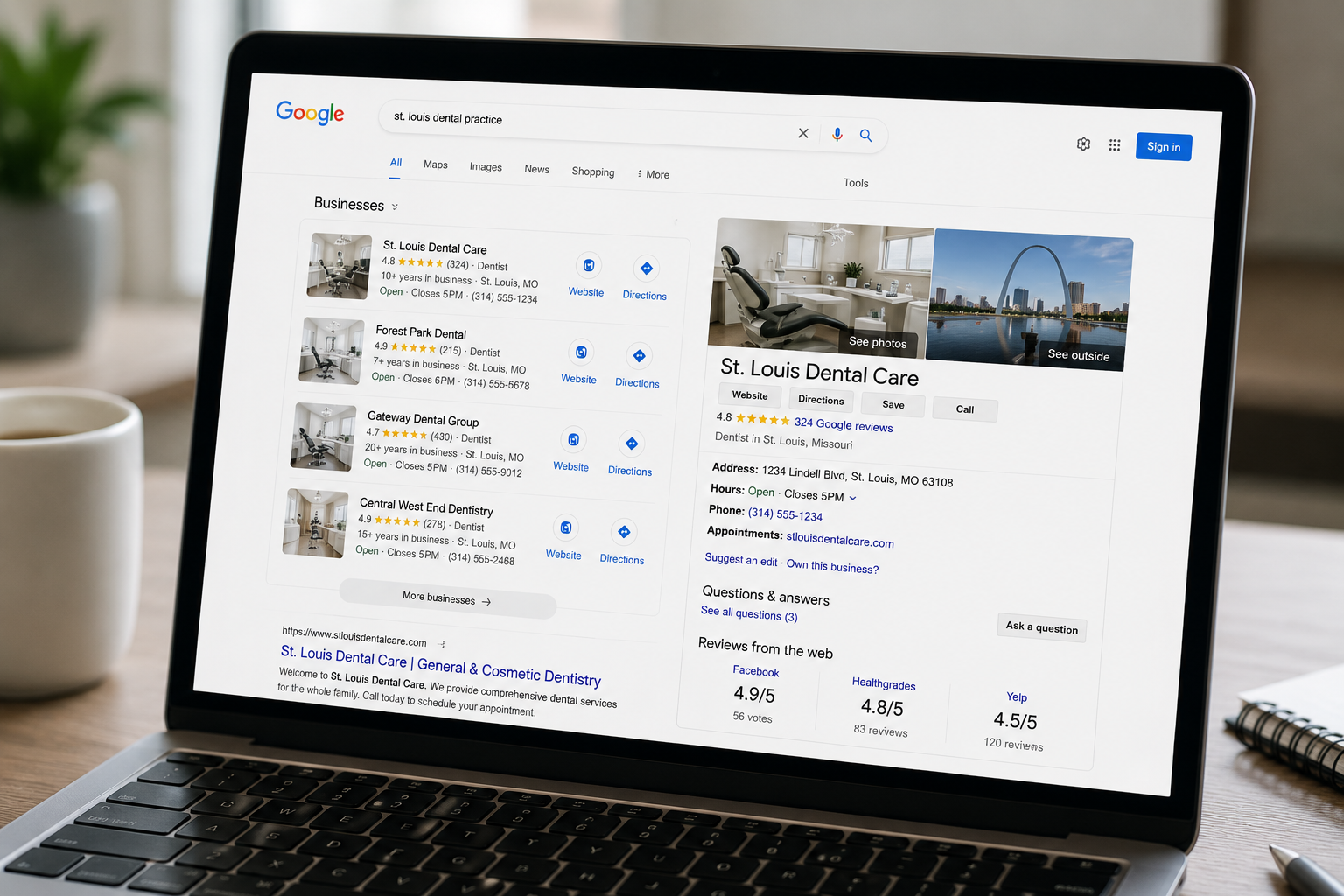
2. Google Business Profile and review engine second. Claim, verify, and complete every field — correct categories, hours, services, photos — then start asking every patient for an honest review in week one. Google is explicit that businesses with complete, accurate information are more likely to show up in local results, and that inaccurate info can keep your profile out of relevant searches entirely.
3. Long-tail content before head terms. Target "accepting new patients [neighborhood]," specific procedures, and real patient questions before you touch "cosmetic dentist [city]." Across our new-practice launches, the "accepting new patients + neighborhood" long-tail indexes and converts faster than the head cosmetic term owners instinctively want first — because there's less competition and clearer intent.
4. Authority and links last. Local citations, community mentions, and genuine partnerships — after the foundation and content exist to support them.
What not to spend on early: head cosmetic terms, mass directory blasts, and any "guaranteed rankings" package. That's exactly why the content engine produces 12 publish-ready articles a month in the right order rather than chasing the flashiest keyword on day one.
The free visibility snapshot takes one reply: send your city and top service, and within 48 hours you'll see exactly where you rank today. Or start with the free first batch — we target 6 keywords for your business; if at least one isn't in Google's top 3, you owe nothing.
SEO vs. Google Ads When You're Opening: Which First, and When to Run Both
Let me be blunt about the tradeoff, because too many pages blur it. SEO on a new domain is a 3–12+ month compounding play. Google Ads buys visibility today. Those are different tools for different problems.
The decision rule is simple. If you need patients in the chair this month to cover overhead, that's a paid-search job — not an SEO failure, just a sequencing reality. Ads put you in front of someone searching "dentist accepting new patients [area]" the day you turn them on, while your organic presence is still earning trust underneath.
The smart from-zero play is usually both. Run Ads for immediate demand during your launch window, keep the SEO engine compounding beneath it, and taper the ad spend as your organic rankings and reviews mature. You buy attention now and build the asset that reduces your ad dependence later.
What neither channel can fix: a weak offer, a broken online-booking flow, or a listing sitting under 4.5 stars. Both SEO and Ads amplify what's already there — and BrightLocal's 2026 survey found 31% of consumers will only use a business rated 4.5 stars or higher, up from 17% the year before. If your listing is under that bar, paying to send more people to it just makes the leak more expensive.
Getting Your First Reviews From Zero (and Why Recency Now Ranks You)
The cold-start review problem is the hardest part of opening. You launch at zero while a rival across town has hundreds. And reviews matter more now than they ever have.
BrightLocal's 2026 Local Consumer Review Survey found that 97% of consumers read reviews before choosing a local business, that the share who will only use a business rated 4.5 stars or higher nearly doubled from 17% to 31%, and that 47% won't even consider a business with fewer than 20 reviews. Recency is now its own filter, too: 74% of consumers look for reviews written in the last three months, and 32% want them from the last two weeks. A wall of five-year-old reviews doesn't carry what it used to.
The compliant playbook: ask every patient at the point of a good visit, make it one tap, and respond to every review you get. What you must not do is incentivize. Under the FTC's Consumer Reviews and Testimonials Rule — effective October 21, 2024 — offering compensation or incentives conditioned on reviews expressing a particular sentiment is prohibited and can carry civil penalties, so ask everyone for honest feedback, no conditions.
One compliance note dentists can't skip: you're a HIPAA-covered entity. Never publish patient protected health information or before/after photos without documented written authorization, and don't frame a review request in a way that discloses someone's patient status publicly.
In our launches, a review engine started in week one compounds faster than any on-page tweak — because it's the one prominence signal you can build from a standing start. Google confirms directly that more reviews and positive ratings can help your business's local ranking.
AI Search and Your New Practice: Getting Cited When You Have No Authority Yet
Search is changing, but the way you win a citation in an AI answer is not some separate trick. It's the fundamentals — done well. This is where answer engine optimization and traditional SEO converge rather than split apart.
Google says this plainly. Its guidance on AI features in Search states that the best practices for SEO remain relevant for AI features like AI Overviews and AI Mode, with no additional requirements or special optimizations needed to appear in them — while still worth reviewing the fundamentals. Google has also given site owners Search Console controls over how their content appears in generative AI features, alongside new insights on how pages surface there.
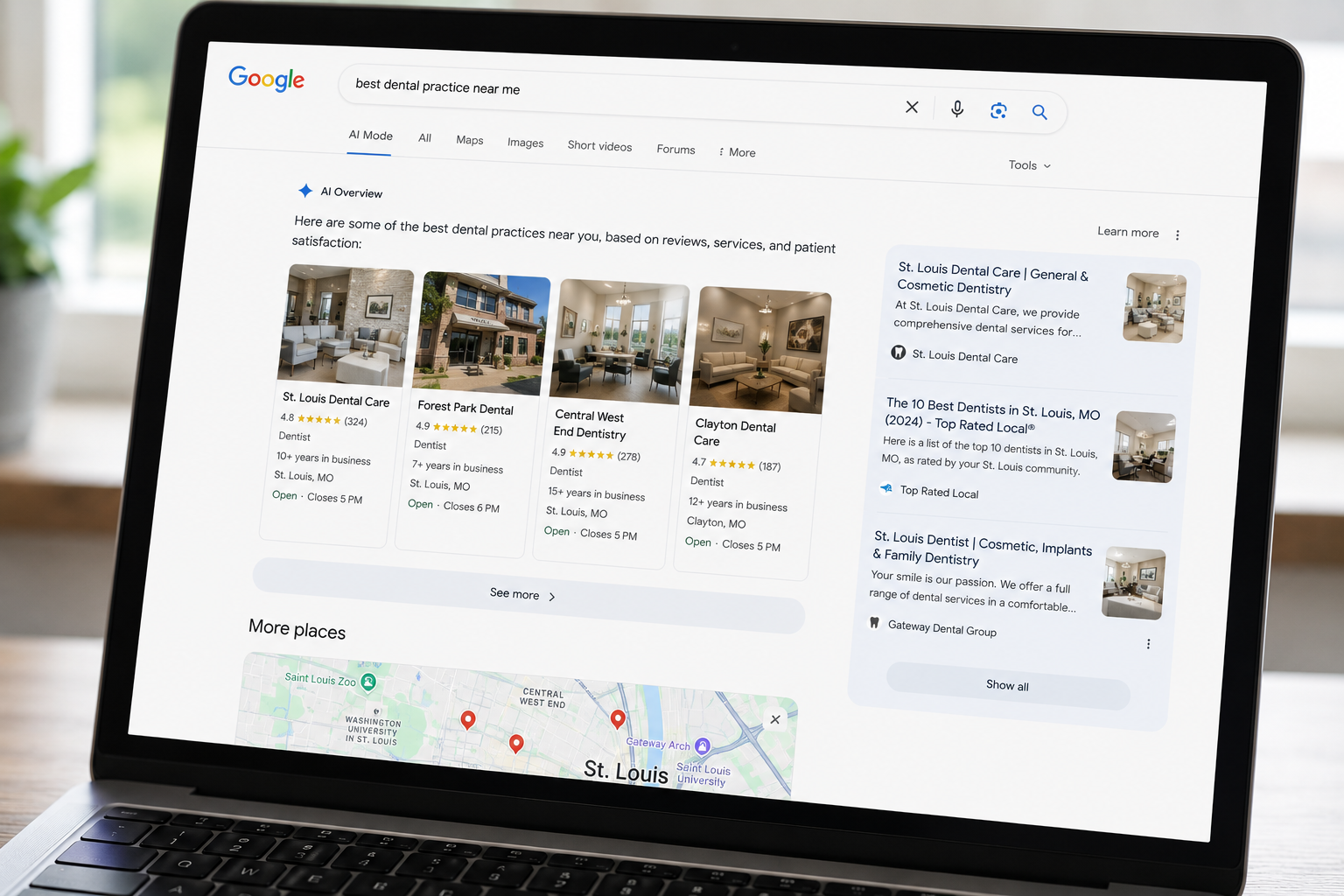
For a new practice, the levers you control are accuracy and completeness: a fully filled-out GBP (which feeds AI local answers), clear question-and-answer content, correct schema, and consistent business info everywhere it appears. Those are exactly the things a from-zero site can nail immediately — the same signals that earn LLM citations and AI Overview mentions in a zero-click result.
Why it's worth doing now: BrightLocal's 2026 survey found 45% of consumers now use AI tools like ChatGPT for local business recommendations — up from just 6% the year before — making AI the third most popular local-discovery source. Accurate, complete listings surface in those AI answers even when you don't yet have domain authority.
The honest limit: you won't out-authority an entrenched rival in AI answers overnight. Completeness and accuracy are what you can win on today; authority is what you build over the runway.
When You Should NOT Hire an Agency (and What to DIY First)
I'd rather tell you the truth than sell you something you don't need yet.
If cash flow is tight at launch, DIY the GBP basics before paying anyone. Claim and verify your profile, complete every field accurately, and ask every patient for an honest review. These are free, high-impact, and Google confirms complete, accurate info is what gets you shown for relevant local searches. Do them regardless of who you hire later.
DIY is genuinely the right call when you're pre-open with no budget, or you're a single-location owner with the time and discipline to publish consistently. There's no shame in that — it's a sequencing decision, not a judgment.
An agency earns its fee when you can't sustain consistent publishing, when you're running multiple locations, or when you need a compounding content engine you realistically won't build alone. That's the honest line: pay for what you can't do yourself, not for what you can.
And know what SEO can't fix: a weak offer, a broken booking flow, or an under-4.5-star listing. Fix those first — no amount of ranking will save a schedule that leaks at the point of conversion. When you're ready to accelerate, the risk-reversal free first batch lets you test us on six keywords before spending a dollar — the lowest-risk way to prove SEO for a new dental practice works in your market.
Frequently Asked Questions
How long does dental SEO take for a brand-new practice?
Expect early movement on lower-competition local terms in about 30–60 days, with compounding results building over 3–12+ months as your new domain earns trust and reviews accumulate. That's slower than the "3–6 months" often quoted, which describes established practices. Anyone promising fast #1 rankings from a brand-new domain is either targeting no-volume keywords or using risky tactics.
How much should a new dental practice budget for SEO each month?
Legitimate small-business SEO generally runs $500–$5,000/mo depending on scope. Our content engine is $125/blog — $1,500/mo at the recommended 12 — with 6- and 9-blog tiers on the live calculator and multi-location discounts of 10–20%. Budget for the compounding runway rather than a fast fix — cheap $100–$400/mo packages often rely on thin content that can hurt a health-vertical site.
Should I start SEO before or after opening?
Start the foundation before opening if you can — the technical build, GBP claim/verify, and first content take time to index, and getting them live early captures launch-window demand instead of waiting on trust to accrue. If you're already open, start now; the earlier your domain and reviews begin compounding, the sooner competitive terms become reachable.
Should a new dental practice do SEO or Google Ads first?
If you need patients this month to cover overhead, lead with Google Ads — it buys visibility immediately, while SEO on a new domain compounds over 3–12+ months. The strongest approach for most new practices is running both: Ads for immediate demand, SEO building underneath, then tapering ad spend as organic rankings and reviews mature.
How many reviews do I need to rank and win patients?
There's no fixed ranking number, but consumer expectations set a practical floor: BrightLocal's 2026 survey found 47% of consumers won't consider a business with fewer than 20 reviews, and 31% only use businesses rated 4.5 stars or higher. Recency matters too — 74% look for reviews from the last three months. Start a compliant, non-incentivized review engine in week one.
How do I find out if SEO is worth it for my new practice?
The free visibility snapshot takes one reply: send your city and top service, and within 48 hours you'll see exactly where you rank today. Or start with the free first batch — we target 6 keywords for your business, and if at least one isn't in Google's top 3, you owe nothing. It's the lowest-risk way to see what SEO can realistically do before committing.