SEO for Physical Therapists: An Honest 2026 Guide for Clinic Owners
Honest 2026 SEO guide for PT clinic owners: what it costs, realistic timelines, condition pages that convert, and how independent clinics outrank chains.

By Evan Rief, Founder & Lead SEO Strategist
Last reviewed: August 2026
This guide draws on the real local-health and physical therapy campaigns we run at Clementine, plus named data from Google, APTA, SparkToro, and BrightLocal. We're happy to walk through a live Search Console account so you can see the numbers yourself. Results vary by market and competition — no one can honestly promise you rankings, and anyone who does is selling something.
SEO for physical therapists is the work of getting your clinic's website and Google Business Profile to show up when nearby patients search their condition — not the term "physical therapist." Expect roughly $500–$5,000 per month for legitimate small-business SEO depending on scope, with lower-competition local terms typically reaching page 1 in 30–60 days and gains that compound at 60–90+ days.
Key Takeaways
PT SEO now replaces the referral network — all 50 states plus D.C. and the U.S. Virgin Islands allow some form of direct access to physical therapist services as of July 2025.
Patients search their condition, not "PT near me" — build condition pages (sciatica, post-surgical, ACL), not one generic services page.
Expect lower-competition local terms on page 1 in 30–60 days; compounding at 60–90+ days. No one can honestly promise a timeframe.
Legitimate small-business SEO runs $500–$5,000/mo; at the rock-bottom end you buy demoted content, not rankings.
The same fundamentals that rank you on Google — first-hand, condition-specific content plus reviews and schema — are what get you cited in AI Overviews and ChatGPT.
What SEO for Physical Therapists Means in the Direct-Access Era
SEO — search engine optimization, the ongoing work of getting your website found when someone searches — matters more for physical therapy now than it ever has. There's a specific reason why. As of July 1, 2025, per APTA's direct-access summary, all 50 states, the District of Columbia, and the U.S. Virgin Islands have either provisional or unrestricted direct access to physical therapist services for evaluation and treatment.
Translated: a patient can now choose you without a physician's referral. The referral network that used to feed your schedule has been partly replaced by a search bar. That shift is the whole game — online visibility is your new referral source.
Be honest with yourself about the nuance, though. APTA notes that even where patients may go directly to a physical therapist without a referral, some provisions tied to treatment absent a referral still persist in a number of states — 29 states, D.C., and the U.S. Virgin Islands allow only provisional access, with 21 states unrestricted. Direct access isn't identical everywhere, so know your state's rules before you build your marketing around them.
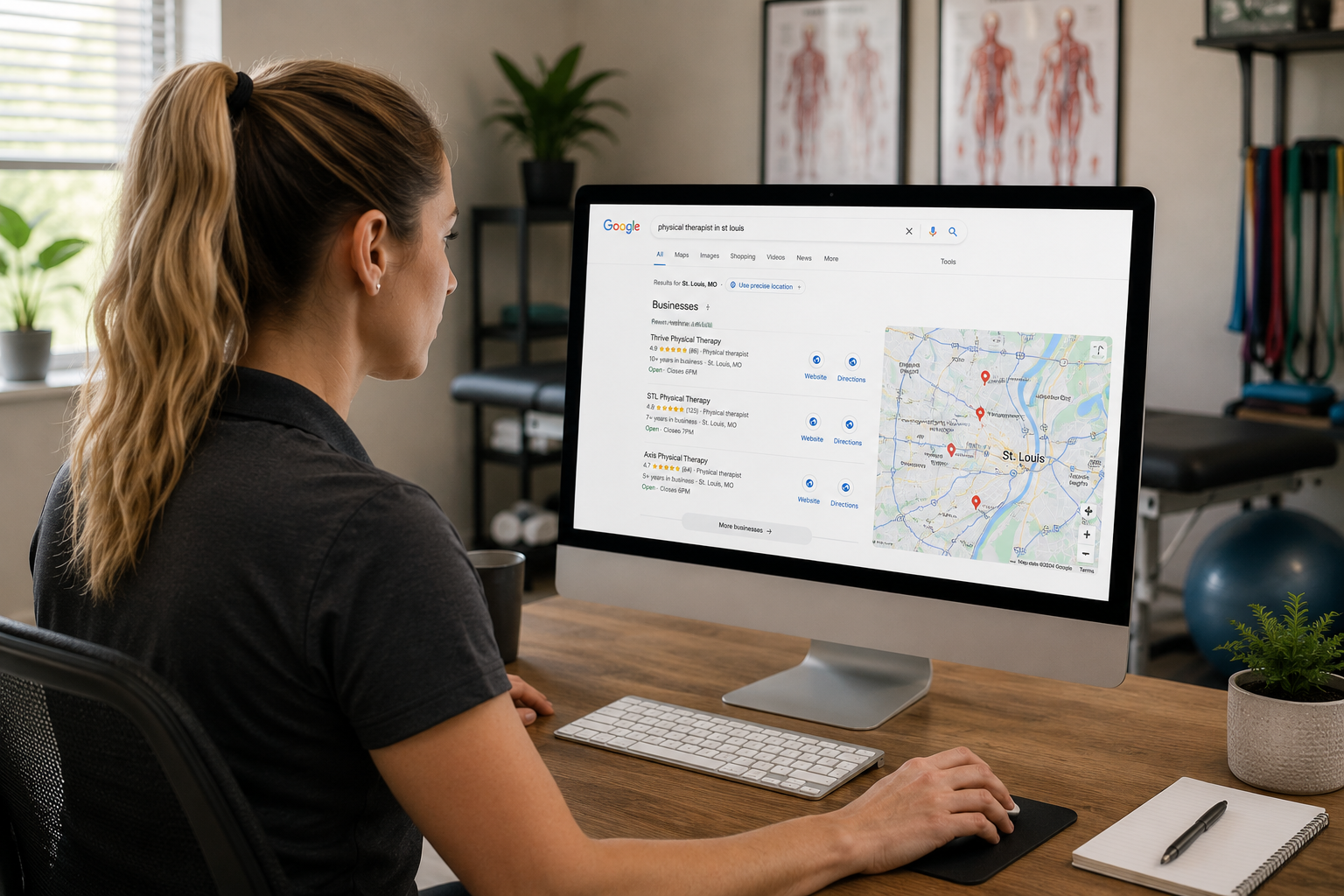
The components of PT SEO are straightforward to list, harder to execute well:
Keyword research — matching the actual terms patients type.
Google Business Profile — your free Google listing (formerly Google My Business) that powers the local pack.
Condition-focused content — pages built around what people search.
Technical performance — a fast, crawlable site.
Reviews — the trust signal that decides local rankings.
Across our local-health client accounts, the clinics that win treat their website as a referral replacement, not a digital brochure. If you want to see the mechanics, here's the 12-articles-a-month content engine we use to build these pages.
Why Patients Search Their Condition, Not "Physical Therapist Near Me"
Someone with radiating leg pain does not search "physical therapist near me." They search "sciatica relief" or "why does my leg go numb when I sit." Your content has to meet that condition search first, then convert the visit into a booked appointment. This is the single behavior most generic agencies miss, because it doesn't apply to their other clients.
That's why we build around a three-layer keyword model:
Condition terms — sciatica, rotator cuff tear, post-surgical rehab, pelvic floor dysfunction.
Treatment terms — dry needling, manual therapy, vestibular rehab, blood flow restriction.
Local modifiers — your city, neighborhoods, "near me."
Reviews then decide who gets the click. BrightLocal's Local Consumer Review Survey 2026 found that 97% of consumers read reviews online, and 41% now "always" read reviews when browsing for a business — a jump from 29% the year before. In our campaigns we see reviews decide local rankings as much as any on-page factor.
Here's where PT has a structural advantage: your multi-week plan of care produces outcome-specific reviews ("got me back to running after my ACL") that a hospital system's centralized profile never accumulates.
One honest limit: SEO can't rescue a clinic with two Google reviews and a booking form that emails a dead inbox. Visibility only matters if the visit converts. Fix the reviews and the booking flow first, or the traffic goes to waste.
The Condition-Page Playbook: Sciatica, Post-Surgical & ACL Pages That Convert
Competitors name conditions; almost none show you the actual build. Here's the on-page anatomy of a condition page that ranks and books:
H1 with the condition plus intent — e.g., "Physical Therapy for Sciatica in [City]."
A symptom-answering intro — answer the patient's first question in the first two sentences.
What to expect in treatment — the plan of care, timeline, what a first visit looks like.
Credential signals — your DPTs, specialties, certifications.
Local proof — reviews, neighborhoods served, insurance accepted.
An FAQ block — the follow-up questions patients ask.
A clear booking CTA.
Structured data — MedicalClinic/LocalBusiness plus FAQPage schema so search engines read the page cleanly.
The critical move is splitting intent across separate pages. "Sciatica relief exercises" is informational — that's an educational article or blog post. "PT for sciatica [city]" and "sciatica physical therapy near me" are transactional — those get a dedicated service page built to convert. Collide the two on one page and you serve neither well.
This is also why thin condition pages fail. Google's helpful content documentation confirms that people-first content should be useful to an audience that would come directly to you, and should clearly demonstrate first-hand expertise and a depth of knowledge. A DPT explaining a post-surgical protocol clears that bar; a 300-word AI-spun page does not.
In our flagship multi-location medical wellness campaign, 9 of the first 17 tracked keywords reached Google's top 5 within 60 days, and 14 of 17 reached the top 10 — the condition and local terms moved first. We're happy to walk through the live Search Console account so you can see exactly which terms moved and when.
Local SEO & Google Business Profile: How Independent Clinics Beat Hospital Systems
Your Google Business Profile is the most valuable free asset you have, and Google is specific about the rules. Google Business Profile Help states you should represent your business as it's consistently represented in the real world, make your address or service area accurate and precise, and choose the fewest number of categories it takes to describe your core business.
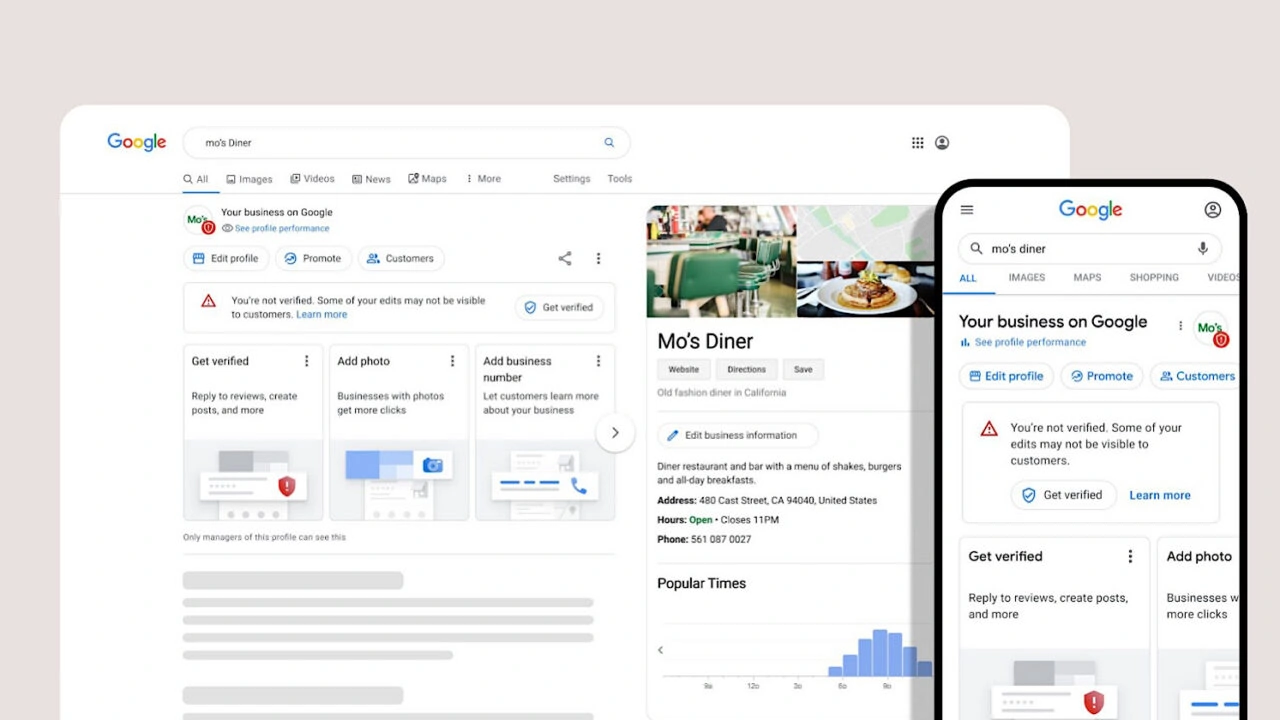
This is where an independent clinic can genuinely out-rank a hospital system. Corporate chains run generic, centrally-managed profiles built for a network, not a neighborhood. You can be hyper-specific — your conditions, your specialties, your streets — and you accumulate the richer, outcome-specific reviews their bulk profiles never earn.
A practical GBP checklist:
Primary category: Physical therapist.
Specialty services listed explicitly (dry needling, vestibular rehab, pelvic floor).
Photos of the clinic, staff, and equipment.
Accurate service area and hours.
A steady review cadence — ask every discharged patient.
Regular posts for offers and updates.
One myth worth killing: stuffing keywords into your business name ("City Physical Therapy — Best Sciatica Dry Needling Clinic") is a violation, not a hack. Google confirms your profile must not display low-quality, irrelevant, or distracting content such as misspellings or gimmicky character use. It can get your listing suspended. Keeping your profile clean and consistent is part of the foundation every campaign starts from.
What PT SEO Really Costs in 2026: Honest Tiers and Break-Even Math
Legitimate small-business SEO typically runs $500–$5,000 per month depending on scope. At the rock-bottom end — the $99–$300 "package" — you're generally buying templated content that Google's systems now demote, not rankings. Here's how the market actually reconciles:
$99–$300/mo (cheap/templated) — thin, duplicated content. Incremental at best, and a demotion risk at worst.
Clementine content engine — $125/blog · $1,500/mo at the recommended 12. 12 articles, keyword research, on-page optimization, and the monthly rank report. Starter (6) and Grow (9) tiers on the live calculator; multi-location discounts of 10% (2–5) or 20% (6+).
Broader small-business market — $500–$5,000/mo. Varies widely by scope and market.
Our content engine is $125 per published blog — $1,500/mo at the recommended 12 — on a 3-month recommended run, then month-to-month. No setup fee, no dashboard fee.
The break-even math is friendlier for PT than most verticals because your product is a plan of care, not a single visit. If a course of treatment generates meaningful revenue, a small number of new organic patients per month covers the investment. Run your own plan-of-care value against the monthly figure — the number of new patients you need to break even is usually low.
Now the honest part about the cheap tier. Google has confirmed it targets content created primarily to manipulate search rankings rather than for people. That's exactly what most bargain-bin packages produce, and the risk isn't just wasted spend — thin templated content can drag your whole domain down. You can see our published pricing laid out in full.
Realistic Timelines: What Ranks in 30–60 Days vs. 6–12 Months
Lower-competition local and long-tail condition terms typically reach page 1 in 30–60 days; gains compound from there at 60–90+ days. Competitive head terms take longer and vary by market. No honest agency states any of this as a promise.
Lower-competition local + long-tail condition terms — page 1 in 30–60 days.
Compounding gains — 60–90+ days.
Competitive head/organic terms — longer; varies by market.
Here's the best case, framed as exactly that. In our flagship campaign, the first #1 ranking came in 3 weeks — faster than typical, the best case we've seen, and never something we promise upfront. Peak daily clicks reached roughly 10x the pre-engagement baseline (44 per day versus about 4). And the compounding is real: 73% of the trailing-12-month clicks (1.32K of 1.81K) and 87% of impressions (119K of 137K) landed in the first four months.
In our campaigns we see the same pattern repeatedly — condition and local terms move first, and momentum builds rather than fades. We're glad to screen-share that live account so you can judge the trajectory for yourself, not take my word for it.
The free visibility snapshot takes one reply: send your city and top service, and within 48 hours you'll see exactly where you rank today.
Getting Your Clinic Cited in AI Overviews, ChatGPT & Perplexity (GEO for PT)
Search is changing, but the fundamentals that win aren't. Industry data suggests the change is significant. SparkToro's 2026 zero-click study found that in the first four months of 2026, 68.01% of US Google searches ended without a click. Within the same study, Ahrefs data shows AI Overviews now appear on more than 20% of searches and reduce click-through by roughly 60% when present.
That sounds alarming until you see what earns the citation. When a patient asks an AI "best PT near me for vertigo," the answer is synthesized from crisp, extractable content, condition specificity, first-hand expertise signals, structured data, and strong reviews. Google has confirmed its systems identify factors showing experience, expertise, authoritativeness, and trustworthiness — and that of these, trust is the most important.
Reviews carry into AI answers too. BrightLocal found that the use of ChatGPT and generative AI for local business recommendations jumped from 6% to 45% in a single year — the review corpus that decides your local rankings is increasingly being read back to patients by machines.
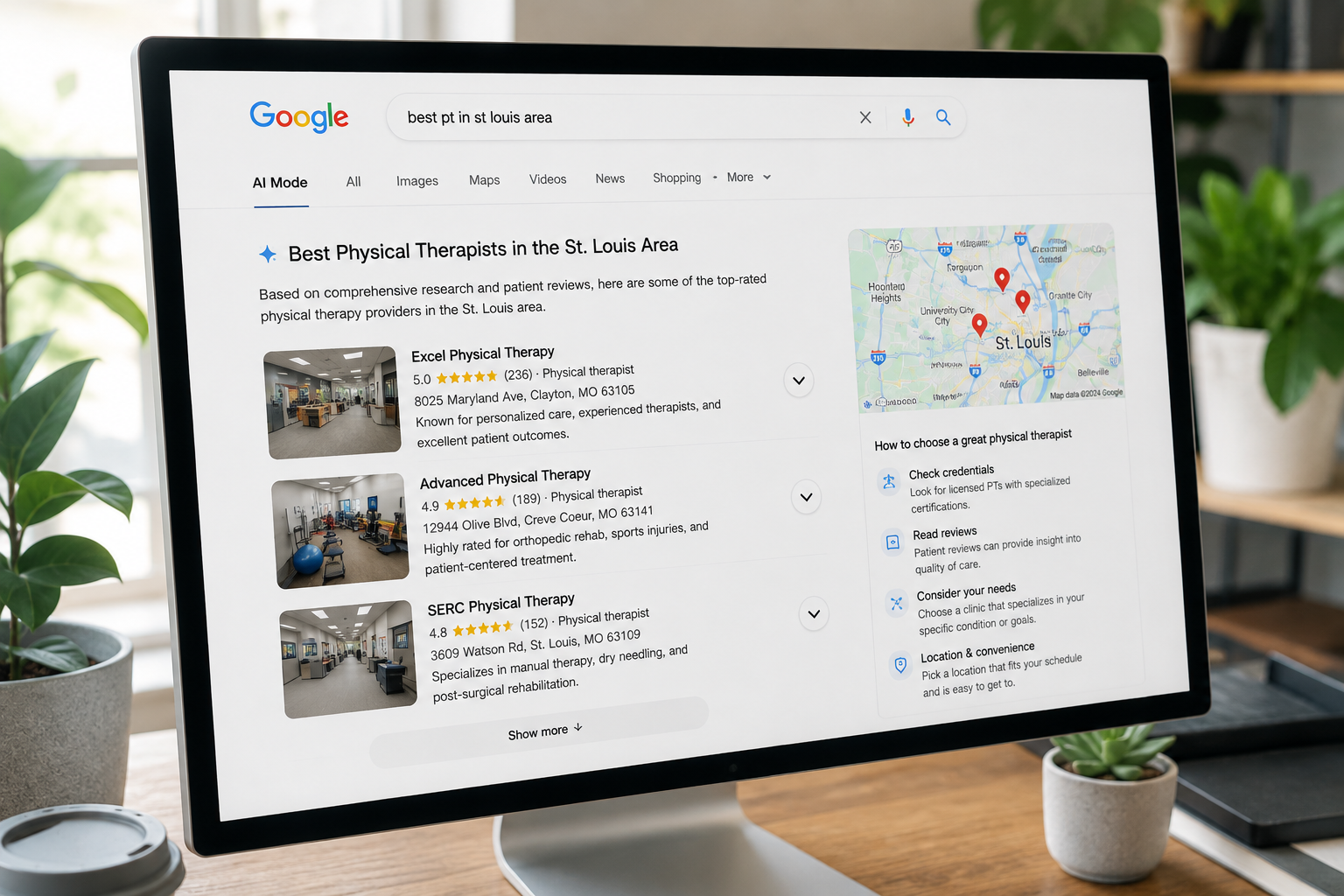
The takeaway is simpler than the acronyms suggest: the same condition-page depth, review strength, and schema that rank you on Google are what get you cited in AI answers. Answer engine optimization — sometimes called GEO — is not a separate gimmick to buy. Build the fundamentals well and you're already competing in both.
When to DIY, When to Hire an Agency, and When to Just Run Ads
There's no shame in doing this yourself, and there are situations where you should. Here's the honest framework:
Tiny budget, one location, time to spare, low local competition — DIY. Manage your own Google Business Profile and write your first condition pages.
Clinical hours worth more than the learning curve, multi-location, or stalled progress — hire an agency. Buy back the time and the strategy.
Need bookings this month, can't wait for compounding — run ads (alongside or instead). Paid search fills the gap while SEO builds.
SEO's 60–90-day compounding is a strength for long-term cost, but it's a weakness if your schedule is empty right now. Paid search fills the gap while SEO builds. They work well together.
Be clear on what SEO can't fix, because no amount of ranking solves these: a weak offer, a broken booking flow, or a clinic with no reviews. Address those first.
And know the red flags. Anyone guaranteeing #1 rankings, selling directory-spam packages, hiding their pricing, or pushing exact-match domains is selling a stale or dishonest product. Google explicitly works to demote manipulation, so those tactics carry real downside risk. If you want to understand our founder's approach and why we work this way, it's built entirely around avoiding that pattern.
Frequently Asked Questions
How much does SEO cost for a physical therapy clinic?
Legitimate small-business SEO runs $500–$5,000 per month depending on scope. Clementine's content engine is $125/blog — $1,500/mo at the recommended 12 — with 6- and 9-blog tiers on the live calculator and multi-location discounts of 10–20%. At the rock-bottom end, you're usually buying templated content that Google demotes.
How long does SEO take to work for a PT practice?
Lower-competition local and long-tail condition terms typically reach page 1 in 30–60 days, with gains compounding at 60–90+ days. Competitive head terms take longer and vary by market. No one can honestly promise a specific date.
Is SEO worth it for physical therapists?
Usually yes in the direct-access era, because a small number of new plan-of-care patients can cover the monthly cost. But it only works if your offer, booking flow, and reviews are already in order — SEO drives visibility, not conversions on a broken funnel.
Should I build separate pages for each condition, like sciatica, post-surgery, and ACL?
Yes. Separate condition pages capture the specific searches a generic services page misses, and they let you split informational intent (exercises, symptoms) from transactional intent (booking) across the right page types.
How do independent PT clinics outrank hospital systems?
With condition-specific depth, a fully optimized Google Business Profile, and outcome-specific reviews that corporate chains can't accumulate. Hospital systems run generic centralized profiles; an independent clinic can be hyper-specific to its conditions, specialties, and neighborhoods.
Can I do physical therapy SEO myself, or do I need an agency?
DIY works for a single, low-competition location when you have time to spare. Hire an agency when your clinical hours are worth more than the learning curve, when you're multi-location, or when your own efforts have stalled. To test whether it's worth it, start with the free first batch — six keywords, and if none reach Google's top 3, you owe nothing.