SEO for Pilates Studios: A Practitioner's Honest, Data-Backed Guide
What pilates studio SEO actually costs, how long it takes, and the format-page + Google Business Profile strategy that wins bookings — no hype, real data.
By Evan Rief, Founder & Lead SEO Strategist
Last reviewed: August 2026
This guide draws on real client campaigns we run in health, wellness, and local-service verticals — not theory borrowed from someone else's blog. Every statistic cited to Google, BrightLocal, or SparkToro is named and linked, and we're happy to screen-share a live Search Console account on a call so you can see the underlying data yourself. Results vary by market and competition, and no honest agency can promise rankings.
SEO for a pilates studio means getting your studio to show up — in Google's map pack and in organic results — when local people search format-specific terms like "reformer pilates [city]" or "pilates near me." The three levers that move it: an optimized Google Business Profile, a website with a dedicated page for each class format you teach, and a steady flow of recent reviews. Lower-competition local terms typically reach page one in 30–60 days, with compounding gains at 60–90+ days.
Key Takeaways
Pilates searchers are format-decided — someone searching "reformer pilates" is a different buyer than someone searching "mat pilates," so your site needs a dedicated page per format.
Your Google Business Profile is the single biggest local-visibility lever. Google states local results rest on relevance, distance, and prominence — and you can only influence relevance and prominence.
Timeline, stated honestly: lower-competition local terms typically reach page one in 30–60 days, with compounding gains at 60–90+ days. Anyone promising #1 rankings on a fixed timeline is selling you something.
Reviews matter, and recency matters more than raw volume — consumer expectations on total count have actually softened year-over-year, but fresh reviews still carry weight.
Real cost: legitimate small-business SEO runs $500–$5,000/mo; Clementine's content engine is $125/blog — $1,500/mo at the recommended 12. Cheap "SEO" often means directory spam that can hurt you.
What SEO for a pilates studio actually means
SEO for a pilates studio means getting found — in Google's map pack and organic results — when local people search to book a class. The map pack is the block of three business listings with the map at the top of local results; organic results are the standard blue links below it. Winning either one puts your studio in front of someone who is already looking to sign up.
Google's own documentation is blunt about how this works: you can't request or pay for a better local ranking, because results are based mainly on relevance, distance, and prominence. In other words, ranking is earned, not bought — which is the first thing to know if a vendor ever offers to "guarantee your #1 spot." You can read Google's local ranking guidance directly.
Two of those three factors are yours to shape. Distance from the searcher is fixed. But relevance — how well your profile and website match the search — and prominence — how well-known and trusted your studio is — are the levers you actually control. Everything in this guide is about pulling those two levers. If you want the mechanics of how we build content that supports them, here's how our content engine works.
Why pilates SEO is different from generic fitness (and yoga) SEO
Pilates searchers are format-decided in a way most fitness searchers aren't. Someone typing "reformer pilates" wants a reformer class — they will not be satisfied by a generic "pilates classes" page, and they rarely want a mat class instead. Reformer, mat, Lagree, clinical/rehab, and prenatal are distinct search intents from distinct buyers. Contrast this with yoga, where styles blend and searchers browse loosely; a pilates searcher has usually already decided what they want.
That precision changes your ROI math. With the reformer boom, reformer sessions and memberships command premium pricing well above a drop-in yoga class, so a search-acquired student is worth more per booking and often stays longer. A ranking that reliably delivers reformer bookings is a genuine revenue line, not a vanity metric.
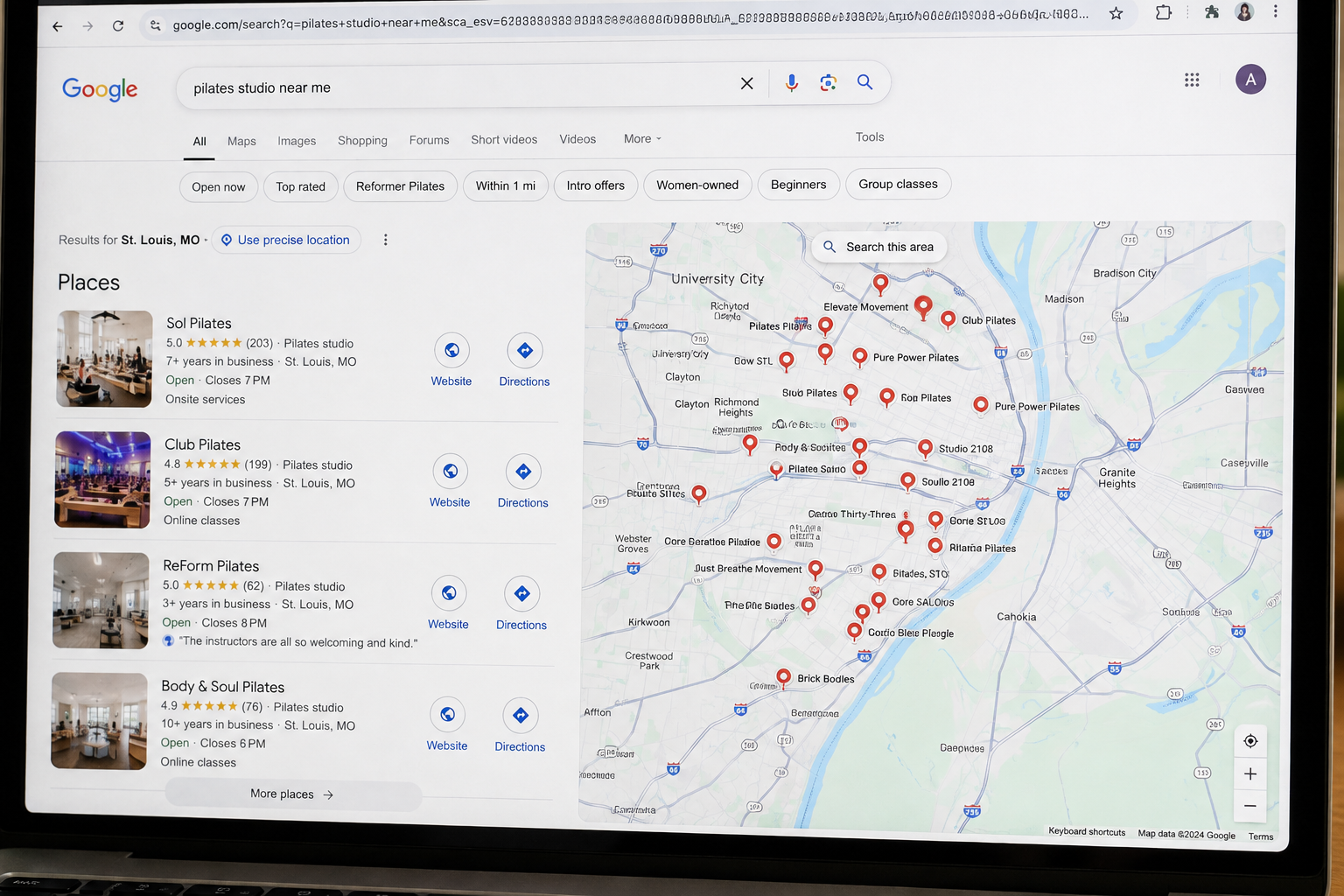
The competition is real but beatable. In most metros a studio faces roughly 10–30 local competitors chasing the same students, and smaller markets move faster. Across the local-service Search Console accounts we manage, the studios that win are the ones whose site structure matches how buyers actually search — not the ones with the most blog posts. If you want to see the full scope of what we handle, here are our SEO services for local businesses.
The economics: what one map-pack ranking is worth to your studio
Let's do the arithmetic competitors only gesture at. Say a member's average spend is $180/month (illustrative, not a client figure) and a search-acquired student stays 12 months. That's roughly $2,160 in lifetime value per member. If a strong ranking reliably brings you even four new members a month, that's about $104,000 in annual bookable revenue from search — before you count referrals. These are hypothetical numbers to show the shape of the math, not a promise; plug in your own membership price and retention and the logic holds.
The reason this compounds is prominence. As Google describes it, prominence reflects how well-known and trusted a business is — shaped by external signals like backlinks, mentions across the web, and online reviews — and more prominent businesses tend to rank higher in local results. Ranking builds reputation, which builds more ranking.
Here's what that acceleration can look like in a real campaign. For a multi-location medical wellness franchise whose engagement began in March 2026, 73% of the site's trailing-12-month Google clicks (1.32K of 1.81K) were generated in the first 4 months, and 87% of trailing-12-month impressions (119K of 137K) landed in that same window. Peak daily clicks reached roughly 10× the pre-engagement baseline (about 44 a day versus around 4). That's a medical wellness franchise, not a pilates studio, and results vary by market and competition — but we're glad to screen-share the live account so you can see how we work with local clients.
Google Business Profile: your #1 lever
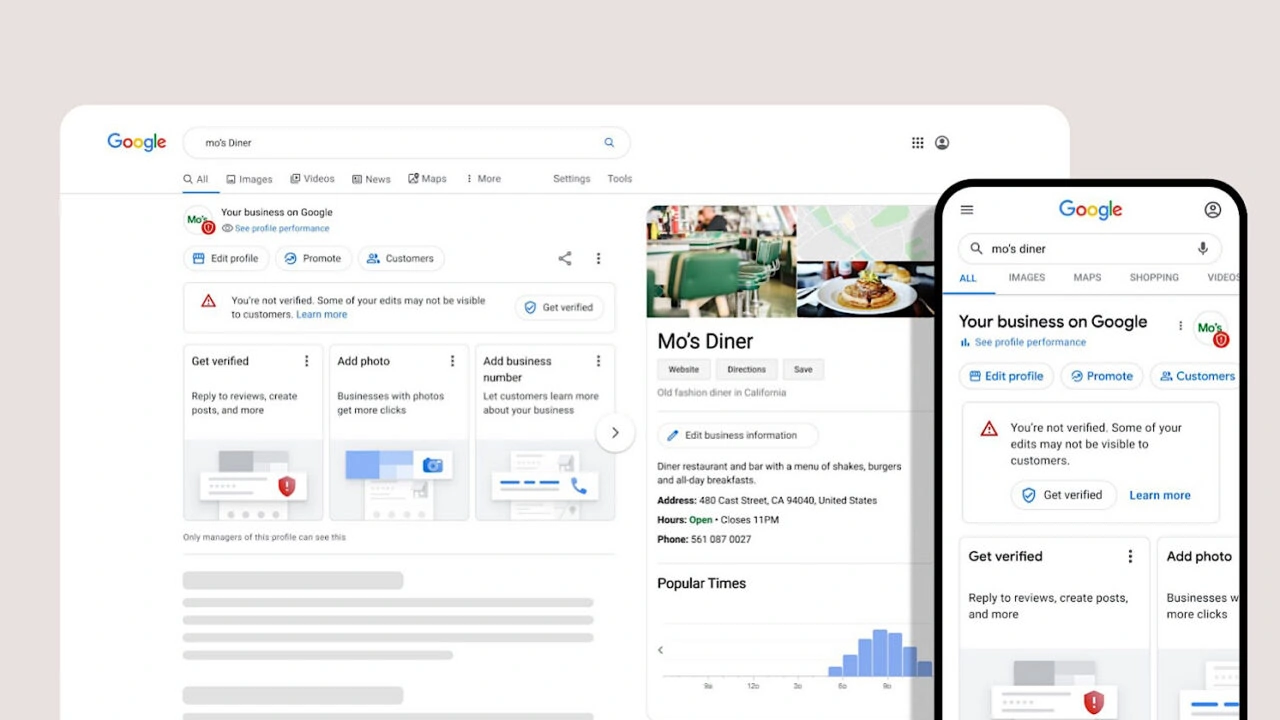
Your Google Business Profile (GBP) is where local visibility is won or lost. The core work: set your correct primary category (Pilates studio, not a generic "gym"), complete every service and description field, add real photos of your space and equipment, keep hours accurate, and maintain a steady review cadence. None of it is glamorous, and all of it moves the needle.
This maps directly onto Google's three pillars — relevance, distance, and prominence — and it bears repeating that there's no way to request or pay for a better local ranking. The profile earns its position through completeness and trust signals, not spend.
Keep your NAP — Name, Address, Phone — identical everywhere it appears online; inconsistency confuses Google and weakens the profile. And here's the honest part: GBP optimization is something a diligent owner can start today, alone, for free. If you'll actually do it, you should. Keeping your citations and listings consistent across the web is part of the foundation every campaign starts from.
Website architecture: a dedicated page for every class format
Because pilates searchers are format-decided, your website needs a separate, genuinely distinct page for each format you actually teach — reformer, mat, Lagree, clinical/rehab, prenatal. Each page targets its own search intent, so each one can rank for its own set of terms. A single "our classes" page trying to cover all of them will underperform every dedicated page it competes against.
The critical distinction: these must be real, different pages — who each format is for, what a first class feels like, what to bring, what results people see — not thin variations of the same template with the format name swapped in. Google is explicit that creating separate content for every possible variation primarily to manipulate rankings violates its scaled content abuse policy, and that a high quantity of pages doesn't make a site higher quality or more relevant. You can review Google's scaled content abuse policy for the full definition.
As examples of the intent each page should serve — not a list to stuff keywords into — think "reformer pilates [city]," "clinical pilates for back pain," "prenatal pilates near me." One intent, one page, written for a human deciding where to book. This is where keyword research and on-page optimization earn their keep: matching page structure to real search demand.
Reviews and reputation: how many you actually need
There's no magic review count that unlocks the map pack — and any number a vendor quotes you as a threshold is a guess dressed up as a fact. What the data shows is that recency and a strong average matter more than raw volume, and that competition in your specific market sets the bar.
Industry data suggests the pressure to amass reviews has actually eased. BrightLocal's consumer review survey reports that consumers are now more willing to choose businesses with as few as 0–49 reviews than in prior years, with expectations for 50+ reviews dropping year-over-year — a shift BrightLocal attributes to growing awareness that review volume can be outside a business's control. That's good news for a newer studio.
Reviews also feed rankings indirectly through engagement. As BrightLocal's local ranking factors research frames it, even when reviews don't directly change rankings, businesses with better ratings and fresh reviews tend to earn more clicks, calls, and directions — and Google often rewards that engagement. Google still leads as a review source, though its dominance has softened somewhat, so don't neglect other surfaces entirely.
The practical move: build steady review velocity. Automate the ask around class checkout or rebooking, so fresh reviews arrive continuously rather than in one big push that then goes stale.
The free visibility snapshot takes one reply: send your city and top service — reformer pilates, say — and within 48 hours you'll see exactly where you rank today. Or start with the free first batch — we target 6 keywords for your studio; if at least one isn't in Google's top 3, you owe nothing.
ClassPass vs. direct booking: the SEO/LTV trade-off
ClassPass and SEO solve different problems, and it's worth being clear-eyed about the trade-off. ClassPass fills empty spots quickly — but at a discount, and without handing you the customer relationship. You're renting access to someone else's audience, and when the class ends, the member belongs to the platform, not to you.
SEO does the opposite work. It builds direct, owned bookings from people who searched, found you, and signed up at full price — the members with the highest lifetime value and the strongest odds of staying. In our campaigns we see that the studios investing in direct discoverability spend progressively less on discount-driven acquisition over time, because they stop renting their customer pipeline.
Here's the honest version: if you're a brand-new studio with empty classes and no reviews yet, using ClassPass early to build momentum is a legitimate choice. SEO is a compounding play, not an overnight fix — the first 30–60 days build the foundation. Use ClassPass tactically to fill gaps; invest in search strategically so you're not renting acquisition forever.
Pilates studio SEO costs — and when to skip an agency
Almost nobody in this space will tell you what they charge, so here it is. Legitimate small-business SEO runs $500–$5,000/mo depending on market and scope. Clementine's content engine is $125/blog — $1,500/mo at the recommended 12 — 12 articles, keyword research, on-page optimization, and a monthly rank report, on a 3-month recommended run and month-to-month after. Starter (6) and Grow (9) tiers are on the live calculator, and multi-location studios get 10% off (2–5 locations) or 20% off (6+). No setup fee, no dashboard fee.
Under ~$300/mo — automated directory submissions, scaled/AI content. High risk: often directory spam or low-value pages Google demotes; can hurt you.
~$500–$1,500/mo — real GBP optimization, format-specific pages, consistent content, rank reporting. The legitimate small-studio range; where most single-location studios should sit.
Clementine content engine — $125/blog · $1,500/mo at the recommended 12. 12 articles, keyword research, on-page, monthly rank report; transparent, published, with a screen-share of live results offered.
$2,000–$5,000/mo — multi-location systems, aggressive link/PR, heavier content volume. Justified for multi-location groups or dense-metro competition.
DIY ($0 + your time) — you optimize GBP and drive reviews yourself. Viable in low-competition markets; the honest right call for some owners.
Now the part most agencies skip: when you should not hire one. In a low-competition market, an owner who will genuinely claim and optimize their own GBP and build a steady review habit can win without paying anyone a monthly retainer. SEO also can't fix a weak offer, a clunky or broken booking flow, or a studio with no reviews and nothing that sets it apart. Fix those first — no ranking rescues a page people bounce off of.
And be wary of cheap "SEO." Sub-$300/mo services often mean directory spam or scaled AI content that Google now actively demotes — you can pay to make your visibility worse. When you're ready to compare the real options, here's Clementine's published pricing.
Pilates SEO in the AI-search era (2026)
Search is changing, but the fundamentals that earn AI Overview citations are the same fundamentals that have always worked. Google confirms this directly: the best practices for SEO remain relevant for AI features like AI Overviews and AI Mode, with no additional requirements or special optimizations needed to appear in them. This is spelled out in Google's guidance on AI features and your site.
So ignore the hype about secret "AEO" or "GEO" hacks. Google is equally direct that while those terms are common online, many of the suggested "hacks" aren't effective or supported by how Search actually works. You optimize for AI features by being the clearest, best-sourced, most genuinely expert answer — nothing more exotic than that.
What has changed is where the answer lands. Industry data suggests a large share of searches never produce a website click at all — SparkToro's June 2026 zero-click study found that 68.01% of US Google searches ended without a click in the first four months of 2026, up from 60.45% in 2024. Within the same study, Ahrefs data shows AI Overviews now appear on more than 20% of searches and cut click-through by roughly 60% when present. For a local pilates search, that means the map pack and your GBP often are the destination. Someone finds your rating, your hours, your photos, and books — never touching your homepage.
The takeaway isn't "SEO is dead." It's that a complete GBP, fresh reviews, crisp answers, and clean site structure matter more than ever — because those are exactly the elements an AI Overview and a map pack pull from. Strong SEO for pilates studios in 2026 is simply strong fundamentals, executed consistently.
Frequently Asked Questions
How much does SEO cost for a pilates studio?
Legitimate small-business SEO runs $500–$5,000/mo, and Clementine's content engine is $125/blog — $1,500/mo at the recommended 12 (keyword research, on-page, monthly rank report included), with 6- and 9-blog tiers on the live calculator. Anything under about $300/mo is usually automated directory spam that can hurt your visibility rather than help it.
How long does pilates studio SEO take to work?
Lower-competition local terms typically reach page one in 30–60 days, with compounding gains at 60–90+ days. Smaller markets move faster than dense metros. Anyone guaranteeing a specific ranking on a specific date is overpromising — ranking timelines depend on your competition.
How many Google reviews does a pilates studio need to rank in the map pack?
There's no fixed number; it depends on your market's competition, and recency and a strong average matter more than raw volume. BrightLocal's data shows consumer expectations for total review count have actually dropped year-over-year, so a newer studio with steady, recent reviews can compete.
Should I have a separate page for reformer, mat, and Lagree classes?
Yes — they're distinct searches with distinct intent, so each format deserves its own genuinely different page written for that audience. Just don't create thin duplicate pages that only swap the format name; Google's scaled-content policy demotes that.
Is ClassPass worth it if I'm investing in SEO?
It can fill empty spots early, but it's discounted and you don't own the customer relationship. SEO builds direct, full-price, higher-LTV bookings you keep. Use ClassPass tactically to fill gaps and invest in search strategically for the long game.
How do I find out if SEO is worth it for my studio?
Start with a free visibility snapshot — send your city and top service, and within 48 hours you'll see where you currently rank. Or start with the free first batch: we target 6 keywords for your studio, and if at least one isn't in Google's top 3, you owe nothing. That tells you whether there's room to win before you spend a dollar.