SEO for Wellness Centers: How to Rank Every Service Without Competing Against Yourself
Learn how to rank every wellness treatment with hub-and-spoke SEO, fix keyword cannibalization, and sequence service pages by revenue, demand, and difficulty.

By Evan Rief, Founder & Lead SEO Strategist
Last reviewed: August 2026
This guide draws on real Clementine client campaigns — including a live multi-location medical wellness franchise account we're happy to walk through on a call via the live Search Console account — alongside Google's own documentation and named tool studies from Ahrefs and BrightLocal. Results vary by market and competition, and nothing here is a ranking guarantee.
Effective SEO for wellness centers starts with a hub-and-spoke structure: one core "services" hub page targeting your center plus local searches, one dedicated page per treatment targeting how patients actually search for that treatment, and educational articles for condition and goal queries that link into the service pages — with exactly one primary keyword and one intent per URL to prevent cannibalization. That single rule is what separates centers that rank across their whole menu from centers that rank for nothing.
Key Takeaways
Multi-service centers often rank for nothing because cramming every treatment onto one page confuses Google about what you're most relevant for.
The fix is a hub-and-spoke architecture: one primary keyword and one intent per URL.
Sequence your service pages by a revenue × demand × difficulty score — don't build all six at once.
In one Clementine multi-location wellness campaign, the first #1 ranking came in 3 weeks (best case, not typical); 9 of the first 17 tracked keywords reached Google's top 5 within 60 days.
Realistic timeline: lower-competition local terms typically reach page 1 in 30–60 days, with compounding gains at 60–90+ days.
Why Multi-Service Wellness Centers Rank for Nothing
You offer IV therapy, hormone optimization, medical weight loss, peptides, and aesthetics — and you rank for none of them. It's the most common problem we see when a wellness center calls us. It almost always traces back to one structural decision: everything lives on a single "Services" page.
Here's the mechanism. Keyword cannibalization — two of your pages chasing the same search so Google can't tell which to rank, and neither wins — is one version of the problem. The one-page brochure is another: a page listing six treatments gives Google no clear topical target for any single one.
Patients don't search "wellness center." They search "IV drip near me," "semaglutide," and "hormone therapy for women" — three different intents, from three different people, at three different research stages. In our campaigns we see that a single page cannot satisfy all of them at once. The page ends up mediocre for every query instead of strong for one.
The path forward is to give each real search its own home. That's exactly how our content engine builds one page per intent, and it's the foundation for everything else in this guide.
The Hub-and-Spoke Architecture for a Multi-Service Center
Think of your site the way you'd think of your floor plan: a front desk that orients everyone, then dedicated treatment rooms. In SEO terms, that's hub-and-spoke — a central hub page connected to focused spoke pages.
Here's the labeled structure:
Hub — your core Services page. Targets your center's brand plus local "wellness center" searches. This is the front desk: it orients and routes, it doesn't try to rank for every treatment.
Spokes — one dedicated page per treatment. Each targets that treatment's real search language ("IV therapy," "medical weight loss"). One page, one job.
Education layer — condition and goal articles ("low-energy treatment options," "menopause symptom support"). These capture people earlier in their research and link into the relevant spoke.
The rule that holds the whole thing together: one primary keyword and one intent per URL. A spoke page for "hormone therapy" should not also try to rank for "IV drips" — that's how you re-create the cannibalization problem you were trying to solve.
The education layer is where centers most often go wrong. A "menopause symptoms" article and a "hormone therapy" service page serve different intents — one is researching, one is ready to book — so they stay separate pages that link to each other. Structured this way, your pages support each other instead of competing.
Deciding What to Rank For First: a Revenue × Demand × Difficulty Model
Most guides tell you to build a page per service and stop there. The harder question — the one nobody answers — is which one first. You have six-plus treatments and a finite budget, and building all six thin pages at once is how you end up with six mediocre pages.
Here's the model we use. Score each service 1–5 on three axes:
Revenue — revenue per booking and lifetime value. A hormone optimization program with recurring visits scores high; a single walk-in IV drip scores lower even if it's popular.
Demand — local search volume for that treatment's real keywords, informed by keyword research.
Difficulty — competition, scored inversely. A term with few strong local competitors scores higher because it's winnable.
Add or multiply the three. Build the highest-scoring services first. The weighting matters: a service with modest search volume but high LTV and rebooking cadence often beats a high-volume, one-and-done service. Search volume alone will steer you wrong.
A quick, clearly hypothetical example:
Hormone optimization — Revenue 5, Demand 3, Difficulty (inverse) 4 → score 12. Wins the first build here: strong LTV, winnable difficulty.
Medical weight loss — Revenue 4, Demand 5, Difficulty (inverse) 2 → score 11. Higher raw demand, but tougher competition.
Single IV drip — Revenue 2, Demand 4, Difficulty (inverse) 3 → score 9. Popular, but lower value per booking.
Hormone optimization wins the first build here — strong LTV, winnable difficulty — even though weight loss has higher raw demand.
Sequence deliberately: build one or two spokes first, prove the model in your own market, then expand. And be honest with yourself — a term that scores high on demand but high on difficulty may simply not be worth chasing yet on a young site. This is the thinking behind our keyword strategy and monthly ranking reports: pick the winnable, valuable targets, then widen.
Keyword Cannibalization on Wellness Sites: How to Spot and Fix It
You can diagnose cannibalization yourself in Google Search Console — the free tool that shows which queries bring you impressions and clicks. The tell-tale signature: two different URLs from your site both collecting impressions for the same query, each stuck on page 2 or 3, neither breaking through.
Across our client Search Console accounts, this pattern is consistent — two near-duplicate service pages split the authority for one search, so Google hedges and ranks both weakly. Consolidate them, and the surviving page tends to climb because it's no longer competing with itself.
Once you spot it, you have three options:
Consolidate — merge two thin, near-duplicate pages into one stronger page and redirect the weaker URL.
Differentiate by intent — rewrite one page to genuinely target a distinct search (for example, separate "IV therapy for hydration" from "IV therapy for immune support" only if the demand and content truly differ).
Canonicalize — set a canonical tag, the piece of code that tells Google which version is the master copy, when you need both pages live but want one to rank. Google's documentation on consolidating duplicate URLs explains how canonicalization signals your preferred version.
One myth worth killing: more pages do not mean more rankings. Publishing six near-identical service pages doesn't multiply your visibility — it fractures it. Fewer, sharper pages beat more, blurrier ones every time.
YMYL and E-E-A-T: the Trust Signals Every Wellness Service Page Needs
Wellness content sits in what Google calls YMYL — "Your Money or Your Life" — topics that can affect someone's health, finances, or safety. For these, Google holds content to a higher trust bar, evaluated against E-E-A-T: Experience, Expertise, Authoritativeness, and Trust.
Google has confirmed this directly. Its guidance on people-first content states that while E-E-A-T itself isn't a specific ranking factor, Google's systems give even more weight to content that aligns with strong E-E-A-T for topics that could significantly impact health, financial stability, or safety. In plain terms: for health content, demonstrable trust matters more than it does for a recipe blog.
One clarification, because it's widely misunderstood. Google's search quality raters have no control over how your pages rank, and their data isn't fed directly into the ranking algorithm. E-E-A-T isn't a switch a rater flips for you — it's a set of genuine trust signals you build.
For wellness pages, those signals are concrete: named practitioner bios with real credentials, medical review of clinical claims where applicable, real photos of your team and space, consistent business details, and genuine patient reviews.
A compliance reality most guides skip: if you offer medical services like HRT, IV therapy, or peptides, you're under HIPAA, and patient testimonials or before-and-after photos require proper documented consent. Never publish identifiable patient information without it — a trust signal that creates a legal problem isn't worth the ranking.
Local SEO Across Multiple Services
Your Google Business Profile (GBP) — the listing that shows up in Maps and the local pack — carries more weight than most owners realize, and category selection is where multi-service centers stumble.
Google's own guidance uses a helpful analogy: for a grocery store with a bakery and deli, you'd select "Grocery store" as the primary category, then add "Bakery" and "Deli" as additional categories. Apply that to your center — choose your primary category by your core service, then add secondary categories for the other treatments you offer. Per Google's guidance on choosing business categories, the categories you select affect your local ranking, so this isn't cosmetic.
One honest caveat, straight from Google: if independent, separately owned and operated practitioners work within your location, they should have their own Business Profiles — don't fold their categories into yours. Co-located but independent providers are a common wellness-center gray area.
GBP and your service pages work together. Each spoke page reinforces your relevance for that treatment's local search, while your profile anchors your local presence in the local pack.
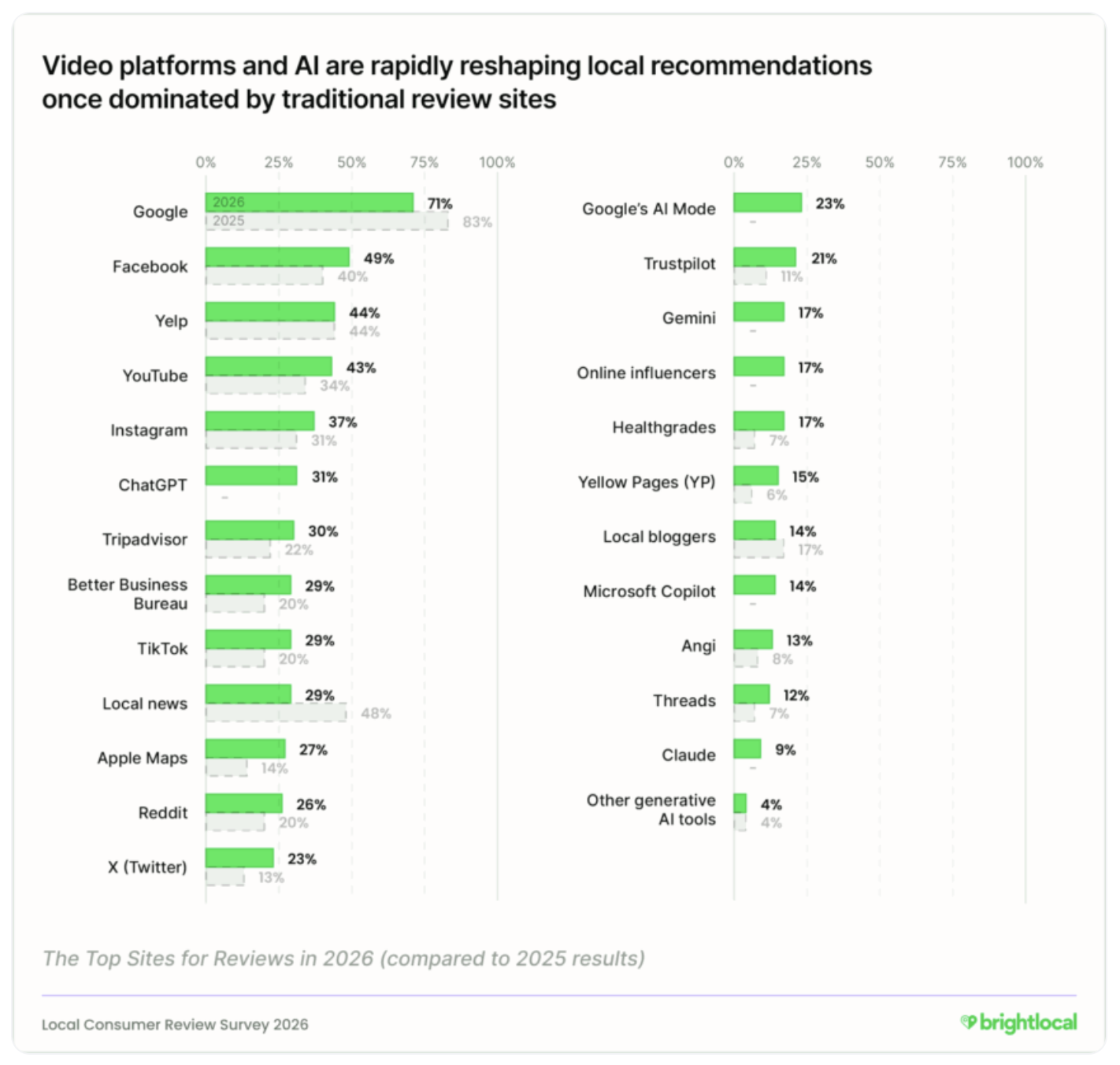
Why it matters: BrightLocal's Local Consumer Review Survey 2026 — a first-party survey of 1,002 US adult consumers — found that 97% read reviews online and that use of AI tools for local business recommendations jumped from 6% to 45% in a single year. Buyers increasingly discover local businesses across multiple sources before they ever contact you.
Ranking in AI Overviews Across Several Treatment Categories
Search is changing, but the fundamentals that win AI Overview citations are the same ones that have always won: clear answers, clean structure, and genuine expertise. This isn't a case for tearing up your strategy.
A well-built spoke page — one that opens with a direct answer and uses clear headings — is exactly the format an AI Overview pulls from when it summarizes a treatment. That's one reason the hub-and-spoke plus direct-answer approach compounds: the same structure that ranks in blue links also tends to earn AI Overview citations.
Industry analysis of Google's published guidelines suggests this reinforces, rather than replaces, what already works — depth and clarity over keyword stuffing. BrightLocal's survey also notes that a surge in video channels and quick adoption of AI tools is changing how consumers use and trust reviews and recommendations. The discovery paths are multiplying, so being the clear, well-structured, trustworthy answer across several treatment categories is what earns citations — the essence of answer engine optimization.
To be straight with you: I can't promise AI-citation results, and anyone who does is guessing. What I can say is that the structure that ranks is the structure that gets cited — so you're building for both at once.
What Wellness Center SEO Costs, How Long It Takes, and When Not to Hire
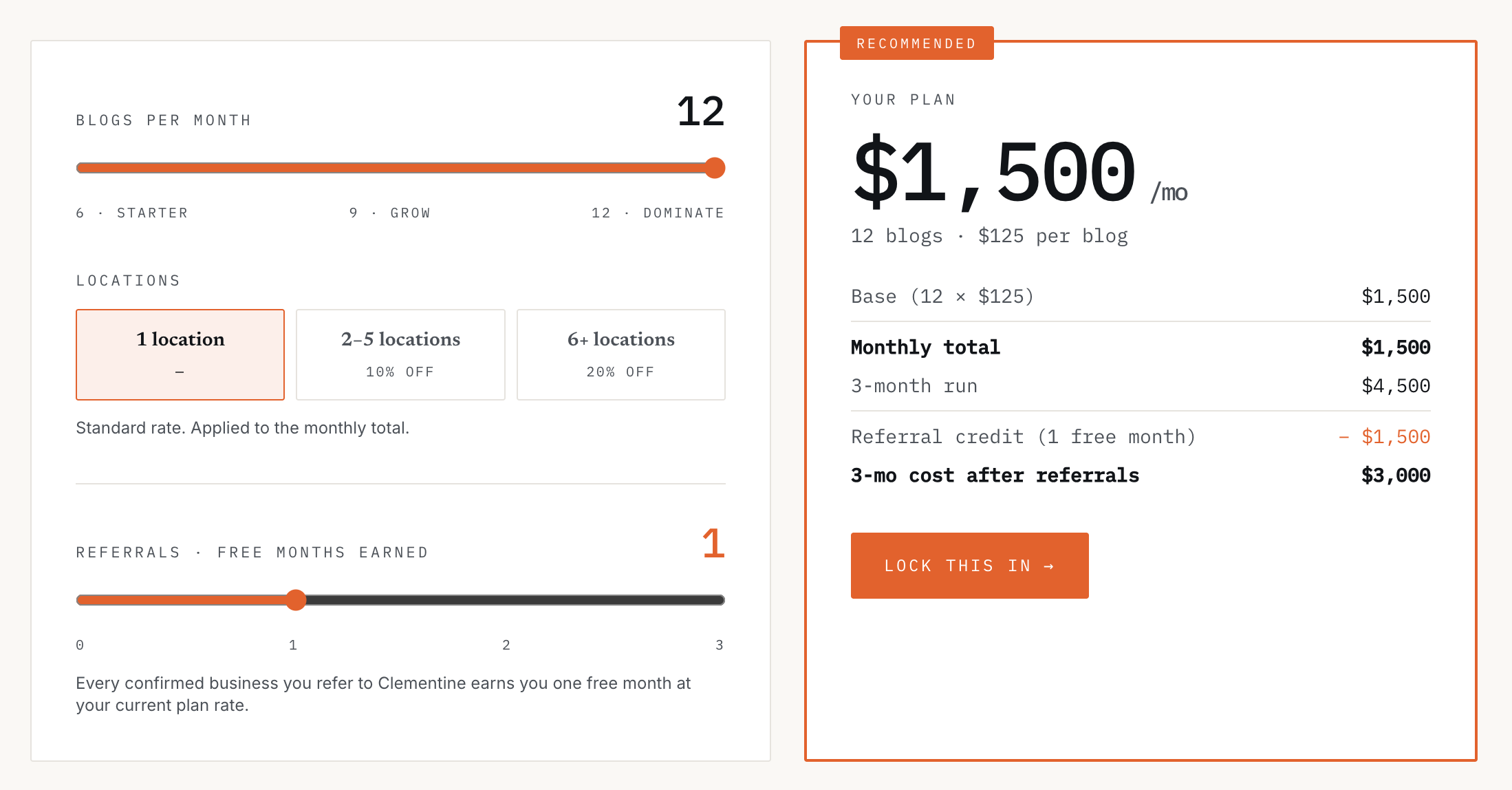
Legitimate small-business SEO typically runs $500–$5,000/mo. Clementine's content engine is $125/blog — $1,500/mo at the recommended 12 — 12 articles, keyword research, on-page optimization, and a monthly rank report, on a 3-month recommended run and month-to-month after. Starter (6) and Grow (9) tiers are on the live calculator, and multi-location businesses get 10% off (2–5 locations) or 20% off (6+). No setup fee, no dashboard fee. Our transparent pricing is published in full — no "get a quote" wall.
Budget — under $300/mo. Automated directory listings: directory spam, not rankings.
Mid — $1,000–$2,500/mo. Content, on-page, and reporting: genuine ranking work.
Premium — $2,500–$5,000+/mo. Multi-location, heavy content: scaled campaigns.
Timeline reality: lower-competition local terms typically reach page 1 in 30–60 days, with compounding gains at 60–90+ days. Our case study's 3-week #1 ranking was best case, not the promise.
Set expectations honestly for competitive head terms. Ahrefs' study of how long it takes to rank found that only 1.74% of newly published pages reach the top 10 within a year, and that the average #1 page is now five years old. Local long-tail moves faster; broad, competitive terms do not.
Here's the honest counterweight, because it earns your trust more than any pitch: SEO amplifies a working business — it doesn't rescue a broken one. If your booking flow is broken, your offer is weak, or you're brand-new with zero reviews, fix those first. And if you have time and one core service, DIY the basics before you hire anyone. No shame in that.
Now the contrast that shows what the model can do. In our flagship multi-location wellness campaign: 73% of the site's trailing-12-month Google clicks (1.32K of 1.81K) and 87% of trailing-12-month impressions (119K of 137K) were generated in the first four months. Peak daily clicks reached roughly 10x the pre-engagement baseline (44/day versus about 4/day), and 14 of the first 17 tracked keywords reached the top 10. We're happy to walk through the live Search Console account on a call so you can verify every figure yourself.
The free visibility snapshot takes one reply: send your city and top service, and within 48 hours you'll see exactly where you rank today. Or start with the performance-gated free first batch — we target 6 keywords for your business; if at least one isn't in Google's top 3, you owe nothing.
Frequently Asked Questions
Why does my wellness center rank for none of its services?
Almost always because every treatment lives on one "Services" page, which gives Google no clear topical target for any single treatment. Patients search for specific things — "IV therapy near me," "medical weight loss" — and a single page can't satisfy those distinct intents at once. The fix is one dedicated page per treatment, each with one primary keyword and one intent.
Does every service really need its own page?
In almost every case, yes — one page per service, each targeting that treatment's real search language. The exception is when two offerings genuinely share the same intent and demand; forcing them apart just creates thin near-duplicate pages. When intent truly differs, separate pages win; when it's identical, one strong page beats two weak ones.
How do I decide which service to optimize first?
Score each service 1–5 on revenue and lifetime value, local search demand, and ranking difficulty (scored inversely, so winnable terms rank higher). Add or multiply the three, then build the top one or two first. Weight lifetime value and rebooking cadence — a high-LTV recurring service often beats a high-volume, one-and-done treatment.
What is keyword cannibalization and how do I fix it?
Cannibalization is when two of your pages chase the same search, so Google can't decide which to rank and both stay weak. Diagnose it in Google Search Console by finding two URLs collecting impressions for one query, both stuck on page 2–3. Fix it by consolidating the pages, differentiating one by intent, or setting a canonical tag to name the master version.
How much does SEO for a wellness center cost?
Legitimate small-business SEO typically runs $500–$5,000/mo depending on market and scope. Clementine's content engine is $125/blog — $1,500/mo at the recommended 12 — with 6- and 9-blog tiers on the live calculator and multi-location discounts of 10–20%. Packages under $300/mo usually buy automated directory listings, not rankings.
How do I find out if SEO is worth it for my business?
Start with the free visibility snapshot: send your city and top service, and within 48 hours you'll see where you rank today — no commitment. If you'd rather see results before paying, the free first batch targets 6 keywords, and if at least one isn't in Google's top 3, you owe nothing. Both paths tell you whether SEO is worth it before you spend.
Sources
Google Search Central: Creating Helpful, Reliable, People-First Content
Google Search Central: Consolidate Duplicate URLs (Canonicalization)
Google Business Profile Help: Guidelines for Representing Your Business on Google
Ahrefs: How Long Does It Take to Rank in Google? (And How Old Are Top-Ranking Pages?)