SEO for Yoga Studios: What It Costs, How Long It Takes, and Whether It's Worth It
SEO for yoga studios explained: real costs ($500–$5,000/mo), honest timelines (30–60 days to page one), and how to know if it's worth it for your studio.

By Evan Rief, Founder & Lead SEO Strategist
Last reviewed: August 2026
This guide draws on real yoga- and wellness-client campaigns we've run at Clementine — and we're happy to walk through the live Search Console account on a call so you can see the numbers yourself. It also leans on named data from Google, BrightLocal, SOCi, and Backlinko, not vendor hype. Results vary by market size and competition, and anyone promising guaranteed rankings on a fixed timeline is selling you something.
SEO for yoga studios is the work of getting your studio to show up when nearby people search Google for classes — especially in the map results at the top of the page. In lower-competition local markets, new studios typically start reaching page one in 30–60 days, with a realistic all-in budget of roughly $500–$2,000 a month. Close to half of consumers (46%) say they "always" or "often" add "near me" to their local searches, according to BrightLocal's local search research, and 42% of searchers click the Google map pack results for local queries, per Backlinko's local SEO study.
Key Takeaways
Local search is where studios get found: nearly half (46%) of consumers "always" or "often" add "near me" to their local searches, and 42% of searchers click the Google map pack for local queries.
Your Google Business Profile is the single biggest lever — Google has confirmed customers are 2.7× more likely to consider a business reputable, 70% more likely to visit, and 50% more likely to consider purchasing from businesses with a complete Business Profile.
Do the math before you spend: a member's lifetime value is roughly monthly dues ÷ monthly churn — and that number sets the most you can afford to pay to acquire one.
Realistic timeline: lower-competition local terms typically reach page one in 30–60 days, with compounding gains at 60–90+ days. Anyone promising a #1 map ranking "in 30 days" is guessing.
Honest published pricing: legitimate small-business SEO runs $500–$5,000/mo; Clementine's content engine is $125/blog — $1,500/mo at the recommended 12.
What Is SEO for Yoga Studios? (the 30-second answer)
SEO — search engine optimization — is the practice of getting your studio to appear on Google when a nearby person searches for yoga. For a local studio, that mostly means one thing: showing up in the Local 3-Pack, the three business listings with the map that appear at the top of local search results.
The stakes are simple. When nearly half of consumers (46%) add "near me" to their searches, the studios that own those searches fill classes and the ones that don't stay invisible. Ranking in the map pack isn't a vanity metric — it's the difference between a prospective member finding your 6 a.m. vinyasa class or your competitor's.
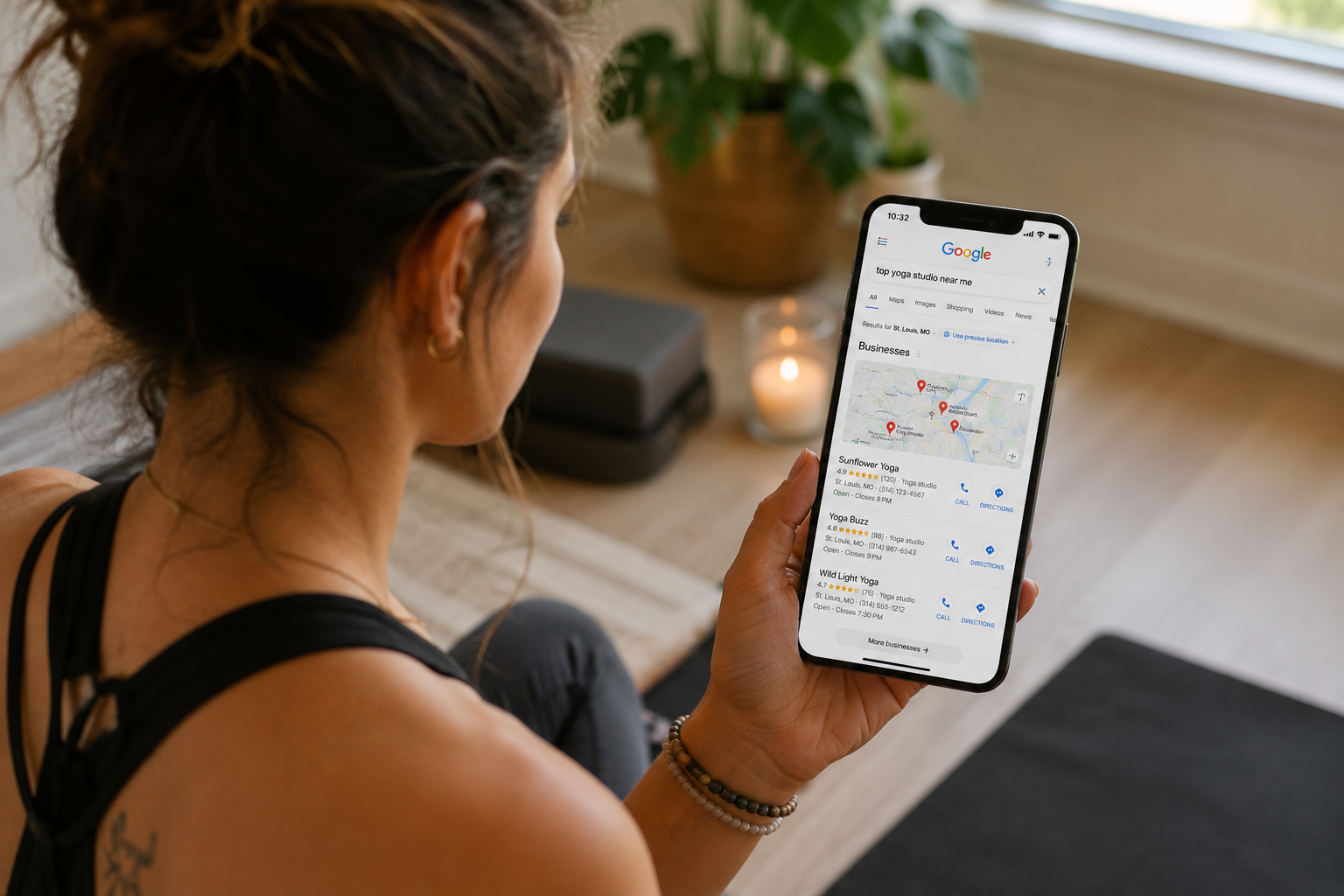
Here's a pattern worth knowing: across our yoga clients' Search Console accounts, the queries that actually convert aren't "yoga." They're neighborhood-plus-class-type combinations — "prenatal yoga in [neighborhood]," "beginner vinyasa near me." The head term looks impressive in a report; the long-tail fills the room.
The Math First: What a New Member Is Actually Worth
Before you spend a dollar on SEO, you need one number: what a member is worth to you. The formula is plain — average monthly dues ÷ monthly churn rate = lifetime value (LTV). Churn is just the percentage of members who cancel each month.
Work the math with your own numbers. At $150/month dues and 3% monthly churn, LTV is roughly $150 ÷ 0.03 = $5,000. A member who quits after three months is worth about $450. That gap is why retention matters as much as acquisition.
Now set your ceiling. Your churn determines member lifespan, and lifespan sets the most you can afford to pay to acquire someone — your maximum customer acquisition cost (CAC). A healthy business keeps LTV at least 3× CAC. If your LTV is $4,500, you can comfortably spend up to about $1,500 to land a member. SEO's job is to bring high-intent members in well below that ceiling — and unlike paid ads you rent every month, the rankings compound.
One honest counterweight: if your monthly churn is running above 5–6%, that's not a marketing problem, and SEO can't fix a leaky studio. Retention problems almost always surface in the first 90 days. More traffic to a studio that can't keep members just spends money faster. Here's how we price the content engine once the math makes sense.
Local SEO Is the Whole Game for Yoga Studios: GBP & the 3-Pack
For a studio, local SEO is the whole game, and the Local 3-Pack is the prize. Searchers rarely scroll past those three map listings, so getting into them is where the members come from.
The single biggest lever is your Google Business Profile — the free listing that populates the map pack. Google's own research shows that customers are 2.7× more likely to consider a business reputable, 70% more likely to visit, and 50% more likely to consider purchasing from a business with a complete Profile. That's the highest-ROI work you can do, and much of it is free.
For a yoga studio specifically, that means: setting the correct primary category, listing your class types as services, uploading real studio photos (not stock), building a steady flow of reviews, and using Google Business Profile Posts to promote workshops and intro offers. Reviews do double duty here — they're both a ranking signal and a conversion signal, and yoga is an experience-driven purchase where instructor profiles and testimonials carry real weight.
I'll be honest about speed, because the field is full of "#1 in 30 days" promises. In our flagship multi-location wellness campaign, we hit our first #1 ranking in three weeks — but that's the best case, faster than typical, not a promise, and it depends entirely on how competitive your market is. We're happy to walk through the live Search Console account on a call.
The free visibility snapshot takes one reply: send your city and top service, and within 48 hours you'll see exactly where you rank today — get a free visibility snapshot of your current rankings.
The Keywords That Fill Classes (and Your Booking-Flow Handoff)
Most studio owners want to rank for "yoga." Don't. The head term is expensive, competitive, and low-intent — someone searching "yoga" might be looking for a mat, a YouTube video, or a definition. The keywords that fill classes are specific: class type plus neighborhood.
Target the long-tail: "prenatal yoga [neighborhood]," "beginner vinyasa [city]," "yoga for back pain near me." In our campaigns, these are the queries that convert, because the searcher already knows what they want and just needs to find where to get it. They're also cheaper and faster to rank for.
Structure follows intent. Build one studio pillar page and a cluster of supporting pages around it — one per class type, teacher bios, a beginner's guide, pose and style explainers — published consistently rather than all at once. That architecture is exactly what our monthly SEO content engine produces.
Then there's the handoff almost nobody covers: your class schedule. The search-to-booking conversion happens on your schedule page, not your homepage. Make sure that page is fast, indexable, and that your Mindbody, Mariana Tek, or other booking embed isn't hiding your schedule from Google or breaking the path to booking. A perfect ranking that dumps people onto a broken schedule page wastes every click.
One honest note on virtual classes: yes, SEO works for online yoga, but the strategy is different. Online classes compete nationally on content and topic authority, not the local 3-pack, so set that expectation before you spend against local keywords that won't move the needle for a remote offering.
SEO in the AI-Search Era: Overviews, ChatGPT/Gemini & Reviews
Search is changing, but the fundamentals that win in AI-driven results are the same ones that have always won locally. A complete Google Business Profile, real reviews, structured content, and consistent contact information are exactly what AI Overviews and answer engines pull from when they recommend a business.
That trust depends on data hygiene, which is where many studios quietly fall down. SOCi's 2026 Local Visibility Index (reported by BrightLocal) found that only 68% of business contact information on ChatGPT and Perplexity matches the details on Google Business Profiles. If your name, address, and phone number are inconsistent across the web, you're feeding answer engines conflicting information and losing recommendations you'd otherwise earn.
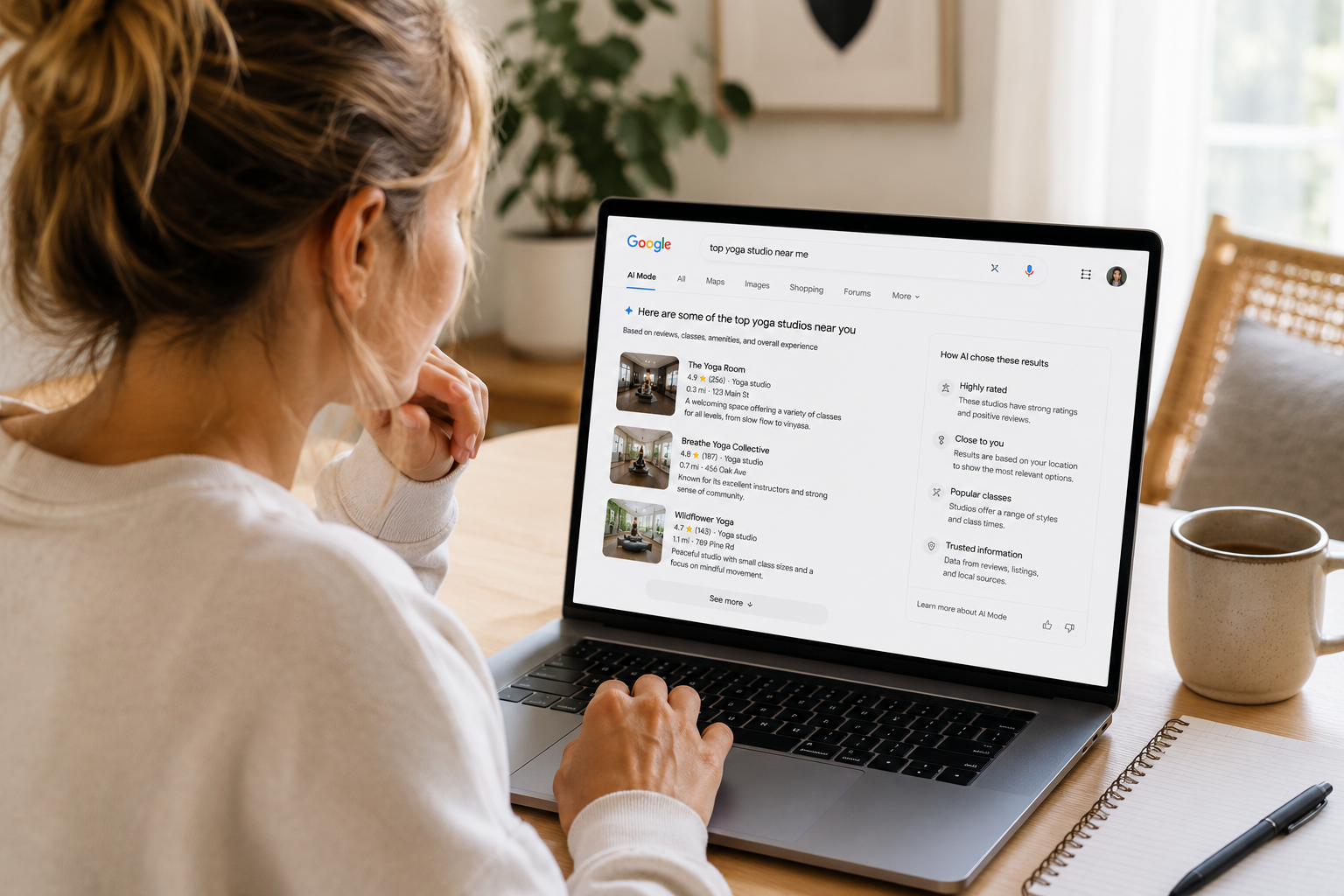
Practically: keep your Profile complete and fresh, earn recent reviews, and use clear service and FAQ content backed by schema — the code that tells search engines what your page is about. None of this is exotic. It's the same discipline that ranked you in the map pack, applied to a wider set of surfaces.
What Yoga Studio SEO Costs & How Long It Really Takes
Most agencies hide this behind a "contact us." Here's the real range, and here's exactly what we charge.
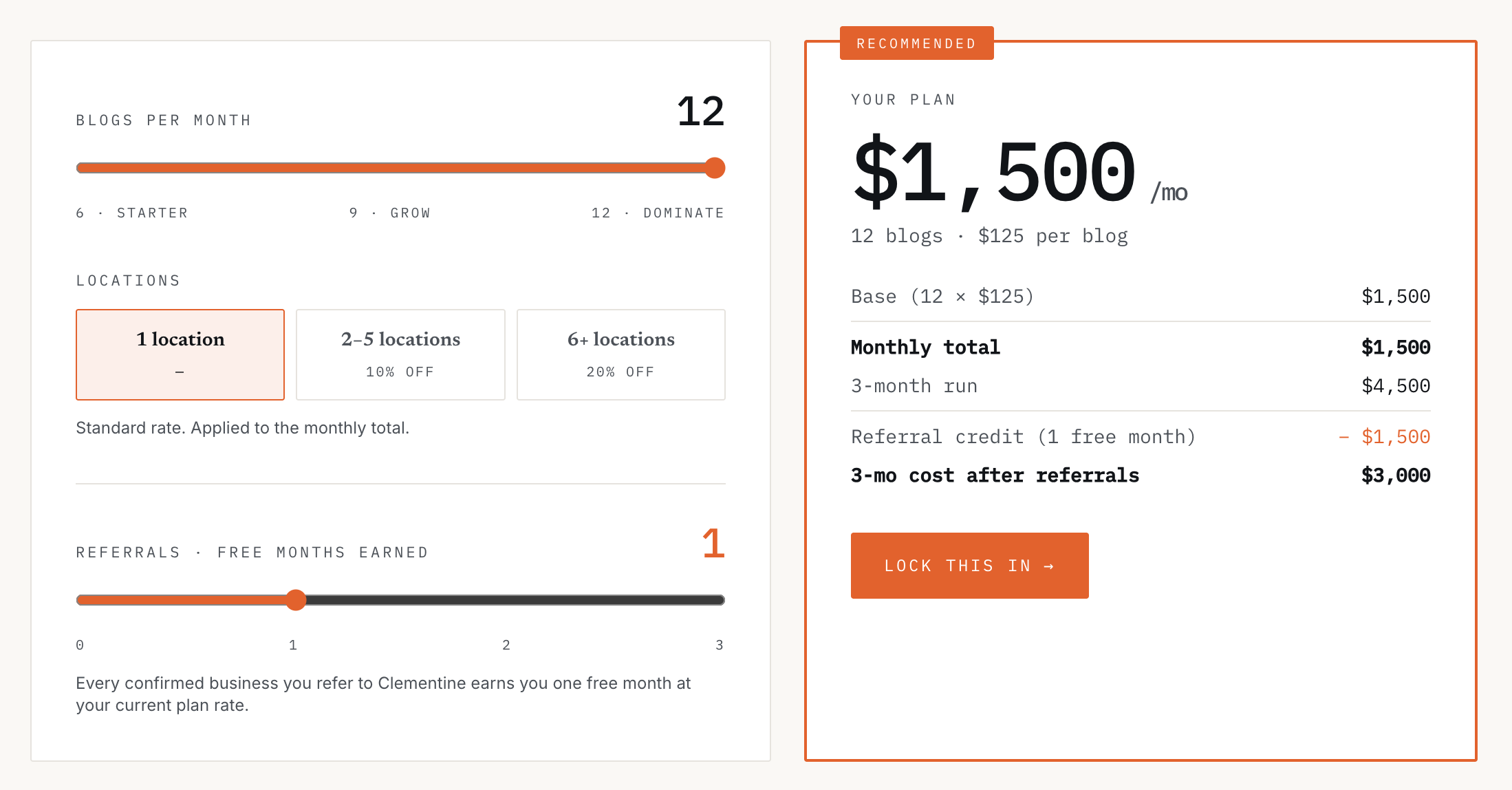
Monthly content/SEO engine — $500–$5,000/mo market range; Clementine is $125/blog · $1,500/mo at the recommended 12. 12 articles, keyword research, on-page optimization, and the monthly rank report; 3-month recommended run, month-to-month after.
Volume tiers — Starter (6) and Grow (9) blogs a month. Per-blog rates on the live calculator.
Multi-location — 10% off (2–5 locations), 20% off (6+). No setup fee, no dashboard fee.
Be careful at the bottom of the market. Sub-$300/month "SEO" is almost always automated directory spam or thin AI-generated content, and it can actively hurt you. The templated content-mill tell — a page that reads like it was written for a plumber, or references "insurance accepted" on a yoga site — is the signature of a vendor who has never run a real campaign for a studio like yours.
On timeline: lower-competition local terms typically reach page one in 30–60 days, with compounding gains at 60–90+ days as your content and authority build. The "#1 in Google Maps in 30 days" claim you'll see elsewhere is possible only as a best case in an easy market — never a guarantee.
Here's what the compounding actually looked like in our flagship multi-location wellness campaign. In the first four months, that site generated 73% of its trailing-12-month Google clicks (1.32K of 1.81K) and 87% of its trailing-12-month impressions (119K of 137K). Peak daily clicks reached roughly 10× baseline (44/day versus about 4/day). Of the first 17 tracked keywords, 9 reached the top 5 within 60 days and 14 reached the top 10. We're happy to walk through the live Search Console account on a call.
A realistic month-by-month shape:
Weeks 0–4 — setup and Google Business Profile optimization.
Weeks 4–8 — first long-tail keyword movement.
Weeks 8–12 — page one for lower-competition terms.
Week 12+ — compounding gains across the cluster.
I don't know of a competitor in this space who publishes their numbers like this. That's deliberate — a studio owner who's been burned before deserves to see the math before deciding.
When to DIY Yoga Studio SEO vs. Hire an Agency
Sometimes the right answer is to do it yourself, and I'll tell you when. If you have one location, a few hours a week, and you haven't yet claimed and completed your Google Business Profile — do that yourself first. It's the highest-ROI free move in local SEO, and you don't need an agency to complete a Profile.
There's also a case for not hiring anyone yet. If your monthly churn is above 5–6%, fix retention first — SEO amplifies what exists, it can't rescue a studio members keep leaving. Same if your booking flow is broken or your offer itself isn't compelling. Get the foundation right, then turn on demand.
Hiring makes sense when you've got multiple locations, no time, a DIY plateau, or you want a compounding content engine running while you focus on teaching. Multi-location studios have a specific requirement: each location needs its own Google Business Profile and a uniquely written location page — duplicate location content hurts rankings, which is why our per-location discounts kick in at 2+ locations. You can see everything the content engine includes if that's you.
Before you sign anywhere, watch for these red flags:
Guaranteed #1 rankings. No one can guarantee rankings; it's a sales tell.
Won't show you Search Console. You can't verify results you can't see.
Hides pricing. Legitimate work has a legitimate number.
Buys backlinks or directory spam. Cheap now, penalties later.
No named strategist. Nobody accountable for the work.
If you'd rather test us than trust us, that's the sensible move — meet the founder behind these campaigns and start there. Or start with the free first batch — we target 6 keywords for your studio; if at least one isn't in Google's top 3, you owe nothing.
Frequently Asked Questions
How much does SEO for a yoga studio cost?
Legitimate small-business SEO runs $500–$5,000/month, and Clementine's content engine is $125/blog — $1,500/month at the recommended 12, with 6- and 9-blog tiers on the live calculator. Be wary of anything under about $300/month — that's usually automated directory spam or thin AI content that can hurt your site more than help it.
How long does yoga studio SEO take to show results?
Lower-competition local terms typically reach page one in 30–60 days, with compounding gains at 60–90+ days. Our best case was a #1 ranking in three weeks, but that's the exception in an easy market, not the promise — real timelines depend on how competitive your area is.
What is the Google Local 3-Pack and why does it matter for a yoga studio?
The Local 3-Pack is the group of three business listings with a map that appears at the top of local search results. It matters because 42% of searchers click the map pack for local queries, and most people rarely scroll past it.
Is SEO or Google Ads better for a yoga studio?
It's both, at different jobs: ads are rented traffic that appear instantly and stop the moment you stop paying, while SEO is an owned asset that compounds over time. Run the LTV and CAC math on your studio — if member lifetime value comfortably supports a 3:1 return, SEO usually wins on cost per member long term.
Should each of my studio locations have its own Google Business Profile?
Yes — every physical location needs its own Google Business Profile plus a uniquely written location page. Duplicating the same content across location pages hurts your rankings, so each one should reflect its real neighborhood, classes, and instructors.
How do I find out if SEO is worth it for my yoga studio?
Start with the free visibility snapshot: send your city and top service, and within 48 hours you'll see exactly where you rank today. Or start with the free first batch — we target 6 keywords for your studio, and if at least one isn't in Google's top 3, you owe nothing.