What's Actually Inside an SEO Package for Small Business (Deliverables, Cadence & 2026 Costs)
See exactly what ships in a small-business SEO package — deliverables, cadence, and honest 2026 costs from $500–$5,000/month, with real data.

By Evan Rief, Founder & Lead SEO Strategist
Last reviewed: August 2026
Everything below reflects packages we actually deliver and data we can show you on a live screen-share — not a template. When the case study comes up, we're happy to walk through the live Search Console account so you can see the numbers move in real time. What your specific market will do depends on your competition, and I'll say so every time it matters.
A small-business SEO package bundles a fixed set of monthly and periodic deliverables: keyword research, on-page optimization (the words, titles, and headings on your actual pages), a set number of new content pieces (a typical package includes around 12 articles a month), technical fixes, local presence and citation work, and a monthly ranking report. In 2026, legitimate SEO packages for small business typically run $500–$5,000/month depending on your competition. Clementine's content engine is $125/blog — $1,500/month at the recommended 12 — for keyword research, on-page work, and a monthly rank report. Below is exactly what ships, how often, and what each line item is worth.
Key Takeaways
A package is only as good as its itemized deliverables with cadence attached — "SEO management" is not a deliverable; "12 articles/month, technical audit quarterly, monthly rank report" is.
Legitimate small-business SEO runs $500–$5,000/month; sub-$500 packages usually underperform (industry survey data below).
Timeline reality: lower-competition terms typically reach page 1 in 30–60 days; compounding gains show up at 60–90+ days.
The single biggest hidden question to ask any vendor: can you keep your content and links if you leave?
AI-search visibility is now a legitimate package line item — but the fundamentals that win it are the same fundamentals that win classic search.
What's Actually Inside an SEO Package (the 6–7 core deliverables)
A real SEO package ships seven things: keyword research, on-page SEO, content creation, technical SEO, local presence and citations, off-page work (links or digital PR), and reporting. Everything else is a variation on those.
Here's each one in plain English — and the vague version you should distrust:
Keyword research — finding the exact phrases your buyers type. Real version: a documented list tied to search volume and buyer intent. Vague version: "we'll target relevant keywords."
On-page SEO — the titles, headings, and body copy on your actual pages. Real version: specific pages optimized against specific keywords. Vague version: "on-page improvements."
Content creation — new pages and articles on a stated cadence. Our content engine ships 12 articles a month; if you want to see how our content engine actually works month to month, it's mapped there in detail.
Technical SEO — the plumbing: site speed, crawlability, schema markup (code that helps Google understand your pages). Mostly one-time fixes, not a recurring line.
Local presence and citations — your business name, address, and phone listed consistently across directories, plus Google Business Profile optimization.
Off-page / links — earning references from other reputable sites. Real version: named placements. Vague version: "high-authority backlinks" with no examples.
Reporting — a monthly report you can actually read.
One thing to watch: a line item called "monthly SEO optimization" is not a deliverable. It's a placeholder. In our campaigns, the packages that work name the exact output shipping each month — not an activity.
The Cadence Map: What Ships Monthly vs. Quarterly vs. One-Off
This is the asset most package pages skip. A deliverable list tells you what; a cadence map tells you how often — and that's where overbilling hides.
The crucial distinction: some line items are one-time work that should not reappear on month seven's invoice. Schema markup, sitemaps, redirects, and speed configuration are built once and maintained rarely. If you're paying monthly for them forever, you're overpaying.
Here's the full matrix, with honest volumes from a real package:
Keyword research — monthly, ongoing. 10–20 target terms, handled by the strategist.
Content articles — monthly, ongoing. 12 per month, handled by writers.
On-page optimization — monthly, ongoing. Tied to the new content, handled by the strategist.
Technical audit — quarterly, ongoing. A full site crawl, handled by the technical team.
Schema, sitemaps, redirects — one-off. Site-wide setup, built once by the technical team.
Local citations — monthly rollout, front-loaded. A tiered rollout across directories, handled by the technical team.
Google Business Profile — monthly, ongoing. Updates and posts, handled by the strategist.
Monthly ranking report — monthly, ongoing. The full keyword set, handled by the strategist.
GEO / AI-answer optimization — monthly, ongoing. Structured content, handled by the strategist.
Read the "one-off" items carefully. If the technical setup items are still billing at full monthly rate a year in, ask why. That's the buyer-protection point nobody in this space wants to spell out.
What an SEO Package Costs in 2026 — and Why Quotes Range From $39 to $10,000
Here's the honest reconciliation: the range is real because different quotes measure different things — market width, competition level, and human-hours. A $39 offer and a $10,000 retainer aren't lying to you; they're describing wildly different amounts of work.
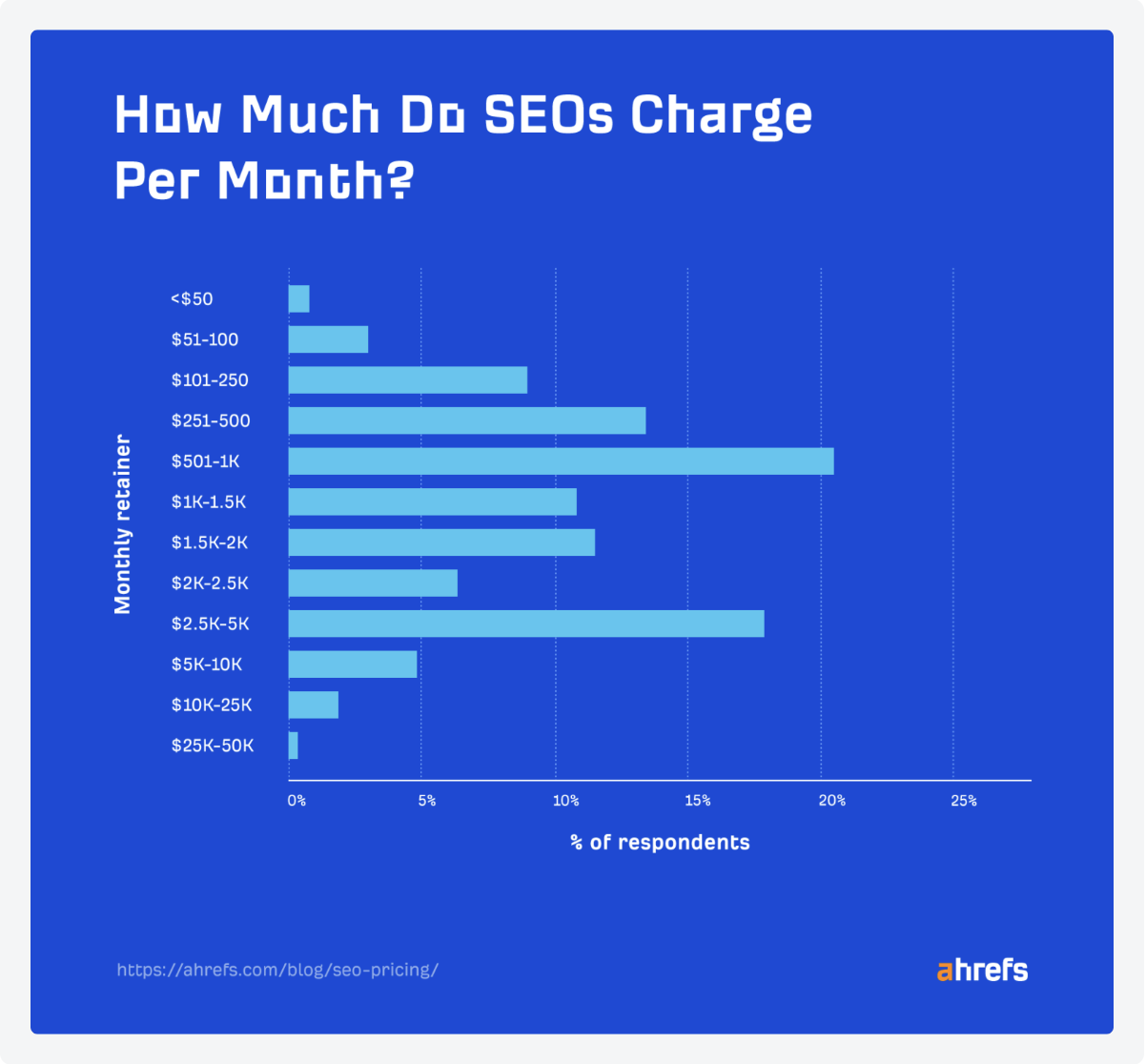
Industry surveys confirm the spread. Ahrefs polled 439 SEO providers and found an all-provider average of $2,917/month, with the single most common retainer band at $501–$1,000 (20.4% of respondents) — and a sharp split by provider type, with agencies averaging $3,209/month versus freelancers at $1,348. SE Ranking's survey of 260 agencies found 64% charge under $1,000/month. Both are accurate; they're measuring different slices. SE Ranking's sample skews small: 94% of those agencies serve small or local businesses and 78% are under 10 people.
Here's where we publish our own numbers, since most pages hide theirs:
Budget / offshore — under $500/mo. Templated content, thin citations. Rarely worth it.
Clementine content engine — $125/blog · $1,500/mo at the recommended 12. 12 articles, on-page work, and the monthly rank report. Best fit: single or multi-location local practices.
Mid-market agency — $2,000–$5,000/mo. Broader content, links, strategy. Best fit: competitive markets.
Enterprise retainer — $5,000–$10,000/mo. Custom hours, heavy link work. Best fit: national or high-competition.
Our actual figures: the content engine is $125/blog — $1,500/month at the recommended 12, with Starter (6) and Grow (9) tiers on the live calculator, multi-location discounts of 10% (2–5 locations) or 20% (6+), and no setup or dashboard fee.
Why does sub-$500 usually fail? Backlinko's SEO services research found clients who spent over $500/month were 53.3% more likely to be "extremely satisfied" than those who spent less. The band tells you little on its own — the deliverable count inside it tells you almost everything. You can see our current package pricing, in full rather than take my word for it.
What a Real Monthly Report Should Contain
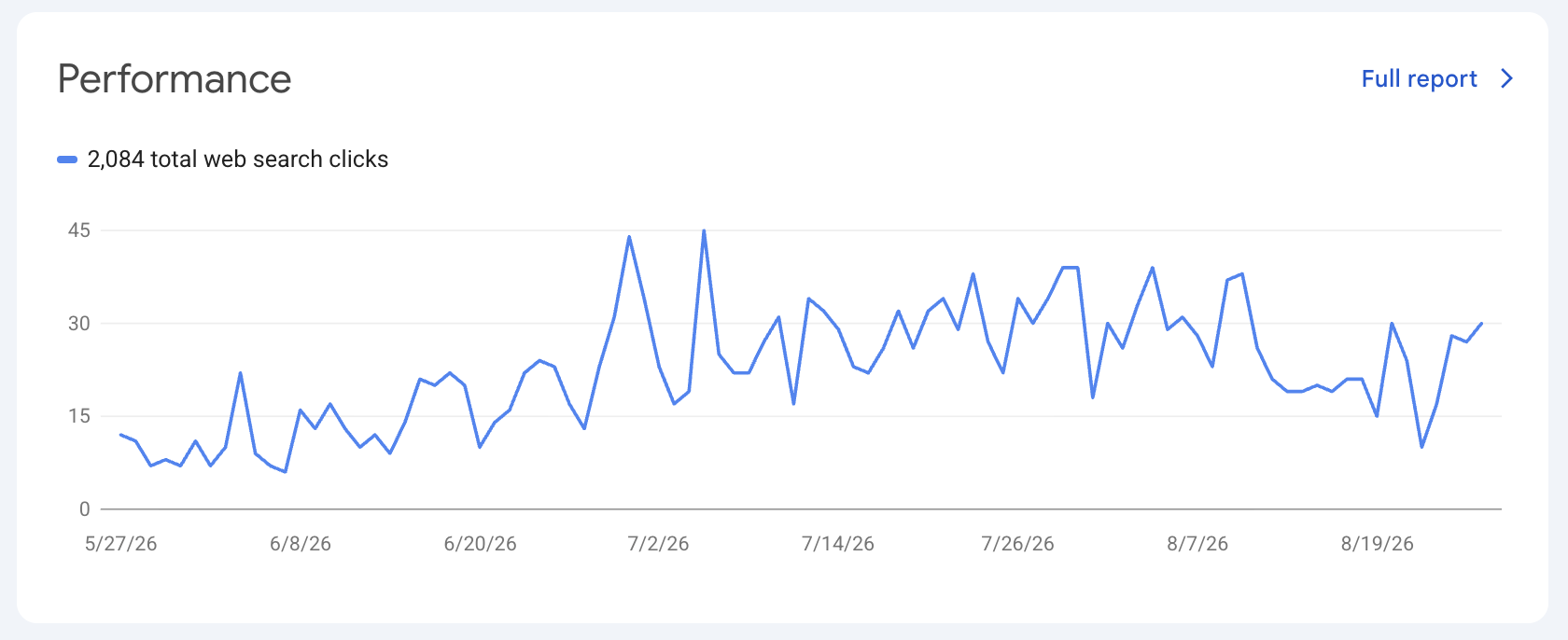
The report is itself a deliverable — one of the most important. A real monthly report shows keyword rankings with movement (up or down, not just position), impressions and clicks pulled from Google Search Console, leads or booked actions where they're trackable, and increasingly your visibility inside AI answers.
Google Search Console is the source of truth here. It reports impressions and clicks directly, and it now surfaces some AI Overview impression data — use that alongside your rank tracker to see which pages are getting cited.
Read past the vanity metrics. A report showing "1,000 new keywords tracked" means nothing if none of them convert. Movement on your money terms and click growth are what matter.
Here's what that looks like over time. In one campaign, 73% of the client site's trailing-12-month Google clicks — 1.32K of 1.81K — were generated inside the first four months. Over the same window, 87% of trailing-12-month impressions landed too: 119K of 137K. Peak daily clicks hit roughly 10× the pre-engagement baseline — about 44 a day versus 4. That first #1 ranking landed in three weeks, which is faster than typical; I'll never sell you on it as the norm. We're happy to walk through the live Search Console account so you can see it isn't a screenshot trick.
Those numbers are what we've seen in our campaigns, not a promise for yours. Your market and competition decide your curve.
AI-Search-Era Deliverables: What GEO Looks Like in a 2026 Package
GEO — generative engine optimization, the work of getting your business surfaced and cited inside AI answers like Google's AI Overviews — is now a legitimate line item. But here's the honest position: the fundamentals that win AI citations are the same ones that win classic search.
Google has confirmed this directly. To be eligible as a supporting link in AI Overviews or AI Mode, a page must be indexed and eligible to appear in Search with a snippet, meeting the standard technical requirements. And per Google's guidance on AI features and your website, the best practices for SEO remain relevant for AI features, with no additional requirements or special optimizations necessary to appear in AI Overviews or AI Mode.
So anyone selling you a secret "AI ranking system" is selling smoke. What actually helps, as a cadence-attached deliverable: structured, answer-first content, clear FAQ and schema markup, entity clarity about who you are and what you do, and monthly monitoring of your AI-answer impressions.
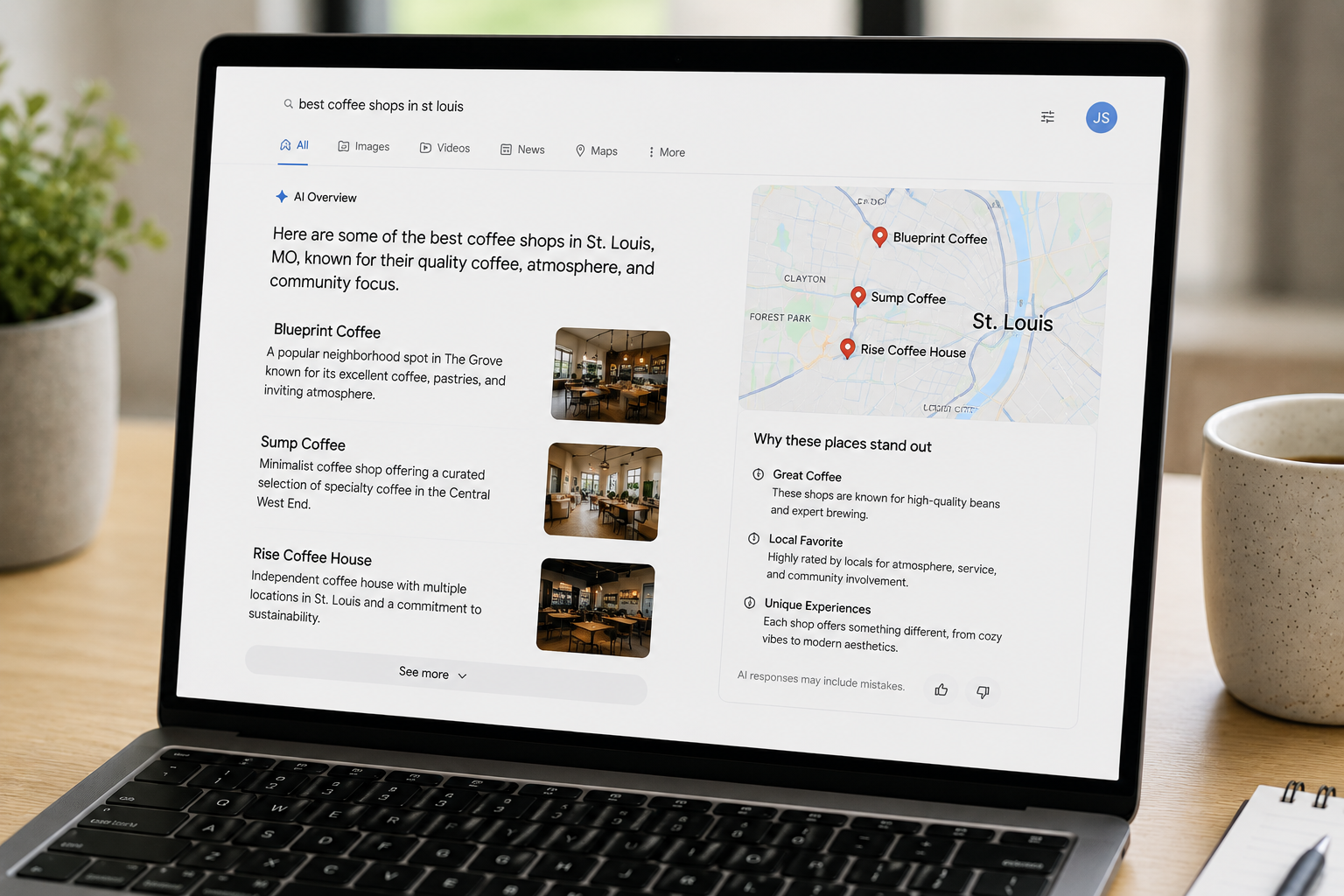
Google has also signaled that first-hand perspectives and trusted, creator-driven content help people search with more confidence. Which is why a named practitioner and real data beat anonymous scaled content — in AI search as much as classic search.
Ignore the "SEO is dead" clickbait. Search changed shape; the work didn't get replaced, it got a new surface.
Deliverables That Drive Results vs. Filler You're Overpaying For
Across our client Search Console accounts, the pattern is consistent: value concentrates in a handful of line items, and the rest is often padding.
High-value, worth paying for:
Real content on a stated monthly cadence.
On-page work tied to actual keyword research.
Genuine technical fixes (once).
Consistent local citations and GBP optimization.
Reporting you can independently verify in Search Console.
Filler to question:
"Directory submissions" by the hundreds with no cadence or quality.
Keyword-density padding (a tactic that stopped working years ago).
"Monthly optimization" with no named output.
Exact-match domain schemes and other stale shortcuts.
A quick red-flags test: if you can't name what shipped last month, something's wrong. You should be able to point at 12 articles, a rank report, and a citation rollout — not a vague activity summary. Be especially wary of anyone pitching pre-2025 tactics as current strategy. Keyword stuffing and directory spam aren't clever anymore; they're liabilities.
What an SEO Package Looks Like for a Health & Wellness Practice
Let's ground this in one vertical: a physical therapy or med-spa practice. The generic SERP never does this, and the specifics matter.
Search behavior in this vertical runs on money keywords in the patient's own language — "back pain relief," "Botox pricing," "PT for runners." Buyer economics reward it: a patient who rebooks for a course of treatment has real lifetime value, so a package that earns even a handful of new patients monthly pays for itself quickly.
Compliance is non-negotiable. Medical practices operate under HIPAA, and some verticals restrict how you use patient testimonials — a competent package accounts for that instead of scraping reviews into content.
Which line items matter most here? Local presence and reviews, heavily. BrightLocal's 2026 Local Consumer Review Survey found that 80% of consumers are more likely to use a business that replies to all its reviews, while generic or templated replies put off half of them. That's why GBP and review management earn their place in a health-and-wellness package.
One honest process note, paraphrased from our own campaigns: content and reviews earn the traffic, but they can't fix a broken booking flow or a practice with no reviews to begin with. If patients land on your page and can't book in two taps, no package rescues that.
When an SEO Package Is the Wrong Choice
I'd rather tell you not to buy than sell you the wrong thing. A package isn't always the right first move.
When DIY or tools are the right call: A solo operator with one location in a very low-competition market, who has time to learn, can genuinely do a lot alone. No shame in it. Free tools and a few good hours a week go a long way when nobody else is competing.
When a package won't fix the real problem: A weak offer, a broken conversion path, zero reviews, or the wrong service-market fit are business problems, not SEO problems. SEO sends qualified people to your door; it can't make them want what's behind it.
You're ready for a package when your offer converts, your booking works, and your only gap is that not enough people find you. If any of those first two are broken, fix them first. Choosing the right SEO packages for small business comes down to that readiness — matched against itemized deliverables you can verify each month.
Frequently Asked Questions
What is included in a small-business SEO package?
A standard package includes keyword research, on-page optimization, content creation on a set cadence, technical SEO fixes, local presence and citation work, and a monthly ranking report. The best packages attach a specific volume and frequency to each — for example, 12 articles a month plus a quarterly technical audit. If a line item has no output attached, treat it as filler.
How much do SEO packages cost per month in 2026?
Legitimate small-business SEO typically runs $500–$5,000/month depending on your competition. Industry surveys show the spread: Ahrefs' all-provider average is $2,917/month, while SE Ranking found 64% of its 260 surveyed agencies charge under $1,000. Clementine's content engine is $125/blog — $1,500/month at the recommended 12. Sub-$500 packages usually underperform.
How long until an SEO package shows results?
Lower-competition terms typically reach page 1 in 30–60 days, with compounding gains at 60–90+ days. Google's own SEO guidance notes some changes take hours while others take months, and suggests waiting a few weeks to assess impact. We've seen a first #1 ranking in three weeks, but that's a best case, not a promise.
Are SEO packages worth it for a small business?
Yes — when the deliverables are itemized and the market expectation is realistic. A package with named monthly output at a fair price reliably earns visibility over 60–90 days. It's not worth it when the price is sub-$500, the scope is vague, or your offer and booking flow are broken.
Can I keep my content and links if I leave the agency?
Yes — you should own your content, and it should live on your own website, not inside the agency's proprietary tooling. Before signing, ask this directly: if you cancel, does everything published on your domain stay yours? If the answer is no, walk away.
How do I find out if SEO is worth it for my business?
Start with the free first batch: claim your free first batch — we target 6 keywords for your business, and if at least one isn't in Google's top 3, you owe nothing. Send your site and top service and you'll see exactly where you stand.