Blog Writing Services for Small Business: What They Cost, What's Inside, and How to Tell If They Actually Work
Blog writing services for small businesses cost $500–$5,000/mo. See what's really included, what's fair to pay, and how to tell if content actually works.

By Evan Rief, Founder & Lead SEO Strategist
Last reviewed: July 2026
This post draws on real Clementine client campaigns — including one whose live Google Search Console account I'm happy to walk through on a call — plus named Google documentation and third-party rate data from the Editorial Freelancers Association and BrightLocal. Results vary by market and competition, and nothing here is a ranking guarantee.
Blog writing services for small businesses typically cost $500–$5,000/month depending on volume and whether SEO is included. A real package covers keyword research, topic strategy, writing, on-page SEO, images, and monthly reporting — not just words. Expect lower-competition local terms to reach page one in roughly 30–60 days, with compounding gains at 60–90+ days.
Key Takeaways
Real blog-writing packages sell a content system — keyword research through monthly reporting — not a word count.
Legitimate small-business content runs $500–$5,000/month; Clementine's engine is $125/blog at the recommended 12 a month ($1,500/mo), with 6- and 9-blog tiers and multi-location discounts.
Cheap isn't neutral: a $15 content-mill post and a specialized SEO post are both "blog posts," but they produce completely different outcomes.
Realistic timeline: 30–60 days to page one on lower-competition local terms, with compounding gains at 60–90+ days.
A blog is the wrong spend for some businesses — and I'll tell you which ones below.
What Blog Writing Services Actually Include (It's Not Just Words)
When you hire a real blog writing service, you're not buying paragraphs by the pound. You're buying a repeatable, intent-matched content system. It figures out what your customers are searching for, then builds pages designed to be found and to convert.
The tell of a serious provider is that they can itemize what you get. Here's what a complete package should deliver:
Keyword research. Finding the exact phrases your customers type into Google — so every article aims at real demand.
Topic map. A planned sequence of posts, not random ideas — it builds the topical depth Google rewards.
Drafting. The actual writing, by a human who understands your field — accuracy and readability live here.
On-page SEO. Structuring each page so search engines understand it — including meta descriptions (the summary text under your link in results) and alt text (the description behind each image). This is what makes pages eligible to rank.
Images. Relevant, properly labeled visuals for engagement and accessibility.
Internal linking. Connecting related pages on your site to spread ranking strength.
Monthly rank reporting. A record of where your keywords sit each month — it proves the work is or isn't working.
Be wary of any provider who sells "SEO-optimized content" but won't show you a list like this. "Optimized" is a meaningless word without the parts underneath it.
Google has confirmed the standard your content should meet. Its helpful content documentation asks whether a page provides "original information, reporting, research, or analysis" — and whether it covers its topic substantially and completely, rather than skimming it. In my campaigns, the packages that hit that bar are the ones built as a system — you can see how the content engine is built end to end.
What Blog Writing Services Cost in 2026 (Real Numbers, No "Contact Us for a Quote")
The honest market range for legitimate small-business SEO content is $500–$5,000/month. Where you land depends on volume, whether SEO strategy is bundled in, and how specialized your industry is.
Content mill — $100–$500/mo. High-volume generic posts. Where it goes wrong: rarely ranks — thin and templated.
Freelancer — $400–$2,000/mo. Skilled writing with variable SEO. Where it goes wrong: you supply the strategy.
Specialized agency — $1,500–$5,000/mo. The full system plus reporting. The trade-off: higher cost, higher accountability.
Clementine engine — $125/blog · $1,500/mo. 12 articles, keyword research, on-page optimization, and the monthly rank report — 3-month recommended run, month-to-month after.
For context on per-word math, the Editorial Freelancers Association's 2026 rate chart — based on a survey of more than 1,100 EFA members covering 2025 work — puts blog post writing at $0.25 to $0.40 per word for professional freelancers, with more specialized business and marketing writing running higher still. At a mid-range $0.30 per word, a 1,500-word post costs $450. At $0.15 per word — entry-level or content-mill pricing — that same post costs $225, but often lacks the depth and structured thinking that earns rankings.
Here's the honesty most providers skip: a bargain post that doesn't rank isn't a discount — it's 100% wasted spend. My pricing is flat per published blog: $125/blog at the recommended 12 a month ($1,500/mo), with Starter (6) and Grow (9) tiers on the live calculator, multi-location discounts of 10% (2–5 locations) or 20% (6+), and no setup or dashboard fees. You can see the full, published pricing rather than filling out a "contact us" form.
Content Mill vs. Freelancer vs. Specialized Agency: Which One You Actually Need
Not everyone needs an agency. The right choice depends on what you already have in place.
Content mill — $15–$50/post. Best for pure volume and internal use. The real trade-off: it almost never ranks.
Individual freelancer — $200–$600/post. Best when you already have a keyword strategy. The real trade-off: you manage strategy and QA.
Specialized/local agency — $1,500+/mo. Best for businesses that need to rank. The real trade-off: higher cost, full accountability.
If you already have a clear keyword strategy and just need execution, a good freelancer is often the smart, cost-effective call — you don't need to pay agency rates for typing. A content mill can be fine for raw internal volume, but it's rarely right if the point is to get found on Google.
The "$15 vs. $500 post" difference is real even though both wear the same label. Service industries pay a premium for subject-matter accuracy — a chiropractor's or dentist's blog has to be clinically correct. In my campaigns, that accuracy is exactly what separates content that builds trust from content that quietly erodes it.
Proof It Works: Real Results From the 12-Article Content Engine
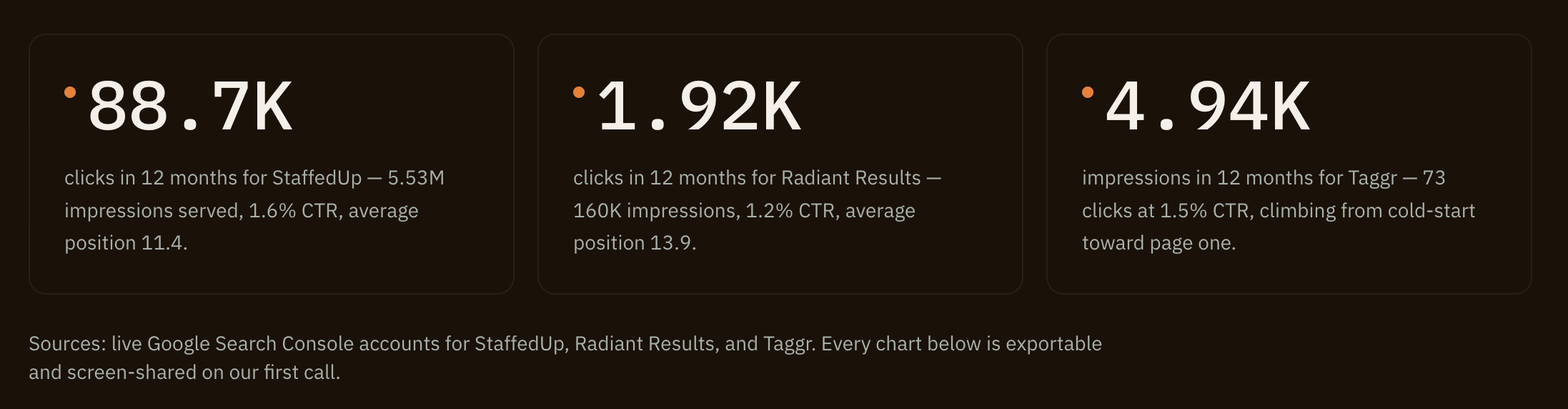
Most providers claim results. Almost none show them. So here's one of mine, and I'm happy to walk through the live Search Console account on a call.
A multi-location medical-wellness franchise engagement began in March 2026. In this campaign, 73% of the site's trailing-12-month Google clicks were generated inside the first four months — 1.32K of 1.81K. Impressions told the same story: 87% of the trailing-12-month total came in that window (119K of 137K).
Peak daily clicks reached roughly 10× the pre-engagement baseline — about 44 a day against a starting point near 4. On keyword movement, 9 of the first 17 tracked keywords reached Google's top 5 within 60 days, and 14 of 17 reached the top 10.
I did hit a #1 ranking in 3 weeks on one term — but that was this campaign's best case, faster than typical, and not something I'll ever promise you. This is one client, and results vary by market and competition.
The Right Cadence — and When NOT to Hire a Service
Most small local businesses see compounding results from a consistent, sustainable cadence rather than occasional bursts. My engine ships 12 articles per month — but more articles only help if quality and intent-match hold. If you want the full cadence math — floors, ceilings, and when volume stops paying — the dedicated cadence guide covers it.
Google has confirmed the risk of chasing volume for its own sake: its helpful-content self-assessment asks whether content is mass-produced or outsourced across so many creators that individual pages get little attention or care. Cadence without care backfires.
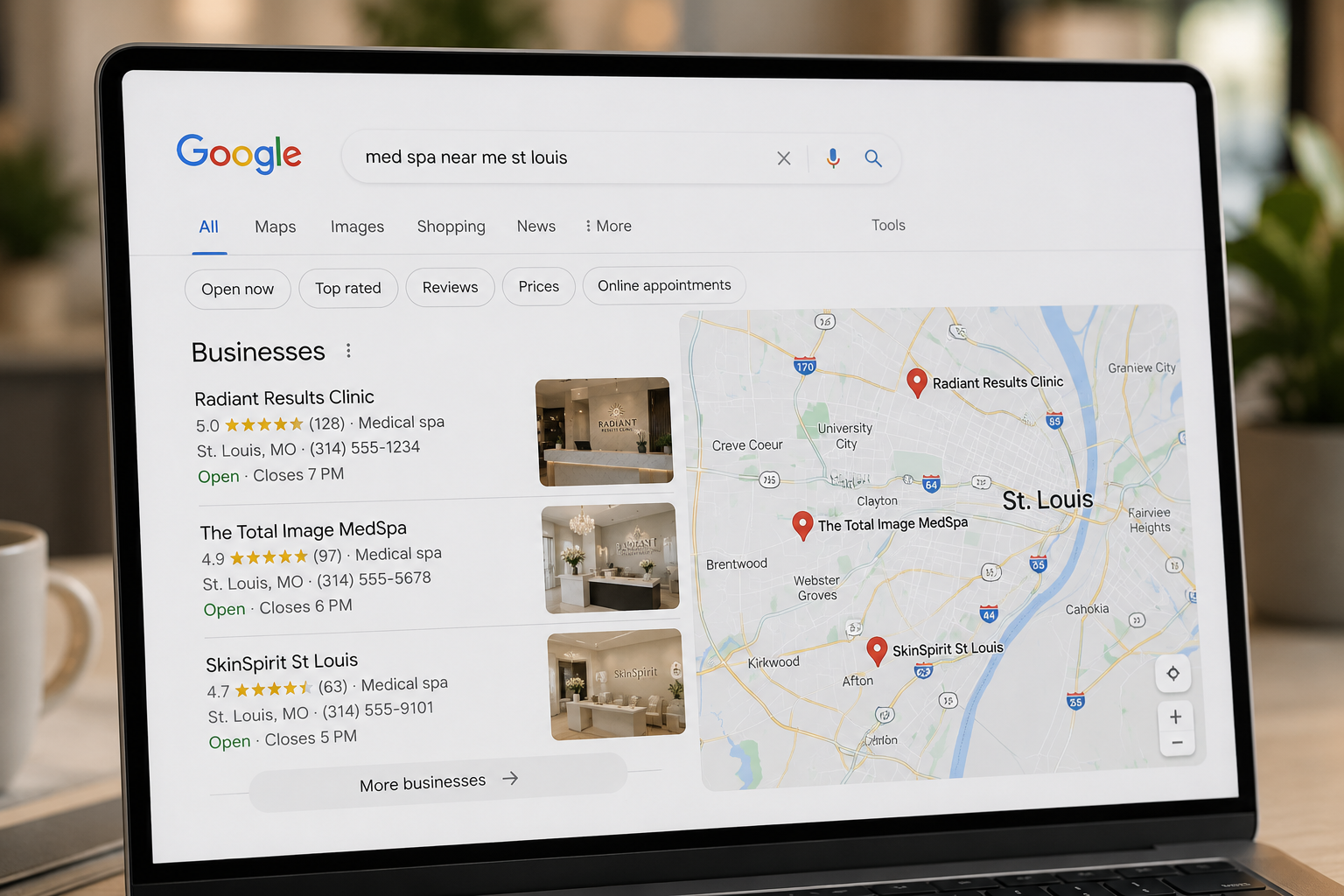
Now the part most agencies won't say out loud: sometimes a blog is the wrong spend. Hold off if your booking flow is broken or missing, if you haven't set up your Google Business Profile foundation yet, if your offer itself is weak or unclear, or if you're on a brand-new site where local presence and reviews will move the needle faster first.
Content can't fix a broken funnel. If people can't book once they find you, more traffic just means more people bouncing. Fix the funnel first — then the content pays.
Do Blog Writing Services Still Work in the AI-Overview Era? (2026 Reality)
Yes — search is shifting, not ending, and the fundamentals that win AI Overview citations are the same ones that have always won. Ignore anyone selling you a whole new "AI playbook" or a proprietary schema hack.
Google has confirmed this directly in its documentation on AI features and your website: established SEO best practices remain what's relevant for AI features, with no additional requirements to appear in AI Overviews or AI Mode and no special optimizations needed. Its guide to generative AI features puts it in one line — it's "optimizing for the search experience, and thus still SEO."
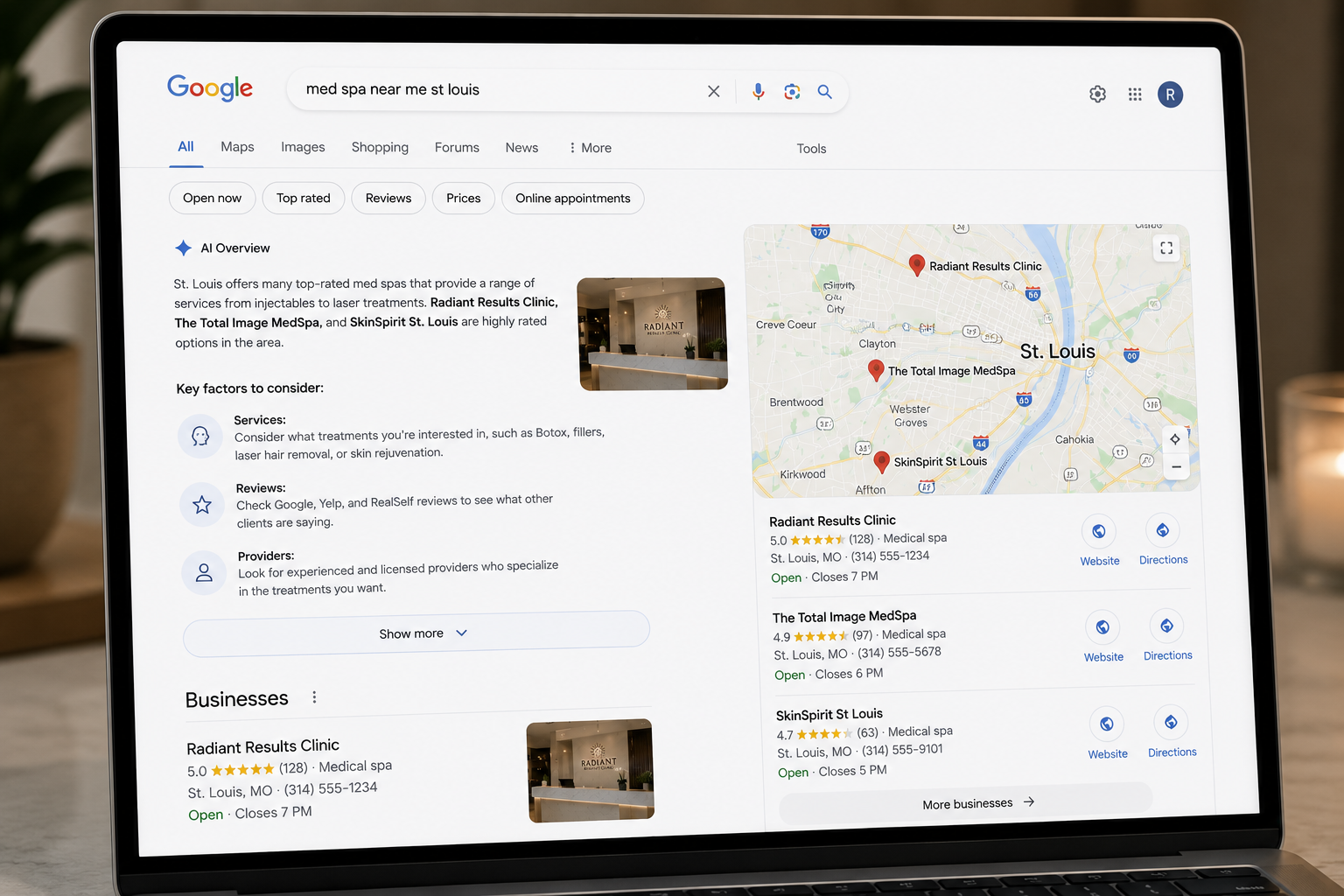
There's a hard eligibility line, too. Per the same documentation, a page must be indexed and eligible to show with a snippet before it can appear as a supporting link in AI Overviews or AI Mode. If your content isn't good enough to rank, it isn't good enough to be cited.
This matters more for local businesses, not less. BrightLocal's Local Consumer Review Survey 2026 found that 45% of consumers now use ChatGPT or other generative AI tools to find local business recommendations. That's exactly why I build for intent-matched, citation-worthy content instead of word-count padding. The blog writing services that survive the AI era are the ones already earning rankings.
The free visibility snapshot takes one reply: send your city and top service, and within 48 hours you'll see exactly where you rank today. Or start with the free first batch — I target 6 keywords for your business, and if at least one isn't in Google's top 3, you owe nothing.
Frequently Asked Questions
How much do blog writing services cost for a small business in 2026?
Legitimate small-business content typically runs $500–$5,000 per month depending on volume and whether SEO is included. Clementine's engine is $125/blog at the recommended 12 a month ($1,500/mo), with 6- and 9-blog tiers on the live calculator. For per-post context, the Editorial Freelancers Association's 2026 chart puts professional blog writing at $0.25–$0.40 per word.
Are blog writing services worth it for a small business?
They're worth it when your funnel is ready and the content targets real search demand. They're not worth it if your booking flow or Google Business Profile foundation is broken — content can't fix a leaky funnel. Fix that first, then invest in content.
What's included in a done-for-you blog writing package?
A complete package covers keyword research, topic strategy, writing, on-page SEO, images, internal linking, and monthly rank reporting. If a provider can't itemize this for you, treat "SEO-optimized" as an empty label.
What cadence should a small business run?
A consistent, sustainable cadence beats occasional bursts. My engine ships 12 articles per month, but volume only helps if quality and intent-match hold — Google explicitly warns against mass-produced content that gets little care per page.
Do blog writing services include keyword research and SEO, or just writing?
Both, when done right. In my engine, keyword research and on-page SEO are built in, not billed as add-ons. Writing without those is just words that may never get found — which is why SEO blog packages should always show their strategy layer.
How do I find out if blog content is worth it for my business?
Send your city and top service for a free visibility snapshot, and within 48 hours you'll see where you rank today. Or start with the free first batch — I target 6 keywords, and if at least one isn't in Google's top 3, you owe nothing. That tells you whether content is your best next spend before you commit a dollar.