SEO vs. Google Ads for Local Business: An Honest Budget-Allocation Guide (2026)
Ads buy speed, SEO builds an asset you own. An honest 2026 guide to allocating a local budget between Google Ads and SEO — with real numbers, not hype.
By Evan Rief, Founder & Lead SEO Strategist
Last reviewed: August 2026
This guide draws on real Clementine client campaigns — the Google Search Console and Google Ads dashboards behind these numbers, which we're happy to walk through on a screen-share. It also cites named Google documentation and industry research from SparkToro, Ahrefs, Backlinko, and BrightLocal. Results vary by market and competition, and nothing here is a ranking or revenue guarantee.
If you have a limited budget and one decision to make, here it is: run Google Ads when you need leads in the next 30 days, are testing a new offer, or face six-plus months of organic competition. Invest in local SEO when you have three to six months of runway and want a compounding asset you own. Most local businesses should run a modest Ads budget to fund the wait while SEO foundations build.
Key Takeaways
Ads buy speed you rent; SEO builds an asset you own — most local businesses need both, in sequence.
In lower-competition local markets, SEO typically reaches page 1 in 30–60 days, with compounding gains at 60–90+ days.
Ads deliver leads day one but stop the moment you stop paying; SEO's cost-per-lead falls over time as the asset matures.
Running Google Ads does not change your organic or map-pack rankings — they're separate systems (Google-confirmed).
In 2026, roughly 68% of US Google searches end without a click (SparkToro), up from about 60% in 2024 — which changes how you measure SEO's return, not whether it pays off for local.
SEO vs. Google Ads for Local Business: The 60-Second Answer
Use Google Ads — pay-per-click paid placement at the top of the results — when you need leads in the next 30 days, are testing a new offer, or face six-plus months of organic competition. Invest in local SEO — earning organic and map-pack visibility you don't pay per click for — when you have three to six months of runway and want an asset you own. Most local businesses should run both, in sequence.
Here's the number nobody else in this discussion will show you: in one of our medical-wellness campaigns, paid cost-per-lead stayed roughly flat while organic cost-per-lead kept falling. Later in this guide I'll show you the month it crossed over — from a real dashboard, not a slide.
This matters because most "SEO vs. Ads" content is written by someone selling you one side. I run both channels for local businesses every month. So this is written to help you allocate a budget, not to talk you into a service. That includes how our content engine builds that organic asset — and the cases where I'll tell you not to touch it yet.
Ads win on speed. SEO wins on durability. The right answer is almost never "pick one forever."
What Each Channel Actually Costs a Local Business in 2026
Google Ads for a local service business typically runs a daily budget of $20–$100 (roughly $600–$3,000/month in spend), plus management if you're not running it yourself. Legitimate small-business SEO typically runs $500–$5,000/mo, depending on market and scope — for the full market breakdown, see what SEO really costs a small business.
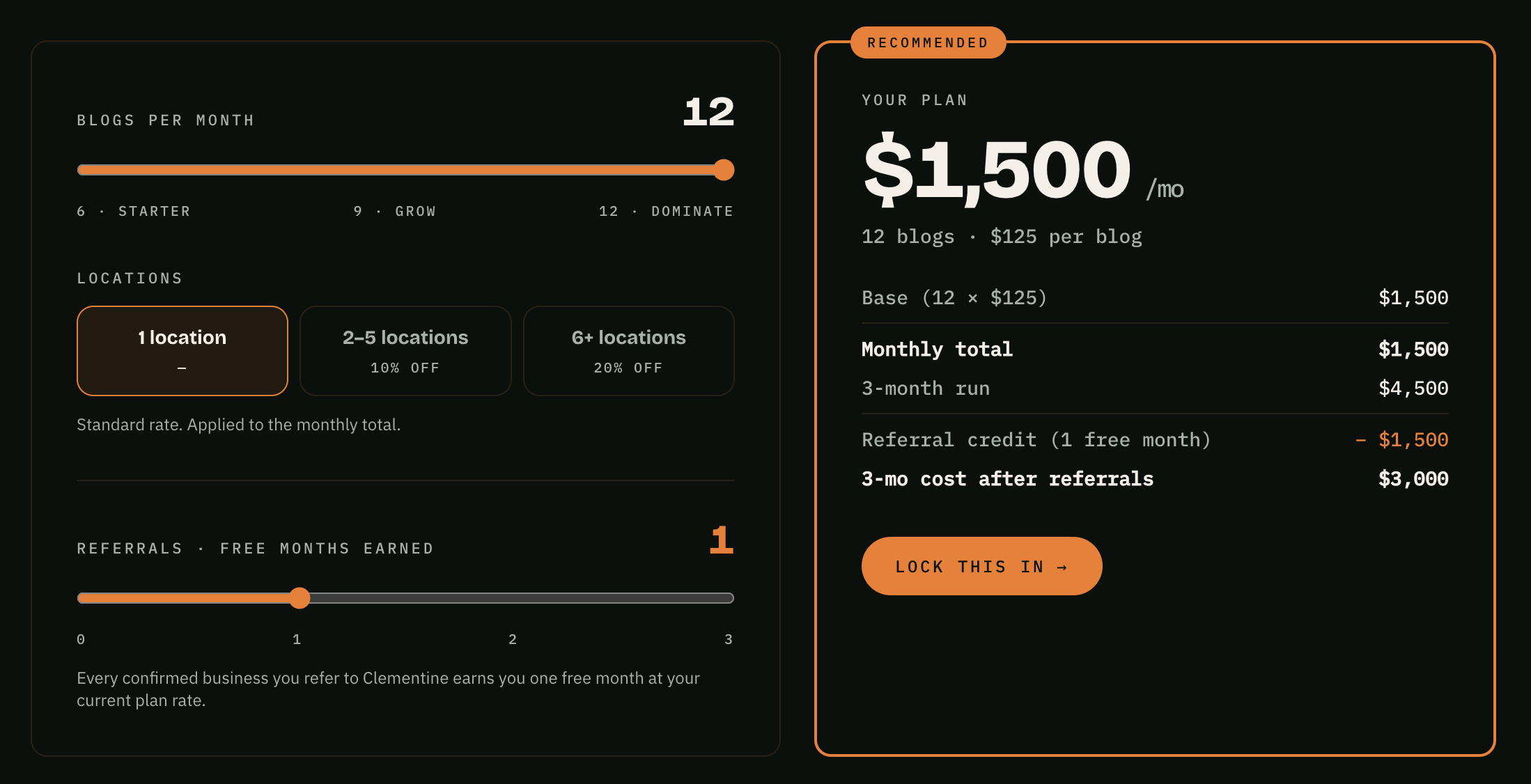
Here's what we charge, exactly — no rounding, no "contact us for a quote." Our content engine is $125/blog — $1,500/mo at the recommended 12 (keyword research, on-page work, and the monthly rank report included), with 6- and 9-blog tiers on the live calculator, multi-location discounts of 10% (2–5 locations) or 20% (6+), no setup fee, and a 3-month recommended run that goes month-to-month after. You can see our full pricing laid out in dollars.
Now the part most agencies won't say out loud: what $99–$299/mo "SEO" actually buys. At that price, you're getting spun or AI-scaled content, automated directory submissions, and no strategy — because there's no room in the budget for a human doing real work. It rarely moves rankings, and Google increasingly demotes exactly that kind of content, as spelled out in Google's guidance on scaled content abuse. Cheap SEO isn't a discount; it's usually money spent to accomplish nothing.
The structural difference between the two channels:
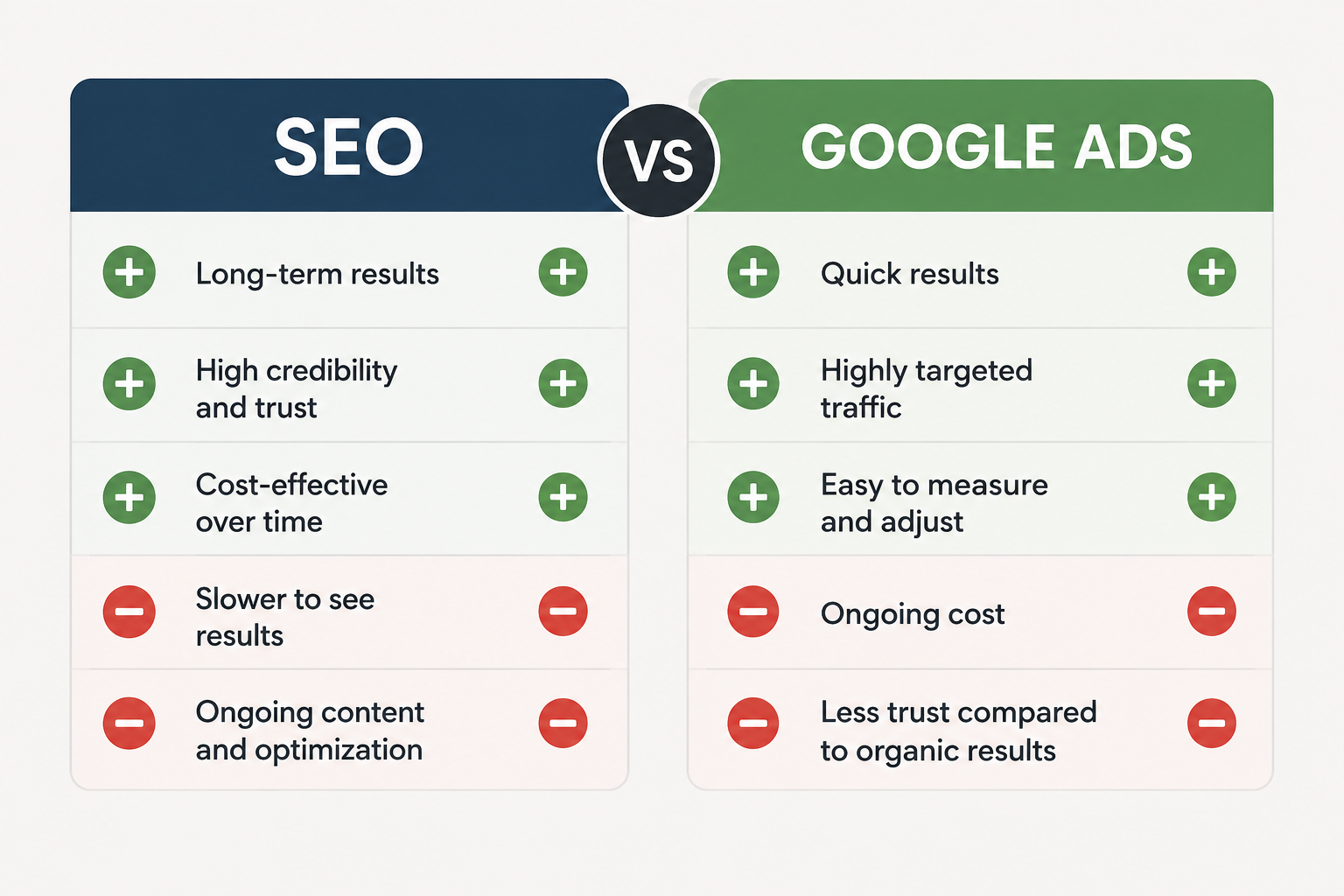
Typical monthly cost. Ads: $600–$3,000 in spend. Local SEO: $500–$5,000.
Time to first leads. Ads: same day. SEO: weeks to a few months.
What you're paying for. Ads: clicks, per click. SEO: an asset you own.
What happens when you stop. Ads: visibility disappears immediately. SEO: rankings largely persist.
Best-fit situation. Ads: speed, testing, hyper-competitive terms. SEO: runway and compounding value.
The Cost-Per-Lead Crossover: When SEO Gets Cheaper Than Ads
Cost-per-lead (CPL) is simply what you spend to generate one inquiry — a call, form fill, or booking. It's the number that actually matters, not clicks or rankings.
With Ads, CPL stays roughly flat: you keep paying per click, so more leads means proportionally more spend. With SEO, CPL starts high — you've invested upfront and have few leads to show for it — then falls as rankings compound and traffic grows against a fixed monthly cost. That declining curve is the crossover.
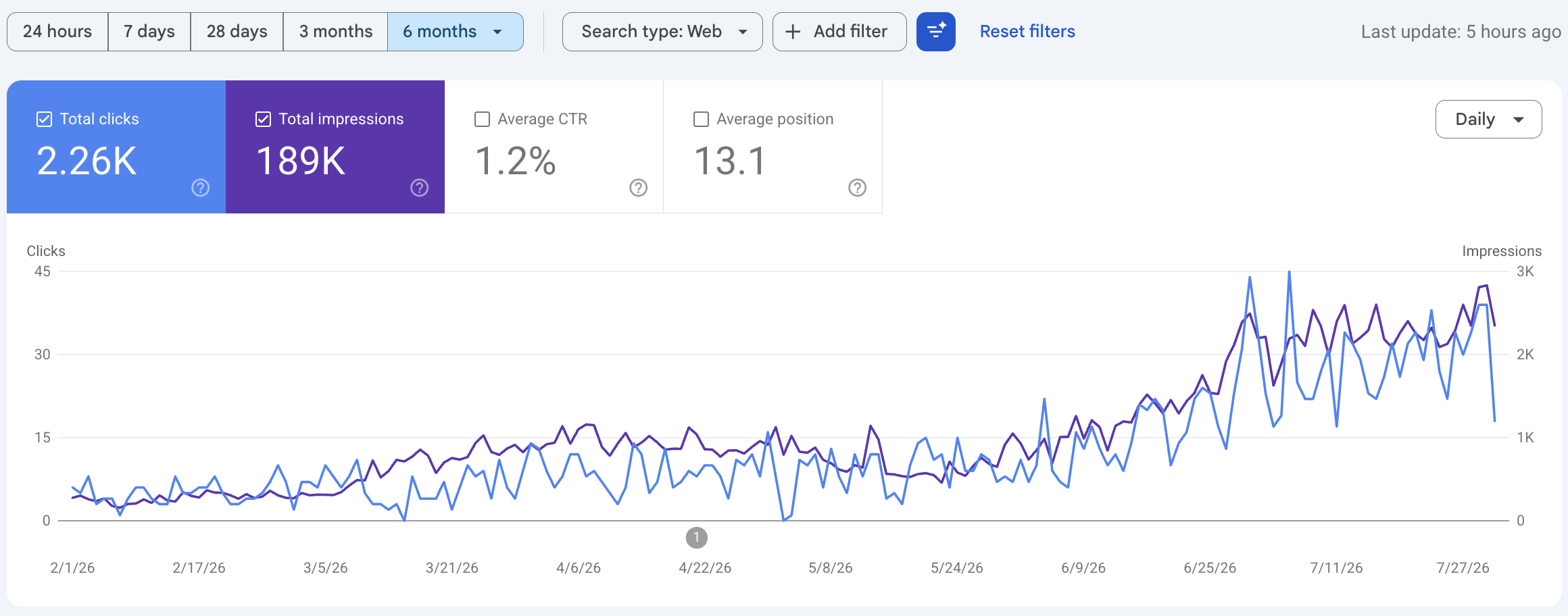
In our flagship multi-location medical-wellness campaign (engagement began in March 2026 — and we're happy to walk through the live Search Console account), the ramp was steep. 73% of the site's trailing-12-month Google clicks were generated inside the first four months (1.32K of 1.81K). 87% of trailing-12-month impressions landed in that same window (119K of 137K). Peak daily clicks reached roughly 10× the pre-engagement baseline — 44 a day versus about 4. As organic clicks climb against a fixed content-engine cost, the per-lead cost falls. That's the mechanism behind a crossover. You can read about the team behind these numbers in more detail.
Illustratively, the pattern runs like this: Ads CPL sits at its baseline in month 1 and is still at that baseline in month 12. SEO CPL starts at its highest in month 1, falls through month 3, typically drops below Ads somewhere around month 6, and keeps falling through month 12. The shape is consistent; the exact crossover month varies by market.
One honesty note: if you see a suspiciously precise, uncited ROI figure — a clean "748% return" with no source — treat it as a red flag. I'd rather show you the dashboard than quote a number I can't back up.
When Google Ads Is the Right Call (and We'll Tell You to Use It Over Our SEO)
Ads genuinely win in a few situations: you need leads in 30 days or less; you're testing a brand-new offer or location and want fast feedback; you're chasing a hyper-competitive term where organic will realistically take six-plus months; or you're running a time-boxed promotion.
Here's where I'll talk myself out of a sale. If you need revenue this month and have no runway, I'll tell you to run Ads first — not our SEO service. Recommending SEO to someone who can't survive the ramp is how agencies burn clients, and I'm not interested in doing that.
Be honest with yourself about the trade-off: Ads are instant but rented. The moment you stop paying, you disappear from the results entirely.
One factual point most "vs." articles skip: Google has confirmed that running Ads does not buy or boost your organic or map-pack rankings. They're two separate systems, as stated in Google's documentation on how search works. Anyone who tells you paying for Ads lifts your organic position is selling you a story.
When Local SEO Wins — and How AI Overviews Changed the Math in 2026
SEO wins when you have three to six months of runway, want a compounding asset you own, and want map-pack and AI-citation presence that keeps working without per-click spend.
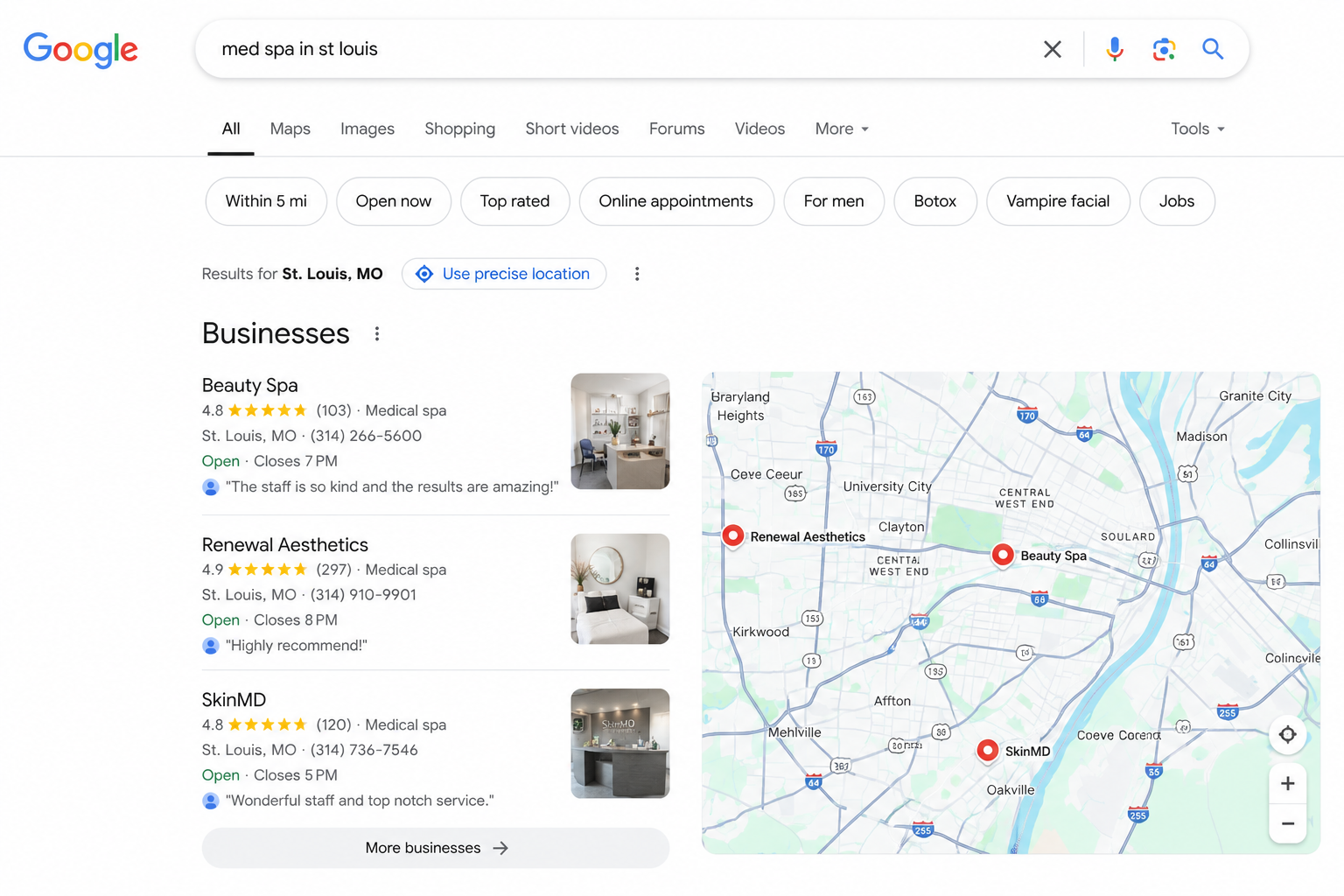
For health and wellness practices, the economics tilt further toward SEO because of lifetime value. In our campaigns we see it clearly: a med spa patient rebooks quarterly, a chiro's new patient carries months of visits. When one organic lead can be worth thousands over a year, even modest organic volume can outrun Ads spend across twelve months.
Now the honest adjustment nobody makes. The traffic math has changed. SparkToro's June 2026 zero-click study found that 68% of US Google searches ended without a single click in early 2026, up from about 60% in 2024 — a sharp two-year jump, with the caveat SparkToro itself flags that measurement panels changed across years. Within the same study, Ahrefs trigger data shows AI Overviews now appear on more than 20% of searches, and Ahrefs' click analysis — cited by SparkToro — finds click-through drops by roughly 60% when one is present.
So does SEO still pay for local? Yes — and the study's own nuance is the reason: the click decline concentrates in informational queries that an AI answer can fully satisfy. Branded, local, and transactional searches — the ones that make you money — are affected far less. The map pack still drives calls, and AI answers still cite and recommend well-optimized local businesses. But you should measure calls, bookings, and citations, not just raw organic clicks.
On earning that AI visibility: Google has confirmed there's no separate "AEO" or "GEO" playbook — standard SEO is what makes a page eligible across both classic and AI-based search, per Google's guidance on AI features and your site. That's exactly how we approach content that earns AI citations and rankings. And the local click that matters most is holding: Backlinko's local SEO research found 42% of local searchers click a result inside the map pack — while BrightLocal's 2026 survey shows 45% of consumers now also use AI tools for local business recommendations. Both surfaces reward the same well-built presence.
How SEO and Google Ads Compound Together (the Allocation Playbook)
Don't just "do both" — sequence them. Here's the split I recommend for most local businesses:
Days 1–90 — Ads leads, SEO builds. Run a modest daily Ads budget for immediate leads while the foundations get built: Google Business Profile, on-page work, the first content batch. Measure cost per lead.
Days 90–180 — rebalance. As organic leads start appearing, shift spend toward the compounding channel while Ads covers the gaps. Watch organic leads grow month over month.
Day 180+ — SEO carries, Ads snipes. Keep Ads running for high-intent and emergency terms only, and let SEO carry the bulk of your volume. Measure total blended cost per lead.
Ratios are a practitioner recommendation; adjust to your market and runway.
Ads can support SEO indirectly — increasing brand awareness, generating engagement signals, helping you occupy more of the results page, and handing you real keyword and conversion data to feed your content strategy. What Ads can't do is buy rankings or fast-track a brand-new site past the trust it has to earn over time.
Before You Spend a Dollar: Fix This First — or DIY Instead
Here's the truth if you're cash-strapped. Before either channel, fix the conversion path. Claim and fully complete your Google Business Profile, make sure your site loads fast, and make it dead-simple to call or book. Sending paid or organic traffic to a broken booking flow wastes money on both.
And if you have more time than money with a single location, DIY is a legitimate, high-ROI start — no shame in it. Claim and optimize your own Google Business Profile, gather reviews steadily, and write your first service pages yourself. Hiring an agency before you've done the basics is usually premature.
Be clear on what SEO can't fix, either: a weak offer, bad reviews, a confusing website, or a service nobody's actually searching for. Ranking a bad funnel just gets more people to bounce off it faster.
The Business Profile point isn't optional. Per Google's own research, a complete Business Profile makes a business 2.7× more likely to be considered reputable, 70% more likely to attract visits, and 50% more likely to be considered for a purchase. That's the highest-return hour you'll spend all quarter, and it costs nothing.
The free visibility snapshot takes one reply: send your city and top service, and within 48 hours you'll see exactly where you rank today. Or start with the free first batch — we target 6 keywords for your business; if at least one isn't in Google's top 3, you owe nothing.
FAQ: SEO vs. Google Ads for Local Business
Is SEO better than Google Ads for a local business?
Neither is universally better. Google Ads win on speed and testing; SEO wins on durability and owned value that keeps working without per-click spend. For most local businesses, the right answer is running both — Ads for immediate leads while SEO compounds into a lasting asset.
Which is cheaper over time, SEO or Google Ads?
SEO usually gets cheaper. Its cost-per-lead falls as the asset compounds and traffic grows against a fixed monthly cost, while Ads cost stays roughly flat per click. Over a 6–12 month horizon, SEO's per-lead cost typically drops below paid — though the exact crossover point varies by market.
Should a brand-new local business start with SEO or Google Ads?
Usually Ads first, for immediate leads and fast feedback, while SEO foundations build in the background. But before spending on either, claim and complete your Google Business Profile and make sure your booking flow works — otherwise you're paying to send traffic somewhere it can't convert.
Do Google Ads help or hurt your organic or map-pack rankings?
Neither, directly. Google has confirmed that Ads and organic search are completely separate systems with no real connection — running Ads won't lift your rankings or your map-pack position. The only benefits are indirect, like brand awareness and engagement signals.
With AI Overviews taking clicks, is local SEO still worth it in 2026?
Yes, for local. SparkToro's 2026 study shows 68% of US searches now end without a click, and Ahrefs data cited in it shows AI Overviews cut click-through by roughly 60% where they appear — but the decline concentrates in informational queries, while branded, local, and transactional searches are affected far less. The map pack still drives calls; Backlinko finds 42% of local searchers still click within it. Measure calls and bookings, not just clicks.
How do I find out if SEO is worth it for my business?
The fastest way is the free visibility snapshot: send your city and top service, and within 48 hours you'll see exactly where you rank today. Or start with the free first batch — we target 6 keywords for your business, and if at least one isn't in Google's top 3, you owe nothing.